Showing posts with label Tudors. Show all posts

Tuesday, 19 January 2016

School life in the 16th and 17th centuries


In the Middle Ages when all schools of any importance were run by the church, the scholars rose according to monastic rule, and this pattern of early rising was carried over into secular boarding schools on the 16th and 17th centuries.   A 15th century book of Latin exercises describes the pain of early rising:

'When I was a childe, from III yere old to X (for now I go upon the XII yere)...I was wont to lye still abedde tyll it was forth dais...My brekefaste was brought to by beedys side as oft as me liste to call therefor...But nowe...sat fyve of the clocke by the monelyght I most go to my book...and yff our master hap to awake us, he bryngeth a rode stede of a candle.'
  ( Mathurin Cordier (1479?-1574), Geneva: Corderii colloquiorum centuria selecta)

Mathurin Cordier, in his colloquies, describes the pupil rising in the morning:
  'I took my Breeches and Stockings, I put on both, I put on my shoes, I tied my Breeches to my Doublet with Points (laces), I tied my Stockings with my Garters upon my legs, I girt myself with my Girdle, I combed my head diligently, I fitted my Cap to my Head, I put on my Gown, then going out of my Chamber I went below.  I made water in the Yard against the wall, I took cold water out of the Bucket, I washed myt hands and face, I rinsed out my Mouth and Teeth, I wiped my Hands and Face with the Towel, in the mean Time the Signal is given to Prayer .'
   (Mathurin Cordier, op. cit)

Title page of Mathurin Cordier, Colloquia 1579 ed.

The colloquies, or conversational exercises, are based on life at the Puritan school set up by Calvin in 1559 in Geneva, where many English exiles lived, They are full of boys running home to fetch their 'beaver' or snacks.  The boys also frequently go into town on errands, visiting the 'Botchers' to have their stockings mended, the 'Barber's' to have a septic bite dressed, to the merchants' stalls to buy books and paper, taking care they 'be not cozened(cheated)'  Pens have to be made out of goose quills, an in one colloquy Calvin himself appears making two for a small pupil.

There is a description of making such quill pens in Hollyband and Erondell's dialogues:
  Master:  "Have you brought your weapons?  Have you brought your pennes and incke-horne?  We write with goose quilles,  Cut off the feathers with a penknife..."
Maurice: "My maister taught me to make my penne softe with spitalle, and rubbing it against the inside of my cote."
   (M. St. Clare Byrne.  The Elizabethan home discovered in two dialogues by Claudius Hollyband and Peter Erondell.  1930.  op. cit)

In Erondell and Hollyband's school the older children learened Latin in the mornings and French in the afternoon, by Francis Vives' and Roger Ascham's new method of double translation:'Children, turne your lessons out of French into English, and then out of English into French' (Hollyband and Erondell, op.cit)

The children are lively and naughty, providing an entertaining French vocabulary exercise:
 'Nicholas: "Maister, John Nothing-worth hath sworne by God,
played by the way, solde his poyntes, chaunged his booke, stollen a knife, lied twice, lost his cappe."
Master: "Is it true? Come hether companion, untrusse upi: untie you, put your hosen down, dispatche."
John N. "Nicholas doth mocke me, plucketh me by the heare, by the eares; hath stroken me with his fist upon the head; hath stroken me, hath made me bleede."
Master: "You shall be beaten both..."
    Erondell and Hollyband, op.cit)

The children at the school in Geneva were naughty too, and indulged in midnight feasts:
'"Woe is me! I am almost out of my wits, I am smitten with such fear"
"What is the matter I say?"
"The Master hath caught us"
"In what? In theft?"
"...Private junketing"
"An hainous crime indeed."'

They also pawned each other's belongings:
'A:"Lend me a Virgil for two days...."
B"Truely I cannot"
A"Why not?"
B"Because Garard, who borrowed it lately of me, hath put it in Pawn.'
   (Mathurin Cordier, op.cit)
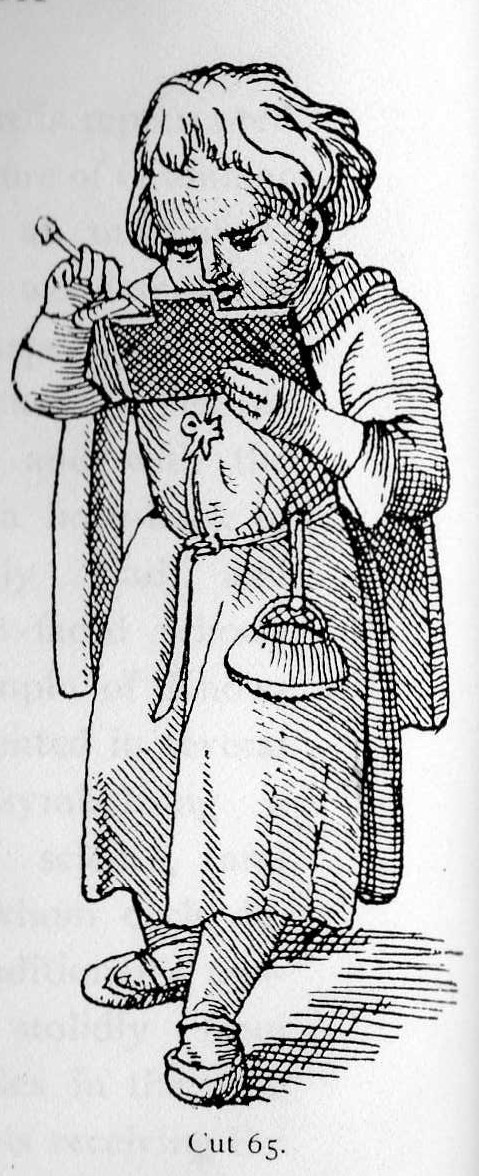
A child studying his letters on a hornbook, Jost Amman, Kunstbuch, Frankfurt, 1580,
 (Tuer, History of the Hornbook, 1896)
Francis Seager describes the 16th century schoolboy in a popular school text, The Schoole of Vertue and book of good nourture for children and youth to learne theyr dutie by, 1557.  Shakespeare was probably attending Stratford-upon-Avon grammar school about this time, and might have had to learn it by heart:
  '...thy satchel and thy books take,
and to the school hast see thou make.
But ere thou go with thyself forethink
That thou take with thee pen, paper and ink,
These things thus had, Take straight thy way
Unto the school without any stay...
Thy master there being Salute with all reverence
Declaring thereby thy duty and ovedience
Unto thy place appointed for to sit
Straight go thou to and thy satchell unknit,
Thy books take out, thy lesson then learn...
Apply thy mind to learning and science
For learning in need will be thy defence...'
   (Francis Seager, Schoole of Vertue...EETS Vol. 32 op cit)

John Brinsley (1581-1624) has left an example of a typical grammar school timetable in his Ludus Literarius or, The Grammar Schoole, 1612. The scholar's day began at six or seven am, an hour later in winter.  although Brinsley says, sympathetically that 'it is hard for the little children to rise so early' early rising was generally the rule for labourer and prince.

Lily's Latin Grammar, the standard Latin grammar book from 1540.

A 1687 edition of William Lily's Latin Grammar

Students would have studied their Latin from William Lily's Latin Grammar, in use right up to the 19th century, and first authorised as the standard Latin text book by Henry VIII.

In many schools day scholars and boarders were both taken and some boys would be lodged in the town.  At 9am, according to Brinsley's timetable, they went home to breakfast.  He allows them fifteen minutes.  Lessons, according to Brinsley, continued after breakfast to eleven, when there was a long break t one o'colck followed by two further periods of lessons with a fifteen minute break between them, finishing with a Bible reading and psalms around five thirty.  Bedtime was around nine.  This timetable was followed at Westminster School  Philip Henry, who was there from 1643, has described the pupils' habit of studying through the night, two or more sitting up till eleven or twelve, then waking a second group and so on through the night. (Diary and letters of Philip Henry, 1631-1696 ed Matthew Henry Lee, 1882)

It was common until the 19th century for several forms to be taught in the same room.  The original schoolroom at Rugby can still be seen, and in it each class would have taken a corner.  Charles Hoole in his book Scholastick discipline, 1659, talks of six or seven forms using one room, and suggested the use of folding doors to reduce the noise which must have been terrible when oral repetition was still a common teaching method.  If the pupils were well disciplined, however, noise does not seem to have been a problem. Cordier, comparing the school in Geneva with small country schools, says, 'There is more silence in our school of six hundred than of forty, yea thirty in those pesty schools' (Cordier, op.cit)
Contemporary woodcuts often show the teacher sitting raised up above the class in a kind of pulpit, with the scholars on what must have been extremely hard wooden benches facing him, no desks.  Right through the 18th century Eton scholars still used their hard top hats, resting on their knees, as writing tables.

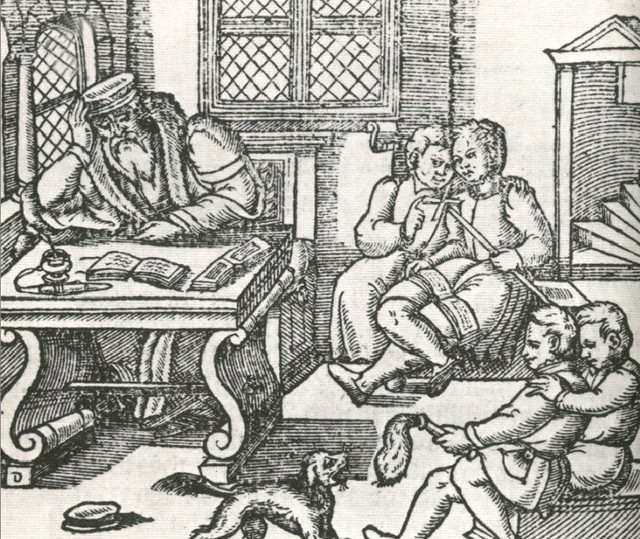
Udalricus Ebrardi, Modus Latinus, Nuremberg 1500, showing the tutor and the class.
Note the birch twigs in the tutor's hand (from Percy Muir, Early Children's Books and their Illustration, 1975)

Many of the collections of colloquies mention gambling, with nuts among the small boys, but also with cards and dice, especially at Christmas.  According to the colloquies from Magdalen School, Oxford, 'They do wysely that send no Children to the Universite but they put them under Creansers (censors) to have the rule
 of them and of their money, for yf they wer not so ordeuynede, they sholde waste all their money att dyss and Cardys in Cristmas tyme.'
   (Magdalen School colloquies, op.cit)

In one of Vives' dialogues a scholar is tempted to play truant with the cobbler's son to play dice, while smaller boys propose:  '"Let us play at nuts, at throwing them into holes."
Scipio: "Nut-shells are good for making little houses to put ants into."'
    (Tudor schoolboy life.  The dialogues of Juan Luis Vives.  Translated...by Foster Watson, 1908)

The boys were often allowed to keep pets at school.  John Evelyn (1620-1706) mentions the pets' corner in the well known Jesuit school at Antwerp which he visited, and was much impressed by, in 1641.  A boy at Magdalen School, Oxford, complained in a colloquy   '...thei say that I kepe a dawe in my chamber, but iwys thei lye falsly upon me for it is but a pore Conye.  'Unfortunately he does not explain why rabbits were permitted but not jackdaws.
A typical Latin class (National Education Network)
Food, of perennial interest to school children, forms the subject of several colloquies.  The meals at Peter Erondell's school do not sound too bad:
'Pisan:"Our breakfast in the morning is, a little peice of bread made of meale not bulted, but with all the bran in it, and a little butter, or some fruits...To dinner, we have herbes, or every one a messe of porridge.  Sometimes turneppes, coleworts, wheate and barly in porridge, a kind of delicate meate made of fine wheate flower, and eggs.  Upon fishe-dayes, fleeted milke, in deepe poengers...with some bread put in it.  Some fresh fische, if in Fish Streate it can be had at a reasonable price.  If not, salt fishe, well wattered.  After, pease, or fitches, or beanes, or lupins (sic)...Some drinke small biere, and a few, but seldome, drink winne, well alaqyed with water.  Our drinking at after none is, a litle bread, and almonds, drie figges, or reasens.  Or if it be Sommer tiem, pears, or apples, cheries, or prunes.  After, whenb we go to the farme, for plesure, then we eate, either new milke, or curded, frech cheese, creame, lupins alayed...The first dish of thge supper is a salat cut small with salt upon it, and moistened with oile of olives...and with vinaiger...And mutton sodde in a large platter, with dry prunes, or small rootes, or chopped herbes.  Sometimes a very good gallimafrie, now and then a minced meat..a little roset-meate, specually veale, and sometime kidde.  Upon fasting dayes, we have egges rosted, fired, or poached...or made ufter the fashion of a pannecake...Thereto is added sometimes a little fische, and after the cheese come nuttes.'
 (Erondell, op.cit)
Another Latin text book., 1673(Yale University)
At the school in Geneva the pupils came and went in what now seems a very casual fashion, drifting back after the school holidays in dribs and drabs, going off to help with the grape harvest or to family occasions, making excuses to visit their doting mothers, who aided and abetted them and defended them from the consequences.  Cordier's colloquies include an account of a boy who tries to use his lice as an excuse to go home:
'Master "Have you any lice?"
 Caius" I, and a great many indeed."
Master "Why do you not tell my wife so much?"
Caius "We durst not."
Master "As though indeed shee was so hard to be spoken to.  She hath a maid chiefly for that purpose, to see you be all kept cleanly...ye are glad ye have an occasion offered you to go and see your mother."'
 (Mathurin Cordier, op.cit)

This was, of course, the school which many Puritans attended in exile. Cordier wrote his colloquies for their use to ensure that their exercises had the correct religious stance. In Geneva the boys prayed together several times during the day and, in addition, according to Puritan practise, 'the Master doth oft admonish us, that every one go aside sometimes some whither into a private place and pray for himself.'
  (Cordier, colloquies, op.cit)
They were also encouraged to 'admonish' the local peasants and remind them of their religious duties.  The peasants did not always take this well: 'There were some that threatened to beat me when I admonished them very kindly.'
  (Cordier, colloquies, op.cit)


nikyrathbone@blogspot.com
childhoodblog@gmail.com

Friday, 15 January 2016

Girls education in Renaissance and Tudor times

Whereas I am wont always to counsel you to give place to your husband, now on the other side, I give you licence to strive to master him in the knowledge of the sphere.'
   Sir Thomas More to his daughter Margaret, The School of Sir Thomas More, in Foster Watson,  Vives and the Renaisance education of women, 1912

The influence of the Renaissance on the education of woman was profound. It mainly reached England through Catherine of Aragon, the first wife of Henry VIII. She was the daughter of Queen Isabella of Spain. The famous European scholar Erasmus described Catherine as 'a miracle of her sex,  nor is she less to be reverenced for her piety than for her education' (Foster Watson, Vives and the Renascence education of women, 1912)
Henry VIII and Catherine's court was, at this time, one to which many nobles aspired to send their daughters for training, and Queen Catherine's influence thus permeated a generation of aristocratic women.

Catherine of Aragon,( Lambeth Palace)
The influence of the very pious Catherine of Aragon  and her Spanish tutor Vives partly account for the pious bias of Renaissance education for girls in England, and for the education they began to receive.

Vives, Erasmus and Sir Thomas More all justify women's education by claiming that it strengthens their virtue.  Vives says:  'All lewd and evil women are unlearned and... they which be learned are most desirous of honesty.
  (Foster Watson, op. cit)

Vives wrote a very influential treatise on the education of women which stressed this point.  He recommended for Princess Mary, daughter of Catherine of Aragon and Henry VIII,and  later Queen Mary I, a plan of studies which included Erasmus, More, St. Jerome, the New Testament, the Christian Latin poets, Cicero, Seneca, Plutarch and some Plato, but not the Classical authors which might sully her ears with accounts of unsuitable classical vices.  Nowhere in his plan of studies for boys does he mention religion, piety or chastity at all.  Vives view, which may be taken as that of his fellow scholars, was that 'woman is a frail thing, and of weak discretion.'  It is possibly because he spent a lot of time in the rigid propriety f the Spanish court that Vives is so concerned with the protection of girls' virtue.  'Avoid all mankind away from her, nor let her not learn to delight among men.' he says, and would include male tutors among those dangers to her virtue which must be guarded against:  'If there may be found any holy and well learned woman, I had rather have her teach them; if there be none, let us choose some man, either well aged, or else very good and virtuous, which hath a wife and that right fair enough, whom he loveth well, and so shall he not desire another'
Maybe Vives had read the famous medieval romance of Abelard and Heloise.

Princess Mary, 1554, Hans Emworth (Wikipedia)
None of these scholars advocated the education of women so that they could take a greater part in affairs outside the home or questioned the innate superiority of man over woman.  Sir Thomas More wrote half jokingly to his favourite daughter:
'Whereas I am wont always to counsel you to give place to your husband, now on the other side, I give you licence to strive to master him in the knowledge of the spheres.  More saw girl's education as a way of increasing the bond between husband and wife and improving the quality of family life.  Like the Roman author Martial, he believed that the husband would profit by educating his wife since she would then be a companion to him.
More converted his friend the famous scholar Erasmus to belief in classical education for girls with a dialogue between a rather poorly educated abbot and a learned lady.  The lady turns all the abbot's arguments round to show that a well educated woman can run her household better, bring up her children better, and be more virtuous if she reads the classics rather than frivolous French novels.
 (The Colloquies of Erasmus, translated by Craig R. Thompson, 1965)

More's friend Richard Hyrde was probably tutor to More's daughter Margaret for a time.  He also defends women's study of classical languages in his preface to Margaret's translation of Erasmus' Treatise on the Lord's Prayer:
'The Latin and the Greek tongues, I see not but there is a little hurt in them as in books of English and French.'
   (see Foster Watson, op. cit)
Hyrde also knew Vives well and translated his Instruction of a Christian Woman into English.

Sir Thomas More and his family (after Holbein, by R. Lockey, 1592, N.T.)

The group which had been mainly responsible for the development of interest in classical education for girls was broken up by Henry VIII's divorce, his rejection of the authority of the Pope, and the English religious Reformation from Catholic to Protestant Christanity.  Vives returned to Spain,  More was beheaded for his opposition to Henry VIII.  However, religious change did not much affect the climate of ideas as far as education for women was concerned.  Two of Henry's later queens, Lady Jane Seymour and Catherine Parr, were also notable for their classical education.  Catherine Parr was brought up after the example of Thomas More's daughters.  All Henry VIII's children were educated in the new tradition.  His son Edward, later Edward VI, founded the Edward VI grammar schools.  His daughter, Princess Mary, translated Erasmus' Paraphrase of St. John's Gospel from Latin to English at Catherine Parr's request.  Udall's preface to the 1548 edition of her translation gives an interesting picture of the effect the new ideas had in England.  Speaking of the reign of Henry VIII, he says:

'The great number of noble women at that time in England not only given unto the study of humane sciences and strange tongues, but also so thoroughly expert in Holy Scriptures that they were able to compare with the best writers, as well as in enditeing and penning of godly and fruitful treatises...as also in translating good books out of Latin or Greek into English...It was now no news in England to see young damsels in noble houses and in the courts of princes, instead of cards and other instruments of idle trifling, to have continually on their hands either Psalms, homilies or other devout meditations...and as familiarly both to read and reason therof in Greek, Latin, French or Italian as in English.  It was now a common thing to see young virgins so trained in the study of good letters that they willingly set all other vain pastimes at nought for learning's sake. It was now no news at all to see Queens and ladies of most high estate... instead of courtly dalliance, to embrace virtuous exercises of reading and writing, and with most earnest study, both early and late to apply themselves to the acquiring of knowledge, as well in all other liberal artes and disciplines as most especially of God and his holy word.'
   (Quoted in Dorothy Gardiner, English girlhood at school, 1929)

Lady Jane Grey, that unfortunate nine day Queen (10-19 July 1553) was much admired by Roger Ascham for her learning; her parents gave her a classical education which conformed to the most advanced and liberal standards of the Renaissance.  On the other hand her parents still expected her to give them complete obedience in both small and important issues, and this enabled them to arrange her marriage and involve her and her young husband like puppets in the bid for the throne which cost them their lives.
She left surely one of the saddest, because the least deserved, accounts of parental severity:

'One of the greatest benefits that God ever gave me is that he sent me so sharp and severe parents...For when I am in the presence of either father or mother, whether I speak, keep silence, sit, stand, or go, eat, drink, be merry or sad, be sewing, playing, dancing, or doing anything else, I must do it, as it were, in such weight, measure, and number, even so perfectly as God made the world, else I am so sharply taunted, so cruelly threatened, yea presently sometime with pinches, nippes, and bobs, and some ways which I will not name for the honour I bear them, so without measure misordered, that I think myself in hell.'
   Quoted in Roger Ascham, The Scholemaster, 1570.

Lady Jane Grey in the Tower, W. F. Yeames, 1867 Sheffield Museums

On the other hand, Princess Elizabeth,  daughter of Henry VIII by Anne Boleyn, made use of the excellent education given her as the daughter of Henry VIII. for herself.  She used her education to read, in Greek and Latin, books on statecraft which might be useful to her, but seems to have done so by her own choice.
Roger Ascham, who was her tutor, wrote a report on Princess Elizabeth in 1550 which describes her studies:

 'The Lady Elizabeth has accomplished her sixteenth year.  She has the most ardent love of true religion and of the best kind of literature.  The constitution of her mind is exempt from female weakness, and she is endued with a masculine power of application...French and Italian she speaks like English; Latin with fluency, propriety and judgement; she also spoke Greek with me, frequently willingly and moderately well.  Nothing can ve more elegant than her handwriting, whether in the Greek or Roman character.  In music she is very skilful but does not greatly delight...The beginning of the day was always devoted by her to the New Testament in Greek, after which she read select orations of Isocrates and the tragedies of Sophocles....'
    (Dorothy Gardner, op. cit)

Princess Elizabeth c. 1546. (Wikipedia)

Although Queen Elizabeth was a good classical scholar, she took no interest in encouraging the ladies of her court, or in educating her wards along the same lines, and although she herself read the classics for pleasure until her death, her ladies were once again indulging in frivolous English and French romances.  For the vogue for classical education for girls was relatively short-lived.  For this the French were probably responsible; at a time when French culture was very much admired in England, works were translated which appeared to ridicule learned women for pedantry, or which implied that women were not capable of serious study.  Probably the fear of ridicule carried weight with parents anxious that their daughters should appear to the best advantage in the marriage market.  In addition, while classical education for sons might be an essential grounding for their entry into professions such as the Church or law, these professions were closed to women and classical education was less directly relevant to their lives.

e-mail:  childhoodblog@gmail.com
nikyrathbone.blogspot.com.


Sunday, 10 January 2016

Schooling from Medieval to Tudor times.

'We children beg you, teacher, to show us how to speak Latin correctly...We would rather be flogged for the sake of learning than be ignorant...I am by profession a monk, and every day I sing seven hour services with the brethren and am occupied with reading and writing'
    Aelfric's Colloquy.  A.S. Cook and C.B. Tinker, Select translations from Old English prose, 1908.

This is a glimpse of an Anglo-Saxon schoolboy.  Until the Renaissance, monastic schools would have been the source of scholarly education.  The pattern of boys;' education was more or less the same all over Europe from the late Middle Ages to the Renaissance.  Most schools were run by the Church and varied considerably in size and standards.  A common expression of piety was the founding of chantries, small chapels with a resident priest paid to say prayers for the benefactor.  Such an endowment often included free schooling for poor scholars.  Many chantry priests also supplemented their generally small incomes by taking paying pupils. These small schools would teach basic reading and writing skills to children under the age of seven.  For many this was all the instruction they would receive, or need, to fit them for their working lives.
More advanced education was provided for boys by the grammar schools which cannon law required every cathedral to maintain after 1300 AD.

In addition to the Church schools, many secular schools were endowed both by individuals and by townsmen's guilds.  Some of these schools in England eventually becoming exclusive public schools.  A certain number of places were traditionally reserved for the free education of the poor. Some which continue to offer these scholarships today are  the King Edward VI grammar schools, founded by Edward VI, son of Henry VIII.
Edward VI, (1537-1553) Guillim Scrots, Guys & St.Thomas's Charity.

The grammar school curriculum and teaching methods were, before the invention of printing, largely dictated by lack of books.  There was an enormous emphasis on learning by heart and oral work, and also on the importance of rhetoric, logic and disputations.  This probably led to the students being very articulate. Even after the invention of printing books were scarce and precious and education remained mainly oral.

But the Renaissance had enormous and far-reaching effect on what was taught.  The re-discovery of classical texts led to a widening of the school curriculum to cover many new subjects.
Henry VIII and his first Queen, Catherine of Aragon, played an important part in attracting prominent scholars to England where they encouraged the spread of the new learning.  Catherine brought with her from Sapin Jan Luis Vives who had been her overseer of studies and her mother's educational advisor.  His friend Erasmus also worked in England for a time and maintained a correspondence with scholars here, and Sir Thomas More was a third scholar of international reputation.  More's  'best beloved children'  both girls and boys received an upbringing which embodied all that was best in the spirit of the Renaissance.  Their charming letters reveal that they studied not only Latin and Greek but philosophy, astronomy, physic, arithmetic, logic, rhetoric and music.
 
They formed part of the close-knit influential group of Renaissance scholars centred on the court of Henry VIII and encouraging the spread of Renaissance thought and the widening of the curriculum to include many new subjects.  They were, of course, all Catholic, and the King's divorce effectively broke up the group, sending Vives overseas again and Sir Thomas More to his death.  Other scholars chose to follow their king or the returning Puritans rather than the {ope, and after the English Reformation maintained the development of the new scholastic tratition.  Prominent members of this second generation of scholare were Roger Ascham, tutor to Princess Elizabeth, Henry Cheke and Richard Mulcaster.  They were all educated at Cambridge which had become noted for its scholars' puritan sympathies.


 Sir Humphrey Gilbert proposed the following scheme for the education of Queen Elizabeth's wards, mostly the sons of noblemen:
'Grammar, Latin and Greek, Hebrew, logic and rhetoric, moral philosophy, natural philosophy, arithmetic, geometry, riding, arms, geography, astronomy, the principles of navigation, science, modern languages, French, Spanish and Italian, dancing, music and heraldry.'
    Lansdowne MS 98, EETS extra series vol. 8 ed. F.J. Furnivall, 1869

In spite of the enormous widening of the curriculum Latin continued to be considered the most important subject studied.  The chief purpose of a classical education was the forming of character through the Classical authors, an idea which remained current right up to the 20th century.  So Dean Colet gave his reason for founding St. Paul's School in 1518 as:
  'by this school specially to increase knowledge and worshiping of God and our Lord Christ Jesus and good Christian life and manners in the children.
  F.  Watson The English grammar schools to 1660.  1968.

There were strong reasons for boys to study Latin. It was the common language of Europe, the language of politics, the Church, and the professions.  Some schools made the upper forms talk Latin at all times, the regulations for Harrow, written in 1580, stated that :
'None above the first form shall speak English in the school or when they are together at play'
   F. Watson op. cit.

As the colloquies of Magdalen School, Oxford, put it:
  'Here we may drynke of the pure well of latyne tongue and eloquence, which is nothynge fayrer, o gracious children that wetith ther lypps therin.'
    British Library MS 249 Arundel Collection. 
    Quoted in W. Nelson, ed. A fifteenth century school book, 1956

There was considerable controversy over the use of beating.  Although individual teachers had, from time to time, condemned the universal practise of beating children who could not learn their lessons, beating was pretty universal. However, the rediscovery of the Institute Oratoria of Quintillian in 1416 was very influential with Renaissance educationalists. This enlightened Roman (c.95CE) believed in the importance of the moral example of the teacher and the use of praise and reproof rather than floggings. These ideas were exploited by Erasmus:
   'Pupil: "The entire company of your pupils beg you to let them play."
   Master:  That's all you do even without permission."
  Pupil:'Your wisdom is aware that wits are stimulated by moderate play, as you have taught us from Quintillian."'
    Colloquies of Erasmus (original in Latin) translated by C.R. Thompson. U. Chicago Press, 1965


Erasmus, Hans Holbein the Younger,.  National Trust

In Europe the Jesuit Catholic schools also used the ideas of Quintillian, and were the first to systematically use competition.  Boys in lower forms were arranged as rivals, in pairs, while each class was divided into two camps, Rome and Carthage, to compete against each other, see the influence of Roman history.  Religion was no barrier to good teaching methods, and th ideas of the Jesuites were adopted by Protestant educators.  The Puritan John Brinsley took the system further, suggesting yearly examinations and an elaborate system of punishments which depended on the loss of place in the form, loss of privileges and use of tasks and detentions. (John Brinsley, Ludus Literarius or The Grammar Schoole, 1627, ed. E.T. Campagnac, Liverpool U.P. 1917, )

An enlightened humanist who had considerable influence on teaching methods in England was Roger Ascham, the Princess Elizabeth's tutor, a Puritan, appointed by her father Henry VIII who took great interest in education and the new Renaissance learning. Ascham's book on educational theory, The Scholemaster, 1570, is full of genuine understanding and love of children.  To judge from the performance of his royal charge, Ascham had a natural gift for teaching, and like all the best teachers he understood that not all children were suited to a classical education, and that they should study according to their abilities: 'Children who are quiet, steady, but slow to learn are not sent to school or driven to hate learning by beating.  Such a child, if he later becomes a student of the common law, or page in the court, or servingman, or bound apprentice to a merchant or to some handicraft, he proveth in the end, wiser, happier, and many times honester too, than many of these quick wits do by their learning.'

The Scholemaster was inspired by Sir William Cecil's reporting to Ascham that 'divers scholars of Eton be run away from the school for fear of beating'
   Ascham, The Scholmaster, 1570, ed. Rev. Giles, 1867

 Theme writing on a moral or political subject and composing Latin verse were methods of teaching which became popular with the English Puritans.  This led many scholars to reading English poetry which they would probably not have read otherwise, since scholars used English models and practised in English before attempting Latin.

Two children, artist unknown, National Museum of Wales.

All Protestants agreed, and differed from their Catholic predecessors, in making the Bible the centre of their religious teaching.  A direct result of the Reformation in England under Herny VIII was the imposition of a government approved English primer or prayerbook in place of the Catholic Latin prayers.  A standard English Bible was also introduced.  For Protestants religious instruction in the vernacular was an integral part of their doctrine and teachers placed greater importance on reading and writing English 'now that we are returned home to our English ABC as most natural to our soul and most proper to our faith.'
   Richard Mulcaster, Positions, 1581, quoted on F. Watson, op.cit

Further injunctions in the reign of Elizabeth I concerning the duty of parents to instruct and catechise their children according to the Church of England show that politicians as well as religious leaders recognised the importance of early training.  There was steady pressure to maintain religious conformity among teachers, culminating in their having, like preachers, to take the Oath of Uniformity.

Wen from the schoole ye shall take your waye
Or orderly then go ye, two in aray...
Not runnynge on heapes as a swarme of bees
As at this day Every man it nowe sees
Not usynge but refusynge Such foolyshe toyes
As commonly are used In these dayes of boyes
As hoopynge and halowynge as in hyntynge the foxe
That men it hearynge Deryde them with mockes'
         Seager, The Schoole of Vertue, 1557

nikyrathbone.blogspot.com
childhhoodblog@gmail.com


Monday, 4 January 2016

Child Marriages in Tudor and Jacobean times


'She had enticed him with two apples to go with her to Colne and to marry her.'
   (F.J. Furnivall ed. Child Marriages, Divorces and Ratifications etc. in the Dioces of Chester, AD 1561-66.    EETS original series Vol. 108, 1897)

Little child with an apple, c. 1600, Holbourne Museum
                                                                                                  
The way that marriages between children were frequently arranged is a clear indication that they were regarded like property, with few individual rights.  Very little regard seems to have been shown for their personal inclinations, and their marriages, particularly those of royalty, were often the cement to an important alliance, a gesture of goodwill from one politician to another, a kind of presentation of hostages.  Mary Queen of Scots was sent as a child bride to France, to cement an alliance with Scotland.  Richard II received a French bride of eight, who spoke very little English, when he was twenty-seven.  One of the prizes of Henry V's victories in France was the hand of the French princess Katherine.  Catherine of Aragon was famously married by proxy to Prince Arthur, heir to the English throne, to cement an alliance with Spain.  When he died, she was simply transferred to the new heir, the future Henry VIII.  In such cases it was, of course, always the girl who was sent to live in her husband's country.  The alliances might crumble as political interests changed, but the marriages were expected to be permanent.


Crown Prince Arthur aged 13, PD Art
Slightly lower down the social scale, such marriage alliances were often arranged between great nobles,
 to join estates, or to strengthen a political position.  A particularly iniquitous practise was the sale of the wardship, or guardianship, of the heirs of great estates whose fathers had died.  This was gradually developed by the Tudors from the rights which an overlord had over the property of a vassal who was still a minor in feudal times to a perquisite of the Crown.  Such wardships might be sold to the highest bidder, not necessarily taking into consideration the good of the child or the existence of close relatives.  Wardship, in fact, rarely went to the mother.  The buyer of the wardship acquired effective guardianship of the child.  The profit to the guardian generally came through arranging the ward's marriage, and was the reason the wardships of heiresses were more highly prized than those of males (one of the few occasions when girls were preferred) Her property would become her husband's whereas a male ward would eventually get control of his property on his coming of age.  Wards rejecting a marriage were fined a sum equivalent to that which the guardian could have gained through the marriage.  Buying a wardship could be a good way of providing for a younger son, and the practise was by no means confined to the aristocracy.  An account of such a marriage in the diocese of Chester in 1562 says regretfully on its dissolution:
    'She should have had by him a pretty bargain if they could have loved one the other.'
   (Child Marriages, Divorces and Ratifications etc. in the Diocese of Chester, 1561-66
     EETS original series Vol. 108. 1897)

 Sir Thomas and Lady Lucy with seven of their children, Cornelius Johnson, 1622, National Trust

Such wards would normally be brought up in the house of their guardian, not necessarily a disadvantage.  William Cecil, Lord Burghley, Elizabeth I's Secretary of State, made a practise of buying wardships, but provided his wards, and those of the Crown, with an unrivalled education and great political opportunities from their base at Cecil House on the Strand.
However, generally the practise of selling wardships was considered iniquitous by those who suffered under it, and the Court of Wards was abolished after the Civil War in 1646.

One effect of the threat to a child's marriage prospects posed by the Court of Wards was the arrangement of very early marriages, particularly among the aristocracy.  This was one way in which anxious parents could tie up their children's estates and futures in they way they felt was best.  It is also an instance of the absolute control which parents were considered to have over children.  Children were expected to follow the parents' wishes.
For instance, Peter Agee explained, when suing for dissolution to his child marriage, that he married Alice when he was thirteen and she nine 'because it was his mother's mind, he dursrt not displease her.'  John Bridge had to marry Elizabeth, he aged eleven, she thirteen, because, 'his father had been undone' owing to a bond he had signed.
    (Child Marriages, op. cit.  For an account of the Court of Wards and sale of wardships see Pinchbeck and Hewitt, Children in English Society, London, 1969, Vol. 1, chapter 3)

Some parents thoroughly abused their children's rights.  Robert Mann, dissolving his marriage to Margaret, contracted when he was nine and she ten, said 'he could never fancy her, nor her father because he kept the mother of the said Robert to paramour (mistress) afore he married her and consumed the said Robert's goods.'
(Child marriages..op cit)
Lady Arabella Stuart (1575-1615) National Trust

Resistance such as Margaret Paston's was rare., She held out against her entire family and was eventually allowed to marry the man of her own choice, although he was considered to be her social inferior.
    (Paston Letters,  various eds)
In fact, most arranged marriages seem to have been quite successful, certainly no worse than those where the partners are allowed to choose for themselves.  The practise still continues today in many cultures.

Girl with a rattle.  Jan Claesz (Dutch, d. 1636)
There was a regular legal framework for child marriages which itself shows that the practise was considered quite usual.  Espousal could take place at seven, although there are cases of it having taken place at two or three.  The records of Child Marriages in the Diocese of Chester, 1561-6 (op cit) show that John Somerford married Jane when they were aged two and three.  They were carried in the arms of friends who spoke the words of marriage for them.  The witness adds: 'It was the youngest marriage that ever he was at'.  But still younger marriages were made.  In his Anatomie of Abuses in Ailgra (East Anglia) Philip Stubbes records that 'in Ailgra there is one great liberty permetted therein; for little infants in swaddling clouts are often married by their ambitious Parents and friends...'
    (Child marriages, op. cit.  preface, p.xxxiv)

Ludger Tom Ring the Younger, portrait of a small child in a fur lined cap and coral beads. National Trust 1583

Nevertheless the practise was frowned on/  Henry Swinburne, Judge of the Prerogative Court of York, defined the law in 1686 as 'Infants...are...children who have not as yet...the age of seven years...Spousals contracted during infancy are utterly void...as infants cannot contract spousals.'
   ( Treatise of Spousals or Matrimonial Contracts, 1686,  Child marriages, op. cit.
There were, however, a large number of exceptions to this general rule, based on the behaviour of the children, which could prevent the parties to the marriage from dissolving it, as they were entitled to do, at the 'ripe age' of twelve for girls, fourteen for boys, by suit in the Bishop's Court  Spousals were considered valid if the infants ratified the contract by word or deed at the age of seven, or cohabited together when one was nearly seven, or both were mature for their ages, or had indicated their liking for each other by kissing, giving of tokens or intercourse.

Provided intercourse had not taken place, there seems, in practise, to have been little difficulty in dissolving such marriages if they were unsuccessful.  About an equal number of boys and girls appear to have petitioned for dissolution, using the Chester diocesan records as a guide, the most common complaint being that 'she/he never fancied him/her.
   (Child marriages..op cit)

There are records of the system being abused.  Grace Boyes v. Robert Talbot, 1562, complained that 'the said Grace Boyes was taken away from her Grandfather;s house by a wile to come lie at Master Talbot's house...and when she was there, without the consent of her friends, was married to the said Robert in the night season.'  Sometimes the system was abused by the children themselves.  James Bullard complained that Anne Bullard 'had enticed him with two apples to go with her to Colne and to marry her.'  James repented the next morning.  The marriage was dissolved and the curate who married them punished.
    (Child marriages op. cit)

That child marriages were generally only intended as a formality is shown by accounts such as that of the marriage of Ellen Davenport and John Andrew, aged eight and ten.  They were put to bed together, as such 'married' children often were, but two of her sisters were put between them on their 'wedding night'.

Rafe Whittall, whose marriage to Joan was dissolved in 1562, was evidently sent to live with her, for he complained that
'he was ordered worse than any servant in her father's house...'
   (Child marriages op. cit)
However, at least among the middle classes, it seems to have been common for the two children to continue to be brought up separately until about the age of twelve to fourteen, when the marriage could be consummated without too much risk to the girl through early pregnancy.

That marriages were arranged like this is an indication of the power parents and guardians established over their children, and their expectations from them.  Perhaps the fact that parents have gradually come to expect less and less of their children in the way of obedience is an indication of the gradual growth, over the centuries, of child power.  At that time, however, the expectation was of total obedience fro the cradle right into adult life.  Adults made every attempt to get their children firmly under control as early as possible, and keep them there, a policy which must surely appeal to some modern parents battling with the problems of permissiveness.

e-mail:  childhoodblog@gmail..com
Niky Rathbone: nikyrathbone.blogspot.co.uk

Wednesday, 30 December 2015

Spare the Rod, Spoil the Child

'Be thou to thy parents ever dutiful,
fair of speech, and let thy teachers
be dear to thee n thy heart and soul'
        A Father's Instruction: The Exeter Book, an anthology of Anglo-Saxon poetry, edited by I. Gollancz. EETS original series Vol. 104, 1895

A Father's Instruction was probably memorised by many little Anglo-Saxons before the Normans landed.  This extreme formality between parents and children is echoed in the later books of courtesy.  Hugh Rhodes describes how children should behave on meeting parents accidently:

Sir Walter Raleigh and his son, 1602. National Trust

'When that thy parents come in sight
do them reverence
Ask them blessing if they have been long out of presence.'
      Hugh Rhodes The boke of Nurture,1577,  ed. F.J. Furnivall, Roxburghe Club, 1867

Writers stress the very formal nature of the relationship:
'And, child worship thy father and thy mother
And look that thou grieve neither one nor other...'
    Symons Lesson of Wysedome for all Maner Chyldren.  MS Bod. 832 leaf 174 in EETS original series Vol. 32

Advice on how to behave with adults is similar:
'If any speak to you, look straight at them and listen well till they have finished, do not chatter or let your eyes wander round the house.  Stand till you are told to sit...bow to your lord when you answer.  If anyone better than yourself come in, retire and give place to him.  Turn your back on no man.  Be silent when your lord drinks, not laughing, whispering or joking.  If he tells you to sit down do so at once.
     The Babees Book.c.1475 ed. F.J. Furnival EETS original series Vol. 32

Letters which survive show a formal relationship between parents and children.There is a charming letter from Edward, Earl of March and Edmund, Earl of Rutland, sons of the Duke of York, aged eleven and twelve, written in 1454, in the middle of the Wars of the Roses, in which Edmund was killed.  This concerns their health and schooling.  They assure their father that they are both well, then go on:
'Ryght hiegh and myghty Prince, our most worschipfull and greately redoubted lorde and Fader, in as lowely wyse as any sonnes con or may we recomaunde us unto your good lordeschip...please hit youre heighnesse to witte that we have attended owre learnyng sith we come heder, and schall here aftur; by the which we trust to God youre gracious lordeschip and good Faturhode schall be plaised...'
     MS Cotton Vespian F xiii fol 35 reprinted in the Paston Letters

Mother and Child, c. 1650. Paulus van Somer, National Trust
In the Paston Letters, those most revealing records of everyday life in the 15th century, Elizabeth Paston, then a married woman, addressed her mother as:
  'Right worshipful and my most entirely beloved mother, in the most lowly manner I recommend me unto your good motherhood, beseeching you daily and nightly of your motherly blessing, evermore desiring to hear of your welfare and prosperity.'
    The Paston Letters, 1422-1509, various editions

The belief that parents should be strict with their children for the child's good is very old.  Sirach in the Apocrypha, writing around 180-175 BC, in the Middle East, says:

He that loveth his son will continue to lay strokes upon him,
That he may rejoice over him at the last...
Play with him and he will grieve thee,
Laugh not with him lest he vex thee...
Let him not have freedom in his youth
And overlook not his mischievous acts.
Bow down his neck in his youth
And smite his loins sore while he is little
Lest he become stubborn and rebel against thee...'
    Sirach in the Apocrypha and Pseudepigrapha ed. R.H.Charles, 1913

This text is interesting not only for the light it sheds on family life in Israel shortly before the birth of Christ but also because the text was highly regarded by the early Church Fathers, especially St. Jerome and St. Augustine, and consequently had considerable influence on early Christian teaching.

As children's bodies might be shaped with corsets and swaddling, so their characters might be trained:
   'Like to the growing plant
which young and tender thou mayst wry and bend
but once a tree and grown to height of strength
no force can make him bow or bend at length.'
   Francis Thynne,  Emblems and Epigrams c. 1600, ed. F.J. Furnivall, EETS original series Vol. 64, 1876


 Lady Dacre aged 6, Chrysogona Baker, 1579.  National Trust 

The old saying 'spare the rod and spoil the child' so often quoted by the Victorians was also a favourite maxim in the Middle Ages and Tudor period.  The anonymous author of the popular 15th century work The Book of Curtesy or Stans puer ad mensam  advises:

'To their plaints give no credence
A rod reformeth all their isnolence.
In their courage no Rancour doth abide
Who spareth the yard (rod) all virtue set aside.'
    The Booke of Curteisie that is Cleped Stans Puer ad Mensam, Lambeth MS 853, c. 1430 EETS original series Vol. 32

William Bulleyn made no pretence that punishment pained him as much as the person punished, nor that he had any hesitation in administering it:
  '....if you have any saucy lought or loitering lubber within your house...There is no prettier medecine for this, nor sooner prepared than boxing is.  Three or four times well set on, a span long on both cheeks...and every man may practise this, as occasion shall serve him in his family, to reform them.'
     William Bulleyn, The Booke of Compoundes, fol. lxviii, 1562, EETS original series vol. 32

It is only fair to add that corporeal punishment was by no means confined to children.  Within the family it was the accepted corrective for self-willed wives, as popular literature testifies.  Flogging has been a form of judicial punishment since time immemorial and has only recently become unacceptable in the West.  It is not in the least surprising that corporeal punishment should have been applied as a corrective to children equally with adults.

e-mail: childhoodblog@gmail.com
Niky Rathbone:  nikyrathbone.blogspot.com


Bringing up Girls: Plantagenets and Tudors

Now haue I thee taught, doughter, As my modir dide me
Thinke theron nyght and day, forgote that it not be
Haue mesur and lownes, as I haue thee taught,
And what man thee wedde schal, him dare care naught
Betere were a child unborn
Than untaught of wifje lore
Mi leue child'
       (How the Good Wijfe Taught hir Doughtir, Lambeth MS 853, c. 1430 ed. F.J. Furnivall, EETS original         series Vol. 32)

Like noblemen's sons, daughters were usually sent away to receive part of their education in another household, hopefully of superior status, where they could acquire social poise and make friendships which would be useful to them in later life.  The rise of Bess of Hardwick, one of the most notable Elizabethan success stories, for a woman,  began when this daughter of a good, but not very important Yorkshire family was sent to London as lady in waiting to Lady Zouch.  There she met and married Robert Barlow, a rich but sickly young man.  He soon died, leaving her with the first of the fortunes which she gained through her marriages.  She became the richest woman in England after the Queen.
Girl;s were sometimes even sent out of the country.  Mary Queen of Scots, sent to France as a child bride, took her four little Marys with her.  Anne Boleyn was also sent to France, with Mary Tudor.  Lord Lisle's wards Anne and Mary Bissett were both placed with good French families in 1533 and 15834 when they were about twelve.  They were able to perfect their French and meet French society. (The Lisle Letters ed. Muriel St. Clare Byrne, 1981)  Muriel St. Clare Byrne calls their education a combination of finishing school and European tour.
Imaginary portrait of Mary Queen of Scots as a child.  John Osterlund . Glasgow Museums
Alternatively girls might be sent for a convent education, like the Lisle's daughter Bridget.  In 1536 she was living at St. Mary's Convent Winchester with twenty-six 'children of lords, knights and gentlemen.'.  Bridget was sent there when she was six.

Until the Renaissance girls received even less formal education that boys.  Those who entered nunneries moight have opportunities for study but on the whole learned women were frowned on.  So, in the 13th century Romance of Floriz and Blauncheflour, when the king's son is old enough to begin his lessons his playmate Blauncheflour is excluded:

'Al wepying seid he
"Ne schal not Blancheflour lerne with me?
Ne can y in no scole syng ne rede
Without Blancheflour" he seide.'
    (The Romance of Florizel and Blauncheflour.  Trentham MS, now Egerton 2862 c. 1250 In Middle                English Metrical Romances ed. Walter Hoyt French and Charles Brockway Hale, New York, 1964,           Vol. 2..  Quoted in Dorothy Gardiner English girlhood at school, 1929)

Upper class girls studied English or French rather than Latin as this was considered a social grace.  They also studied dancing, some music, and were expected to acquire courtly manners, charm and good deportment.  However girls mostly learned domestic skills.  In an age when food for use during winter had to be preserved, and cloth had to be first spun and then woven manually before it could be made into clothes, such household skills were very important.  Even a noblewoman with large numbers of servants needed to have some knowledge of the processes involved in order to run the household.  All the making of preserves, salting, curing, butter and bread making, some spinning and weaving and the preparation of day to day herbal remedies were in the hands of the women and a man expected his wife to direct them.    So the 15th century romance Partonope of Blois describes how the daughter of Constantine learned:
   'To know of every herbe the vertue
And eke of Rothis (roots) where ever they grew
Whether they in kynde be colde or hote
The names of Spyces I know by rote
How in phisike they have her worching
The syke in to heele I canne wele bring.'
   (Partonope of Blois et. W.E. Buckley for the Roxburgh Club,quoted in Gardner op cit p,43)

Also, if a landowner was called away by his overlord to fight, his wife would be expected to take over the running of his estates, a serious business in an agricultural economy.  The knights and soldiers who went to fight in the Crusades were away for several years in some cases.  So while nobly born boys were trained for fighting, their sisters were trained for a domestic role.  So were the daughters of artisans, merchants and farmers.  The advice the Good Wijf gives her daughter on the running of her household gives some idea of the life of a middle class housewife at that time:

Unknown mother and child, Paulus van Somer National Trust collection
  'With your household don't be too sharp or too easy; set them to work at what most needs doing.  If your husband is away, make your people work, and treat them according to what they do.  When necessary set to work yourself, all will be better for it.  Look after your household when at work, and have faults put to rights at once.  See everything straight when they leave work; keep your keys yourself and beware who you trust.  Pay your people on wages day and be generous to them.'
    How the Good Wijf taught hir Doughter c. 1430 EETS Original series Vol. 32 ed. F.J. Furnivall)


There are records of women in business, particularly widows who inherited from their husbands, but far fewr girls were apprenticed to a skill than boys, those that were being mainly apprenticed to traditional female crafts such as the textile trade or became servants.  And always the women sewed.  The invention of the sewing machine, the great liberator, did not happen till the 19th century.  Meantime, from high to low, from childhood to the grave, they sewed, embroidered, ,knitted, darned and mended.  William the Conqueror defeated Harold, his wife Matilda iommortalised the battle in a tapestry to hang on the walls of a draughty castle.  Mary Quewen of Scots wiled away the long hours of captivity embroidering hangings with Bess of Hardwick.  Little princesses and less well born girls sat with for long hours labouring over trousseaux,  ready for marriage.  Most of what a girl was taught was to fit her for being a good wife, and the stress was on obediance:
  'Keep all that I have told you and your husband won't regret marrying you.'
said the Good Wijf.
  'Love your husband above all earthly things.  Answer him meekly and he'll love you.  Be cheerful and true and keep free from blame.'

Books of manners for girls stress the importance of guarding that virtue:
  'Sit not by him neither stand where sin might be wrought
For a scandal raised ill
Is evil forto still
My beloved child.'
   says the Good Wijf
'When any man speaks to you, greet him only, and then let him go on, as he might tempt you to do wrong. For all men are not true that speak fair.  Take no gifts, the're the ruin of many a true woman'.

In The good wyfe wold a pylyremage, c. 1460-70, the writer is more explicit and goes into some detail about the behaviour of flirtatious medieval women:
'Doughter, said the good wife,
hide thy legs white
And show not forth thy street hose (stockings)
To make men have delight....
Though it please them for a time
it shall be thy despite (shame)
And men will say
Of thy body thou carest but light.'
  ( The Good Wyfe Wold a Pylremage, EETS extra series Vol. 8 ed. F.J. Furnivall, )

Child with a rattle, Paulus van Somer (1576–1621 Flemish)
The Good Wyfe is strongly in favour of early marriage:
'And look to thy daughters than none of them be lorn (lost)
From that same time that they be of thee born
Busy thee and gather fast towaqrds their marriage
And give them to spousing as soon as they be able
Maidens be fair and amiable
But of their love ful unstable
My beloved child'

'Gather fast towards their marriage' refers to the custom of giving a dowry with a daughter when she married.  This was intended originally as some kind of security for her.  It was not an outright payment to the husband or his family, and if the marriage broke up the dowry was supposed to return with the wife to her family.  Inevitably, dowries were not always returned and there were numerous lawsuits over disputed claims.  In the case of an heiress the dowry would probably consist mainly of land and money, but a wife normally also brought with her a good stock of household goods such as linen sheets, all made by her.

The Good Wijf continues with some more advice on behaviour her daughter is to avoid when married, which sheds revealing light on the life of a middle class housewife around the time of Chaucer:
  'Don't swear. In town don't gad about, or get drunk on your cloth money (ie money made by selling cloth the daughter has woven and sewn)

Furthermore:
   'Don't go to wrestling and shooting at targets like a strupet but stay at home.'
She gives general advice on conduct towards husband and neighbours:
'Don't be jealous of your neighbour's fine dress...Love your neighbours and do as you would be done by....Don't ruin your husband with your extravagance if he is poor.  Bleed a wren according to his viens.  Don't borrow or take your own dues first or show off with others' goods.
On bringing up children she takes the orthodox medieval line and advises severity:
'If your children are saucy and rebellious if any of them do wrong do not curse or hit them but take a smart rod and beat them in a row until they cry mercy and admit their guilt.'

Unlike the advice for boys, the Good Wijf books of manners are clearly directed to someone who will be occupying a subordinate position.  It is true daughters may carry carry considerable responsibilities, but they must make it their aim to please, and little medieval or Tudor girls learned this in early childhood.

nikyrathbone.blogspot.com
childhoodblog@gmail.com


Monday, 6 July 2015

Table Manners

'Grace being said low curtesy make thou
Saying "much good may it do you"
Of stature then if thou be able
It shall become thee to serve at the table...'
   Seagar, The Schools of Vertue,  ed. F. J. Furnivall,  Early English Text Society Vol. 32

Table manners are dealt with in a lot of detail on books of courtesy, both eating at table and serving since this was one of the  principal duties of a page.  Relationships were very formal.  Coming into the dining hall the page should:

'Say first "good speed" And all that be before
You in this stead salute with humble Face
Start not Rudely; come In an easy pace
Hold up your head, and kneel but on one knee
To your sovereign or lotd, whoever he be...'
    The Babees Book, c. 1475, EETS Vol. 32

Here are some instructions for children serving their parents at table:

'Don't fill the dishes so full as to spill on your parents' dress or they'll be angry.  Have spare trenchers ready for guests.  See that there's plenty of everything wanted.  Empty the bones from the voiders often.  Be at hand if anyone calls.  When they have finished clear the table.  First cover the salt...Put a voider on the table to take the trenchers and napkins.  Sweep the crumbe together into a voider.  Set a clean trencher before everyone.  Then set fruit and cheese on the table with biscuites or caraway seeds.  Serve wine, ale or beer, but wine is best.  When your parents have finished clear the table and fold up the cloth.  Then spread a clean towel, bring basin and ewer, and when your parents are ready to wash take up the water.  Don't be rash and pour out more water than necessary.  Then clear the table so that they may rise.  All things done don't forget thy duty, before the table make a low curtesy.'
   The Babees Book EETS Vol. 32

On table manners Seager also gives the advice so popular with the Victorians:

'Silence is metest
In a child at the table.'

The 14th century Lytylle Childrenes Lytil Boke  gives advice on table manners which make medieval children sound remarkably like modern ones:

'Don't pick your ears or nose, or drink with your mouth full, or cram it full.'
      ETS Vol. 32

Perhaps 'Don't pick your teeth with your knife' is no longer necessary.
The author continues:

'Don't spit over on on the table, that's not proper...don't rush at the cheese or throw your bones on the floor...take salt with your knife....'

Trenchers in early, times and poorer households, would be flat hunks of bread though by the Renaissance plates were in use. Forks were also introduced from Italy then; previously everyone ate with their fingers, a knife and maybe a spoon.  It is interesting to see that, contrary to popular belief, the bones were not thrown into the rushes strewn to cover the floor in polite society but put into big dishes or voiders.  Everyone, including children, drank wine., ale or beer, not because they were a nation of alcoholics but because fermented drinks were more wholesome that the water.  Tea and coffee, of course, were still unheard of in Europe.   Salt was kept in a large, lidded container and added to food to make it taste better.

Caxton gives similar advice to Lyttle John:

'Blow not in your drink nor in your potage (soup)
Nor farse (fill) your dish too full of bread
Bear not your knife towards your visage (face)
...Claw not your visage touch not your head
With your bare hand sitting at table...
Lean not upon the table for that rude is
And if I shall to you plainly say
Over the table ye shall not spittle convey.

He adds that famous saying:
'manners make man.'
   Caxton's Book of Curtesy c. 1488  EETS extra series Vol. 3

The Babees Book gives advice which is a lovely mixture of the outdated and the modern:

'lan a clean trencher before you, and eat your broth with a spoon, don;'t sup it up.  Don't leave your spoon in your dish.  Don't lean on the table or dirty the cloth.  Don't hang your head over your dish, or et with a full mouth, or pick your nose, teeth and anils...Don't dip your meat into the salt cellar, or put your knife in your mouth...Eat properly.
     EETS Vol. 32.

Dining at home 17th century Roxburghe Ballads, ed. J.O. Collier 1847


Contemporary accounts of life in the courts of nobles and princes show it to have been colourful, rich and highly formalised, like a splendid pageant.  On the other hand, as these books of advice indicate, it was also crude and dirty.  The medieval and Renaissance page must have moved from one extreme to the other, as his parents did, and although here and there we may see similarities, would have been much rougher and tougher than the modern child of equivalent background.  It is easy forget when reading such familiar advice on how to behave at table that these children soon grew into powerful, ruthless over-mighty subjects who frequently plunged the country into chaos over their quarrels, and were the leaders of the private armies the king drew on for his foreign wars.  The niceties of the chivalric code might make life more pleasant when they were at peace, but the real business of boys, when they grew up, was fighting.   Edward the Black Prince went on his first campaign with his father Edward III at the age of 15, as a squire, having attended numerous tournaments and mock fights from an early age.  He saw no important fighting on this occasion, but the following year, 1346, he played an important part in the Battle of Crecy and was knighted.  Knighthoods were normally granted to several of the most deserving squires after a victorious battle.


Thursday, 2 July 2015

Life as a Page


'......And teach him to harp
With his nails sharp
Before me to carve
And of the cup serve...'
    Caxton's Book of Curteseye, c. 1488, ed. F.J. Furnival. EETS extra series vol. 3 1868

The education of upper class boys was mainly intended to fit them for leadership, particularly in war. Consequently great emphasis was placed on physical sports, hunting and fighting.  Gradually more scholarly subjects and skills such as music, dancing and poetry were gradually added to the curriculum as they were seen to be useful for the advancement of a gentleman's career in more peaceful times.

Dutch family group, 1655, Michiel Nouts, National Gallery

In the early 14th century poem Ipomydone there is a description of a child's education:
'Tholomew a clerk he took,
That taught the child upon the book
Both to sing and to read;
And after he taught him other deed.
Afterward, to serve in hall
Both to great and to small;
Before the king meat to carve
High and low fare to serve
Both of hounds' and hawks' game
After, he taught him all; and same
In sea, in field and also in river
In wood to chase the wild deer
And in filed to ride a stead
That all men had joy of his deed,'
            Life of Ipomydone, Harleian MS 52, in Strutt, Sports and Pastimes of the People of England
            Vol. 1, 1810.

The life of a lord's page is fairly well documented in the many books of manners written to guide little boys on the thorny path from snivelling infant to noble squire with his first proper sword, at about age fourteen.
These are fun for what they say by implication about behaviour.  This for example, is advice for coping with a runny nose.

'Blow not your nose on the napkin
where you should wipe your hand
But cleanse it with your handkercher'
    Hugh Rhodes, Booke of Nurture and Schoole of Good Manners, 1577.  EETS original series vol. 32

William Caxton, who introduced printing to England,  advised his son, 'Lytle John':

'If thy nose thou cleanse, as may befall,
Look thy hand thou cleanse withall
Ptivily with skirt do it away
Or else through thy tepet (tabard) that is so gay'
  ...........
'Kemp your head and look you keep it clean
Your ears twain suffer not foul to be
In your visage wait no spot be seen
Purge your nose, let no man in it see
the file matter it is none honesty
Nor with your bare hand no filth from it fetch
For that is foul and an uncourteous teach
Your hands wash it is an unwholesome thing
Your nails look they be not jetty black...'
    Caxton: The Boke of Curtasye, ed. J.O. Halliwell, Percy Soc. Tracts Vol. 4, 1849

Here is John Russell's rules for the pages he had to train from Duke Humphrey of Gloucester, Henry V's brother:

'Don't claw your head and back as ager a flea, or stroke and pick your hair as if after a louse.  See that your eyes are not blinking and watery.  Don't pick your nose or let it drip.  Don't sniff or blow it too loud lest your sovereign hear. Don't twist your neck.  Don't put your hands in your breeches to scratch your private parts nor pick or fiddle or shrug.  Don't rub your hands, pick your ears, retch or spit too far, or laugh loudly,,,Don't squirt or spout with your mouth, gape, pout or lick your tongue in the dish.  Don't sigh or cough before your sovereign.  Don't hiccup or belch or groan. Don't straddle your legs or rub with your body.  Good son, don't pick, grind or gnash your teeth or cast stinking breath on your sovereign, and always beware of farting...a man might find many other improprieties not named here...'
    John Russell, The Boke of Nurtur Folowynng Englondis Gise c. 1447. EETS Vol 32.

   
e mail: childhoodblog@gmail.com