Showing posts with label children. Show all posts

Tuesday, 12 January 2016

A Puritan Education

'The end then of learning is to repair the ruins of our first Parents by repairing to know God aright, and out of that knowledge to love him, to imitate him, to be like him, as we may the nearest by possessing our souls of true virtue, which being united to the heavenly grace of faith makes up the highest perfection.'
   John Milton (1608-1674) Of Education, 1644

In the early 17th century educationalists, particularly the Puritans among them, began to favour including practical subjects in the curriculum.  Many of their ideas were pioneered in the works of the Czech educator John Amos Comenius, whose Orbis Sensualium Pictus was first published in Germany in 1658 and was translated into English in 1678 by his friend Charles Hoole.   His ideas were set out in Janua Linguarum Reserata or, the gate of tongues unlocked, 1631.  He believed in universal education, in the vernacular, until., about the age of twelve, combined with practical education in some skill. These ideas and his work on kindergartens and the value of play in learning  continue to inspire educators to the present day, especially in Germany,

The first educational book to successfully use illustrations as a teaching aid.

Charles Hoole recommended the pictures 'to entice witty children to it, that they may not conceit it a torment to be in the School, but dainty-fare.'
   The Usher's Duty, 1659, In A New Discovery in the old Art of Teaching Schoole, 1660, ed. E.T. Campagnac, 1917

Hoole was one of an influential group of mid 17th century Puritan educationalists which included Samuel Hartlib, John Milton and Sir William Petty, who gives a charming picture of the everyday pastimes of children at this time:
  'For we see children to delight in drums, pipes, fifes, guns made of elder sticks...painting flags and ensigns with elderberries and cornpoppy, making ships with paper, setting even nut shells a-swimming...making pictures in their writing books, making tops, gigs and whirligigs, gilting balls, practising divers juggling tricks upon the cards etc...And for the females they will be making pies with clay, making their babies (dolls) clothes and dressing them therewith, they will put leaves on sticks as if they were roasting meat; they will imitate all the talk and actions which they observe in their mother and her gossips...'
  Epistle to his honoured friend Master Samuel Hartlib, 1647

Samuel Hartlib was an agriculturalist and was keen to see practical agriculture more widely taught.  These educationalists gave more importance to science, and to its study through actual observation, weighing, measuring etc.  The Nonconformists began to found their own schools in the later 17th century, because the universities were closed to them because of their non-conforming religious beliefs, and their curriculum has a strong practical bias.  This made their schools popular with families who did not necessarily agree with their religious views but wanted a good general education for their sons.  Defoe attended Newington Green Academy in the late 17th century and describes the curriculum as including classical languages, French, Italian, maths, natural science, history, geography, logic and politics.
I. Pinchbeck, & M. Hewitt, Children in English Society, vol. 1, 1969


Comenius, the master and his pupil

Physical education for boys, continued to be considered very important. In the mid 16th century, Roger Ascham (1515-1568) had recommended that boys should  be able to: 'ride comely, to run fair at the tilt or ring, to play at all weapons, to shoot fair in bow and straigt in gun, to vault lustily; to run, to leap, to wrestle, to swim...to hawk, to hunt, to play at tennis, and all pastimes generally which will be joined with labour used in open space, and in the daylight, containing some ft exercise for war or some pleasant pastime for peace.
 The whole works of Roger Ascham, ed. Rv. Mr. Giles, 1864

In the turmoil of the Civil War, in the 17th century, people were still more inclined to link physical education with provision for an efficient army.  Oliver Cromwell's secretary, John Milton, drew up a detailed plan for the military training of students at the academy proposed in his tract Of Education, 1644:
'This institution of breeding which I here delineate, shall be equally good both for peace and war,'  He recommends that the pupils spend their exercise time learning swordsmanship, wrestling, riding and the arts of war so that, if necessary, they will be ready to act as captains in the army.  At a time when all able-bodied men and boys were supposed to be trained to the use of weapons for the possible defence of the kingdom, schools, where numbers of boys were gathered together, must haver seemed the obvious place for organise military training, and the pracise has continued right up to the present day.

Comenius,  Parents and children, Masters and servants.

Charles Hoole,(1610-1667) the translator of Comenius, was a practising schoolmaster, teaching in Rotherham when the town was attacked during the Civil War.  The town was defended by Col. Fairfax for Parliament and about thirty of the boys at the school 'undertook the management of a draje, which was placed at the entrance of the bridge, and did considerable execution.'  In Kings Norton, now on the edge of Birmingham, the boys attending the local school, run by the Puritan Rev. Thomas Hall (1610-1665) defended the school against the Cavaliers which must have been quite difficult as almost next to the school was a house owned by Charles I's Queen Henrietta.. After the Restoration, Thomas Hall lost his job.

Kings Norton Grammar School
'My counsel is that (children) learn the Greek and Latin tongues especially from Christians and so without the lies, fables, follies, vanities, whoredoms, lust, pride, revenge etc. of the heathens...and most necessary it is that Christians should forget the names of their gods and muses, which were but devils and damned creatures, and all their mythology and fabulous inventions and let them all go to Satan from whence they came.
   William Dell, quoted in Foster Watson The English Grammar Schools to 1660, 1968

nikyrathbone.blogspot.com
childhoodblog@gmail.com

Monday, 4 January 2016

Child Marriages in Tudor and Jacobean times


'She had enticed him with two apples to go with her to Colne and to marry her.'
   (F.J. Furnivall ed. Child Marriages, Divorces and Ratifications etc. in the Dioces of Chester, AD 1561-66.    EETS original series Vol. 108, 1897)

Little child with an apple, c. 1600, Holbourne Museum
                                                                                                  
The way that marriages between children were frequently arranged is a clear indication that they were regarded like property, with few individual rights.  Very little regard seems to have been shown for their personal inclinations, and their marriages, particularly those of royalty, were often the cement to an important alliance, a gesture of goodwill from one politician to another, a kind of presentation of hostages.  Mary Queen of Scots was sent as a child bride to France, to cement an alliance with Scotland.  Richard II received a French bride of eight, who spoke very little English, when he was twenty-seven.  One of the prizes of Henry V's victories in France was the hand of the French princess Katherine.  Catherine of Aragon was famously married by proxy to Prince Arthur, heir to the English throne, to cement an alliance with Spain.  When he died, she was simply transferred to the new heir, the future Henry VIII.  In such cases it was, of course, always the girl who was sent to live in her husband's country.  The alliances might crumble as political interests changed, but the marriages were expected to be permanent.


Crown Prince Arthur aged 13, PD Art
Slightly lower down the social scale, such marriage alliances were often arranged between great nobles,
 to join estates, or to strengthen a political position.  A particularly iniquitous practise was the sale of the wardship, or guardianship, of the heirs of great estates whose fathers had died.  This was gradually developed by the Tudors from the rights which an overlord had over the property of a vassal who was still a minor in feudal times to a perquisite of the Crown.  Such wardships might be sold to the highest bidder, not necessarily taking into consideration the good of the child or the existence of close relatives.  Wardship, in fact, rarely went to the mother.  The buyer of the wardship acquired effective guardianship of the child.  The profit to the guardian generally came through arranging the ward's marriage, and was the reason the wardships of heiresses were more highly prized than those of males (one of the few occasions when girls were preferred) Her property would become her husband's whereas a male ward would eventually get control of his property on his coming of age.  Wards rejecting a marriage were fined a sum equivalent to that which the guardian could have gained through the marriage.  Buying a wardship could be a good way of providing for a younger son, and the practise was by no means confined to the aristocracy.  An account of such a marriage in the diocese of Chester in 1562 says regretfully on its dissolution:
    'She should have had by him a pretty bargain if they could have loved one the other.'
   (Child Marriages, Divorces and Ratifications etc. in the Diocese of Chester, 1561-66
     EETS original series Vol. 108. 1897)

 Sir Thomas and Lady Lucy with seven of their children, Cornelius Johnson, 1622, National Trust

Such wards would normally be brought up in the house of their guardian, not necessarily a disadvantage.  William Cecil, Lord Burghley, Elizabeth I's Secretary of State, made a practise of buying wardships, but provided his wards, and those of the Crown, with an unrivalled education and great political opportunities from their base at Cecil House on the Strand.
However, generally the practise of selling wardships was considered iniquitous by those who suffered under it, and the Court of Wards was abolished after the Civil War in 1646.

One effect of the threat to a child's marriage prospects posed by the Court of Wards was the arrangement of very early marriages, particularly among the aristocracy.  This was one way in which anxious parents could tie up their children's estates and futures in they way they felt was best.  It is also an instance of the absolute control which parents were considered to have over children.  Children were expected to follow the parents' wishes.
For instance, Peter Agee explained, when suing for dissolution to his child marriage, that he married Alice when he was thirteen and she nine 'because it was his mother's mind, he dursrt not displease her.'  John Bridge had to marry Elizabeth, he aged eleven, she thirteen, because, 'his father had been undone' owing to a bond he had signed.
    (Child Marriages, op. cit.  For an account of the Court of Wards and sale of wardships see Pinchbeck and Hewitt, Children in English Society, London, 1969, Vol. 1, chapter 3)

Some parents thoroughly abused their children's rights.  Robert Mann, dissolving his marriage to Margaret, contracted when he was nine and she ten, said 'he could never fancy her, nor her father because he kept the mother of the said Robert to paramour (mistress) afore he married her and consumed the said Robert's goods.'
(Child marriages..op cit)
Lady Arabella Stuart (1575-1615) National Trust

Resistance such as Margaret Paston's was rare., She held out against her entire family and was eventually allowed to marry the man of her own choice, although he was considered to be her social inferior.
    (Paston Letters,  various eds)
In fact, most arranged marriages seem to have been quite successful, certainly no worse than those where the partners are allowed to choose for themselves.  The practise still continues today in many cultures.

Girl with a rattle.  Jan Claesz (Dutch, d. 1636)
There was a regular legal framework for child marriages which itself shows that the practise was considered quite usual.  Espousal could take place at seven, although there are cases of it having taken place at two or three.  The records of Child Marriages in the Diocese of Chester, 1561-6 (op cit) show that John Somerford married Jane when they were aged two and three.  They were carried in the arms of friends who spoke the words of marriage for them.  The witness adds: 'It was the youngest marriage that ever he was at'.  But still younger marriages were made.  In his Anatomie of Abuses in Ailgra (East Anglia) Philip Stubbes records that 'in Ailgra there is one great liberty permetted therein; for little infants in swaddling clouts are often married by their ambitious Parents and friends...'
    (Child marriages, op. cit.  preface, p.xxxiv)

Ludger Tom Ring the Younger, portrait of a small child in a fur lined cap and coral beads. National Trust 1583

Nevertheless the practise was frowned on/  Henry Swinburne, Judge of the Prerogative Court of York, defined the law in 1686 as 'Infants...are...children who have not as yet...the age of seven years...Spousals contracted during infancy are utterly void...as infants cannot contract spousals.'
   ( Treatise of Spousals or Matrimonial Contracts, 1686,  Child marriages, op. cit.
There were, however, a large number of exceptions to this general rule, based on the behaviour of the children, which could prevent the parties to the marriage from dissolving it, as they were entitled to do, at the 'ripe age' of twelve for girls, fourteen for boys, by suit in the Bishop's Court  Spousals were considered valid if the infants ratified the contract by word or deed at the age of seven, or cohabited together when one was nearly seven, or both were mature for their ages, or had indicated their liking for each other by kissing, giving of tokens or intercourse.

Provided intercourse had not taken place, there seems, in practise, to have been little difficulty in dissolving such marriages if they were unsuccessful.  About an equal number of boys and girls appear to have petitioned for dissolution, using the Chester diocesan records as a guide, the most common complaint being that 'she/he never fancied him/her.
   (Child marriages..op cit)

There are records of the system being abused.  Grace Boyes v. Robert Talbot, 1562, complained that 'the said Grace Boyes was taken away from her Grandfather;s house by a wile to come lie at Master Talbot's house...and when she was there, without the consent of her friends, was married to the said Robert in the night season.'  Sometimes the system was abused by the children themselves.  James Bullard complained that Anne Bullard 'had enticed him with two apples to go with her to Colne and to marry her.'  James repented the next morning.  The marriage was dissolved and the curate who married them punished.
    (Child marriages op. cit)

That child marriages were generally only intended as a formality is shown by accounts such as that of the marriage of Ellen Davenport and John Andrew, aged eight and ten.  They were put to bed together, as such 'married' children often were, but two of her sisters were put between them on their 'wedding night'.

Rafe Whittall, whose marriage to Joan was dissolved in 1562, was evidently sent to live with her, for he complained that
'he was ordered worse than any servant in her father's house...'
   (Child marriages op. cit)
However, at least among the middle classes, it seems to have been common for the two children to continue to be brought up separately until about the age of twelve to fourteen, when the marriage could be consummated without too much risk to the girl through early pregnancy.

That marriages were arranged like this is an indication of the power parents and guardians established over their children, and their expectations from them.  Perhaps the fact that parents have gradually come to expect less and less of their children in the way of obedience is an indication of the gradual growth, over the centuries, of child power.  At that time, however, the expectation was of total obedience fro the cradle right into adult life.  Adults made every attempt to get their children firmly under control as early as possible, and keep them there, a policy which must surely appeal to some modern parents battling with the problems of permissiveness.

e-mail:  childhoodblog@gmail..com
Niky Rathbone: nikyrathbone.blogspot.co.uk

Wednesday, 30 December 2015

Spare the Rod, Spoil the Child

'Be thou to thy parents ever dutiful,
fair of speech, and let thy teachers
be dear to thee n thy heart and soul'
        A Father's Instruction: The Exeter Book, an anthology of Anglo-Saxon poetry, edited by I. Gollancz. EETS original series Vol. 104, 1895

A Father's Instruction was probably memorised by many little Anglo-Saxons before the Normans landed.  This extreme formality between parents and children is echoed in the later books of courtesy.  Hugh Rhodes describes how children should behave on meeting parents accidently:

Sir Walter Raleigh and his son, 1602. National Trust

'When that thy parents come in sight
do them reverence
Ask them blessing if they have been long out of presence.'
      Hugh Rhodes The boke of Nurture,1577,  ed. F.J. Furnivall, Roxburghe Club, 1867

Writers stress the very formal nature of the relationship:
'And, child worship thy father and thy mother
And look that thou grieve neither one nor other...'
    Symons Lesson of Wysedome for all Maner Chyldren.  MS Bod. 832 leaf 174 in EETS original series Vol. 32

Advice on how to behave with adults is similar:
'If any speak to you, look straight at them and listen well till they have finished, do not chatter or let your eyes wander round the house.  Stand till you are told to sit...bow to your lord when you answer.  If anyone better than yourself come in, retire and give place to him.  Turn your back on no man.  Be silent when your lord drinks, not laughing, whispering or joking.  If he tells you to sit down do so at once.
     The Babees Book.c.1475 ed. F.J. Furnival EETS original series Vol. 32

Letters which survive show a formal relationship between parents and children.There is a charming letter from Edward, Earl of March and Edmund, Earl of Rutland, sons of the Duke of York, aged eleven and twelve, written in 1454, in the middle of the Wars of the Roses, in which Edmund was killed.  This concerns their health and schooling.  They assure their father that they are both well, then go on:
'Ryght hiegh and myghty Prince, our most worschipfull and greately redoubted lorde and Fader, in as lowely wyse as any sonnes con or may we recomaunde us unto your good lordeschip...please hit youre heighnesse to witte that we have attended owre learnyng sith we come heder, and schall here aftur; by the which we trust to God youre gracious lordeschip and good Faturhode schall be plaised...'
     MS Cotton Vespian F xiii fol 35 reprinted in the Paston Letters

Mother and Child, c. 1650. Paulus van Somer, National Trust
In the Paston Letters, those most revealing records of everyday life in the 15th century, Elizabeth Paston, then a married woman, addressed her mother as:
  'Right worshipful and my most entirely beloved mother, in the most lowly manner I recommend me unto your good motherhood, beseeching you daily and nightly of your motherly blessing, evermore desiring to hear of your welfare and prosperity.'
    The Paston Letters, 1422-1509, various editions

The belief that parents should be strict with their children for the child's good is very old.  Sirach in the Apocrypha, writing around 180-175 BC, in the Middle East, says:

He that loveth his son will continue to lay strokes upon him,
That he may rejoice over him at the last...
Play with him and he will grieve thee,
Laugh not with him lest he vex thee...
Let him not have freedom in his youth
And overlook not his mischievous acts.
Bow down his neck in his youth
And smite his loins sore while he is little
Lest he become stubborn and rebel against thee...'
    Sirach in the Apocrypha and Pseudepigrapha ed. R.H.Charles, 1913

This text is interesting not only for the light it sheds on family life in Israel shortly before the birth of Christ but also because the text was highly regarded by the early Church Fathers, especially St. Jerome and St. Augustine, and consequently had considerable influence on early Christian teaching.

As children's bodies might be shaped with corsets and swaddling, so their characters might be trained:
   'Like to the growing plant
which young and tender thou mayst wry and bend
but once a tree and grown to height of strength
no force can make him bow or bend at length.'
   Francis Thynne,  Emblems and Epigrams c. 1600, ed. F.J. Furnivall, EETS original series Vol. 64, 1876


 Lady Dacre aged 6, Chrysogona Baker, 1579.  National Trust 

The old saying 'spare the rod and spoil the child' so often quoted by the Victorians was also a favourite maxim in the Middle Ages and Tudor period.  The anonymous author of the popular 15th century work The Book of Curtesy or Stans puer ad mensam  advises:

'To their plaints give no credence
A rod reformeth all their isnolence.
In their courage no Rancour doth abide
Who spareth the yard (rod) all virtue set aside.'
    The Booke of Curteisie that is Cleped Stans Puer ad Mensam, Lambeth MS 853, c. 1430 EETS original series Vol. 32

William Bulleyn made no pretence that punishment pained him as much as the person punished, nor that he had any hesitation in administering it:
  '....if you have any saucy lought or loitering lubber within your house...There is no prettier medecine for this, nor sooner prepared than boxing is.  Three or four times well set on, a span long on both cheeks...and every man may practise this, as occasion shall serve him in his family, to reform them.'
     William Bulleyn, The Booke of Compoundes, fol. lxviii, 1562, EETS original series vol. 32

It is only fair to add that corporeal punishment was by no means confined to children.  Within the family it was the accepted corrective for self-willed wives, as popular literature testifies.  Flogging has been a form of judicial punishment since time immemorial and has only recently become unacceptable in the West.  It is not in the least surprising that corporeal punishment should have been applied as a corrective to children equally with adults.

e-mail: childhoodblog@gmail.com
Niky Rathbone:  nikyrathbone.blogspot.com


Bringing up Girls: Plantagenets and Tudors

Now haue I thee taught, doughter, As my modir dide me
Thinke theron nyght and day, forgote that it not be
Haue mesur and lownes, as I haue thee taught,
And what man thee wedde schal, him dare care naught
Betere were a child unborn
Than untaught of wifje lore
Mi leue child'
       (How the Good Wijfe Taught hir Doughtir, Lambeth MS 853, c. 1430 ed. F.J. Furnivall, EETS original         series Vol. 32)

Like noblemen's sons, daughters were usually sent away to receive part of their education in another household, hopefully of superior status, where they could acquire social poise and make friendships which would be useful to them in later life.  The rise of Bess of Hardwick, one of the most notable Elizabethan success stories, for a woman,  began when this daughter of a good, but not very important Yorkshire family was sent to London as lady in waiting to Lady Zouch.  There she met and married Robert Barlow, a rich but sickly young man.  He soon died, leaving her with the first of the fortunes which she gained through her marriages.  She became the richest woman in England after the Queen.
Girl;s were sometimes even sent out of the country.  Mary Queen of Scots, sent to France as a child bride, took her four little Marys with her.  Anne Boleyn was also sent to France, with Mary Tudor.  Lord Lisle's wards Anne and Mary Bissett were both placed with good French families in 1533 and 15834 when they were about twelve.  They were able to perfect their French and meet French society. (The Lisle Letters ed. Muriel St. Clare Byrne, 1981)  Muriel St. Clare Byrne calls their education a combination of finishing school and European tour.
Imaginary portrait of Mary Queen of Scots as a child.  John Osterlund . Glasgow Museums
Alternatively girls might be sent for a convent education, like the Lisle's daughter Bridget.  In 1536 she was living at St. Mary's Convent Winchester with twenty-six 'children of lords, knights and gentlemen.'.  Bridget was sent there when she was six.

Until the Renaissance girls received even less formal education that boys.  Those who entered nunneries moight have opportunities for study but on the whole learned women were frowned on.  So, in the 13th century Romance of Floriz and Blauncheflour, when the king's son is old enough to begin his lessons his playmate Blauncheflour is excluded:

'Al wepying seid he
"Ne schal not Blancheflour lerne with me?
Ne can y in no scole syng ne rede
Without Blancheflour" he seide.'
    (The Romance of Florizel and Blauncheflour.  Trentham MS, now Egerton 2862 c. 1250 In Middle                English Metrical Romances ed. Walter Hoyt French and Charles Brockway Hale, New York, 1964,           Vol. 2..  Quoted in Dorothy Gardiner English girlhood at school, 1929)

Upper class girls studied English or French rather than Latin as this was considered a social grace.  They also studied dancing, some music, and were expected to acquire courtly manners, charm and good deportment.  However girls mostly learned domestic skills.  In an age when food for use during winter had to be preserved, and cloth had to be first spun and then woven manually before it could be made into clothes, such household skills were very important.  Even a noblewoman with large numbers of servants needed to have some knowledge of the processes involved in order to run the household.  All the making of preserves, salting, curing, butter and bread making, some spinning and weaving and the preparation of day to day herbal remedies were in the hands of the women and a man expected his wife to direct them.    So the 15th century romance Partonope of Blois describes how the daughter of Constantine learned:
   'To know of every herbe the vertue
And eke of Rothis (roots) where ever they grew
Whether they in kynde be colde or hote
The names of Spyces I know by rote
How in phisike they have her worching
The syke in to heele I canne wele bring.'
   (Partonope of Blois et. W.E. Buckley for the Roxburgh Club,quoted in Gardner op cit p,43)

Also, if a landowner was called away by his overlord to fight, his wife would be expected to take over the running of his estates, a serious business in an agricultural economy.  The knights and soldiers who went to fight in the Crusades were away for several years in some cases.  So while nobly born boys were trained for fighting, their sisters were trained for a domestic role.  So were the daughters of artisans, merchants and farmers.  The advice the Good Wijf gives her daughter on the running of her household gives some idea of the life of a middle class housewife at that time:

Unknown mother and child, Paulus van Somer National Trust collection
  'With your household don't be too sharp or too easy; set them to work at what most needs doing.  If your husband is away, make your people work, and treat them according to what they do.  When necessary set to work yourself, all will be better for it.  Look after your household when at work, and have faults put to rights at once.  See everything straight when they leave work; keep your keys yourself and beware who you trust.  Pay your people on wages day and be generous to them.'
    How the Good Wijf taught hir Doughter c. 1430 EETS Original series Vol. 32 ed. F.J. Furnivall)


There are records of women in business, particularly widows who inherited from their husbands, but far fewr girls were apprenticed to a skill than boys, those that were being mainly apprenticed to traditional female crafts such as the textile trade or became servants.  And always the women sewed.  The invention of the sewing machine, the great liberator, did not happen till the 19th century.  Meantime, from high to low, from childhood to the grave, they sewed, embroidered, ,knitted, darned and mended.  William the Conqueror defeated Harold, his wife Matilda iommortalised the battle in a tapestry to hang on the walls of a draughty castle.  Mary Quewen of Scots wiled away the long hours of captivity embroidering hangings with Bess of Hardwick.  Little princesses and less well born girls sat with for long hours labouring over trousseaux,  ready for marriage.  Most of what a girl was taught was to fit her for being a good wife, and the stress was on obediance:
  'Keep all that I have told you and your husband won't regret marrying you.'
said the Good Wijf.
  'Love your husband above all earthly things.  Answer him meekly and he'll love you.  Be cheerful and true and keep free from blame.'

Books of manners for girls stress the importance of guarding that virtue:
  'Sit not by him neither stand where sin might be wrought
For a scandal raised ill
Is evil forto still
My beloved child.'
   says the Good Wijf
'When any man speaks to you, greet him only, and then let him go on, as he might tempt you to do wrong. For all men are not true that speak fair.  Take no gifts, the're the ruin of many a true woman'.

In The good wyfe wold a pylyremage, c. 1460-70, the writer is more explicit and goes into some detail about the behaviour of flirtatious medieval women:
'Doughter, said the good wife,
hide thy legs white
And show not forth thy street hose (stockings)
To make men have delight....
Though it please them for a time
it shall be thy despite (shame)
And men will say
Of thy body thou carest but light.'
  ( The Good Wyfe Wold a Pylremage, EETS extra series Vol. 8 ed. F.J. Furnivall, )

Child with a rattle, Paulus van Somer (1576–1621 Flemish)
The Good Wyfe is strongly in favour of early marriage:
'And look to thy daughters than none of them be lorn (lost)
From that same time that they be of thee born
Busy thee and gather fast towaqrds their marriage
And give them to spousing as soon as they be able
Maidens be fair and amiable
But of their love ful unstable
My beloved child'

'Gather fast towards their marriage' refers to the custom of giving a dowry with a daughter when she married.  This was intended originally as some kind of security for her.  It was not an outright payment to the husband or his family, and if the marriage broke up the dowry was supposed to return with the wife to her family.  Inevitably, dowries were not always returned and there were numerous lawsuits over disputed claims.  In the case of an heiress the dowry would probably consist mainly of land and money, but a wife normally also brought with her a good stock of household goods such as linen sheets, all made by her.

The Good Wijf continues with some more advice on behaviour her daughter is to avoid when married, which sheds revealing light on the life of a middle class housewife around the time of Chaucer:
  'Don't swear. In town don't gad about, or get drunk on your cloth money (ie money made by selling cloth the daughter has woven and sewn)

Furthermore:
   'Don't go to wrestling and shooting at targets like a strupet but stay at home.'
She gives general advice on conduct towards husband and neighbours:
'Don't be jealous of your neighbour's fine dress...Love your neighbours and do as you would be done by....Don't ruin your husband with your extravagance if he is poor.  Bleed a wren according to his viens.  Don't borrow or take your own dues first or show off with others' goods.
On bringing up children she takes the orthodox medieval line and advises severity:
'If your children are saucy and rebellious if any of them do wrong do not curse or hit them but take a smart rod and beat them in a row until they cry mercy and admit their guilt.'

Unlike the advice for boys, the Good Wijf books of manners are clearly directed to someone who will be occupying a subordinate position.  It is true daughters may carry carry considerable responsibilities, but they must make it their aim to please, and little medieval or Tudor girls learned this in early childhood.

nikyrathbone.blogspot.com
childhoodblog@gmail.com


Friday, 31 July 2015

Lessons in Good Behaviour for Medieval and Tudor children

'In bed if thou fall harboured to be
With fellow, master or highte degree
Thou shalt enquire by courtesy
In what part of the bed he will lie.
Be honest and lie thou far him from
Thou art not wise but thou do so.'
  The Boke of Curtasye ed, J.O. Halliwell, Percy Soc. Tracts Vol. 4 1849 (c. 1430-40)

This sounds like a delicate warning about sexual molestation which books of manners give no advice on but which was probably a common problem in the promiscuous living conditions of medieval Europe.
Sharing a bed with a stranger was quite normal both in private houses and crowded inns.  The 5th Earl of Northumberland's Gentlemen and Children of the Chapel, for instance, are descriped in the household accounts of Henry VIII as normally sleeping two gentlemen or three children to a bed.
(EETS Vol. 32, Extracts from the Household books of the Earl of Northumberland..c. 1510-11)

Four children of Sir Thomas Lucy III, 1619.  National Trust

Some of the general advice to children in the books of courtesy of the Middle Ages and Tudor times has been popular with parents and teachers from time immemorial, and brings these long ago children vividly to life:

'Child I warn thee in all wise
That thou tell troth and make no lies.....
Child, climb thou not over house nor wall
Forno fruit, birds nor ball
And, child, cast no stones over mens houses
Nor cast stones at no glass windows.
       EETS vol. 32 Symon's lesson of wysdome for all maner chyldren

Several books of courtesy suggest that under fourteens were more mature than most boys that age are now:

And son of one thing I the warn
And on my blessing take good heed
Beware of using of the tavern
And also the dice I thee forbid
And flee all lecherie in will or deed'
  How the wise man taught his son, ca. 430,  EETS vol. 32

'....ye shall nhot you excuse
From breecheles feast (beating) and I may you espy
Playing at any game of Ribaldry
  Caxton, advice to Lytle John ca. 1477-8, ed. F.J. Furnivall, EETS extra series 5, 1868

O Little childe Eschewe thou ever game
For that hath brought many one to shame
As dicing, and carding And such other plays
Which many undoeth as we see nowadays.'
'Tale a Toppe, if though would playe
And not at the hasadrye'
   F.S. Seagar The schoole of vertue...1557 EETS Vol. 32

And be ware and wyse how that thou lokys
Ouer any brynk, well or brokys...
For many chyld without drede
Is dede or dysseyuyd throw ywell hede...
And but thou do thou shat fare the worse
And therto be bete on the bare ers....'
   Symon's lesson of wysdome EETS Vol. 32

As might be expected in a society where the church was very much a part of everyday life, most books of manners impress on children the importance of observing their religious duties.  Symonds in his Lesson of Wysdome says:
  'For make no crying, Japes nor plays
In holy church on holy days.

Symonds also advises, with an eye to the child's future career:
'And lerne as fast as thou may and can
For owre byschope is an old man
And therefor thou most lern fadst
If thou wolt be bysshop when he is past...
  Symon's lesson of wysdome...EETS Vol. 32
 

Monday, 6 July 2015

Table Manners

'Grace being said low curtesy make thou
Saying "much good may it do you"
Of stature then if thou be able
It shall become thee to serve at the table...'
   Seagar, The Schools of Vertue,  ed. F. J. Furnivall,  Early English Text Society Vol. 32

Table manners are dealt with in a lot of detail on books of courtesy, both eating at table and serving since this was one of the  principal duties of a page.  Relationships were very formal.  Coming into the dining hall the page should:

'Say first "good speed" And all that be before
You in this stead salute with humble Face
Start not Rudely; come In an easy pace
Hold up your head, and kneel but on one knee
To your sovereign or lotd, whoever he be...'
    The Babees Book, c. 1475, EETS Vol. 32

Here are some instructions for children serving their parents at table:

'Don't fill the dishes so full as to spill on your parents' dress or they'll be angry.  Have spare trenchers ready for guests.  See that there's plenty of everything wanted.  Empty the bones from the voiders often.  Be at hand if anyone calls.  When they have finished clear the table.  First cover the salt...Put a voider on the table to take the trenchers and napkins.  Sweep the crumbe together into a voider.  Set a clean trencher before everyone.  Then set fruit and cheese on the table with biscuites or caraway seeds.  Serve wine, ale or beer, but wine is best.  When your parents have finished clear the table and fold up the cloth.  Then spread a clean towel, bring basin and ewer, and when your parents are ready to wash take up the water.  Don't be rash and pour out more water than necessary.  Then clear the table so that they may rise.  All things done don't forget thy duty, before the table make a low curtesy.'
   The Babees Book EETS Vol. 32

On table manners Seager also gives the advice so popular with the Victorians:

'Silence is metest
In a child at the table.'

The 14th century Lytylle Childrenes Lytil Boke  gives advice on table manners which make medieval children sound remarkably like modern ones:

'Don't pick your ears or nose, or drink with your mouth full, or cram it full.'
      ETS Vol. 32

Perhaps 'Don't pick your teeth with your knife' is no longer necessary.
The author continues:

'Don't spit over on on the table, that's not proper...don't rush at the cheese or throw your bones on the floor...take salt with your knife....'

Trenchers in early, times and poorer households, would be flat hunks of bread though by the Renaissance plates were in use. Forks were also introduced from Italy then; previously everyone ate with their fingers, a knife and maybe a spoon.  It is interesting to see that, contrary to popular belief, the bones were not thrown into the rushes strewn to cover the floor in polite society but put into big dishes or voiders.  Everyone, including children, drank wine., ale or beer, not because they were a nation of alcoholics but because fermented drinks were more wholesome that the water.  Tea and coffee, of course, were still unheard of in Europe.   Salt was kept in a large, lidded container and added to food to make it taste better.

Caxton gives similar advice to Lyttle John:

'Blow not in your drink nor in your potage (soup)
Nor farse (fill) your dish too full of bread
Bear not your knife towards your visage (face)
...Claw not your visage touch not your head
With your bare hand sitting at table...
Lean not upon the table for that rude is
And if I shall to you plainly say
Over the table ye shall not spittle convey.

He adds that famous saying:
'manners make man.'
   Caxton's Book of Curtesy c. 1488  EETS extra series Vol. 3

The Babees Book gives advice which is a lovely mixture of the outdated and the modern:

'lan a clean trencher before you, and eat your broth with a spoon, don;'t sup it up.  Don't leave your spoon in your dish.  Don't lean on the table or dirty the cloth.  Don't hang your head over your dish, or et with a full mouth, or pick your nose, teeth and anils...Don't dip your meat into the salt cellar, or put your knife in your mouth...Eat properly.
     EETS Vol. 32.

Dining at home 17th century Roxburghe Ballads, ed. J.O. Collier 1847


Contemporary accounts of life in the courts of nobles and princes show it to have been colourful, rich and highly formalised, like a splendid pageant.  On the other hand, as these books of advice indicate, it was also crude and dirty.  The medieval and Renaissance page must have moved from one extreme to the other, as his parents did, and although here and there we may see similarities, would have been much rougher and tougher than the modern child of equivalent background.  It is easy forget when reading such familiar advice on how to behave at table that these children soon grew into powerful, ruthless over-mighty subjects who frequently plunged the country into chaos over their quarrels, and were the leaders of the private armies the king drew on for his foreign wars.  The niceties of the chivalric code might make life more pleasant when they were at peace, but the real business of boys, when they grew up, was fighting.   Edward the Black Prince went on his first campaign with his father Edward III at the age of 15, as a squire, having attended numerous tournaments and mock fights from an early age.  He saw no important fighting on this occasion, but the following year, 1346, he played an important part in the Battle of Crecy and was knighted.  Knighthoods were normally granted to several of the most deserving squires after a victorious battle.


Thursday, 2 July 2015

Life as a Page


'......And teach him to harp
With his nails sharp
Before me to carve
And of the cup serve...'
    Caxton's Book of Curteseye, c. 1488, ed. F.J. Furnival. EETS extra series vol. 3 1868

The education of upper class boys was mainly intended to fit them for leadership, particularly in war. Consequently great emphasis was placed on physical sports, hunting and fighting.  Gradually more scholarly subjects and skills such as music, dancing and poetry were gradually added to the curriculum as they were seen to be useful for the advancement of a gentleman's career in more peaceful times.

Dutch family group, 1655, Michiel Nouts, National Gallery

In the early 14th century poem Ipomydone there is a description of a child's education:
'Tholomew a clerk he took,
That taught the child upon the book
Both to sing and to read;
And after he taught him other deed.
Afterward, to serve in hall
Both to great and to small;
Before the king meat to carve
High and low fare to serve
Both of hounds' and hawks' game
After, he taught him all; and same
In sea, in field and also in river
In wood to chase the wild deer
And in filed to ride a stead
That all men had joy of his deed,'
            Life of Ipomydone, Harleian MS 52, in Strutt, Sports and Pastimes of the People of England
            Vol. 1, 1810.

The life of a lord's page is fairly well documented in the many books of manners written to guide little boys on the thorny path from snivelling infant to noble squire with his first proper sword, at about age fourteen.
These are fun for what they say by implication about behaviour.  This for example, is advice for coping with a runny nose.

'Blow not your nose on the napkin
where you should wipe your hand
But cleanse it with your handkercher'
    Hugh Rhodes, Booke of Nurture and Schoole of Good Manners, 1577.  EETS original series vol. 32

William Caxton, who introduced printing to England,  advised his son, 'Lytle John':

'If thy nose thou cleanse, as may befall,
Look thy hand thou cleanse withall
Ptivily with skirt do it away
Or else through thy tepet (tabard) that is so gay'
  ...........
'Kemp your head and look you keep it clean
Your ears twain suffer not foul to be
In your visage wait no spot be seen
Purge your nose, let no man in it see
the file matter it is none honesty
Nor with your bare hand no filth from it fetch
For that is foul and an uncourteous teach
Your hands wash it is an unwholesome thing
Your nails look they be not jetty black...'
    Caxton: The Boke of Curtasye, ed. J.O. Halliwell, Percy Soc. Tracts Vol. 4, 1849

Here is John Russell's rules for the pages he had to train from Duke Humphrey of Gloucester, Henry V's brother:

'Don't claw your head and back as ager a flea, or stroke and pick your hair as if after a louse.  See that your eyes are not blinking and watery.  Don't pick your nose or let it drip.  Don't sniff or blow it too loud lest your sovereign hear. Don't twist your neck.  Don't put your hands in your breeches to scratch your private parts nor pick or fiddle or shrug.  Don't rub your hands, pick your ears, retch or spit too far, or laugh loudly,,,Don't squirt or spout with your mouth, gape, pout or lick your tongue in the dish.  Don't sigh or cough before your sovereign.  Don't hiccup or belch or groan. Don't straddle your legs or rub with your body.  Good son, don't pick, grind or gnash your teeth or cast stinking breath on your sovereign, and always beware of farting...a man might find many other improprieties not named here...'
    John Russell, The Boke of Nurtur Folowynng Englondis Gise c. 1447. EETS Vol 32.

   
e mail: childhoodblog@gmail.com


Sunday, 31 May 2015

Little boys' education in early times

'The want of affection in the English is strongly manifested towards their children.'
(The Venetian Ambassador to the Court of Henry VII, c. 1500. Trans. C.A. Sneyd, Camden Soc. Vol. 37, 1847)

The Ambassador goes on:
'...for having kept them at home till they arrive at the age of seven or nine years at the utmost, they put them out, both males and females, to hard service in the houses of other people, binding them generally for another seven or nine years.  And these are called apprentices, and during that time they perform all the most menial offices; and few are born who are exempted from this fate, for everyone,however rich he may be, sends away his own children to the houses of others, whilst he n return receives those of strangers into his own.  And on enquiring the reason for this severity, they answered that they did it in order that their children might have better manners.'
The Ambassador then gives his own reasons:
'But I, for my part, believe that they do it because they like to enjoy all their comforts themselves, and that are better served by strangers than they would be by their own children.  Besides which, the English being great epicures, and very avaricious by nature, indulge in the most delicate fare themselves and give their household the coarsest bread, and beer, and cold meat baked on Sunday for the week, which, however, they allow them in great abundance.  That if they had their own children at home, they would be obliged to give them the same food as the made use for themselves.'


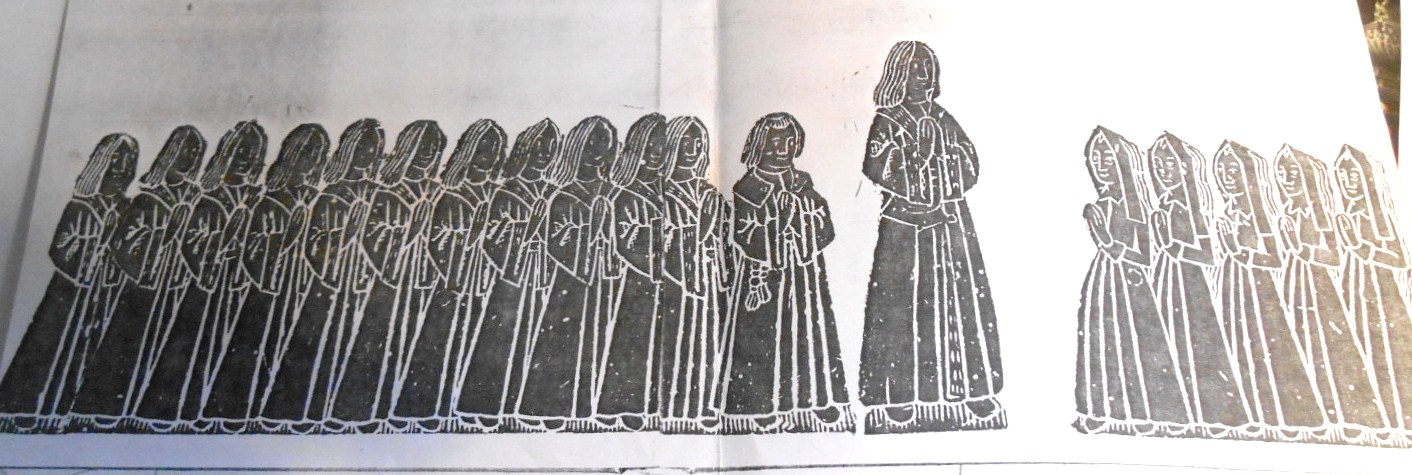
Thirteen sons and five daughters with their father on a monumental brass, 1501. 
 Families could be large.


The exception was the children of unskilled laborours on the land, who were denied even the opportunity of apprenticeship by a statute passed in the reign of Richard II (1367-1400) which tied agricultural workers' children to work on the land:
'It is ordained and assented, That he or she which used to labour at the plough and cart, or other labour or Service of Husbandry till they be of the age of Twelve Yeare, that from thenceforth they shall abide at the same labour, without being put to and Mystery or Handicraft; and if any Covenant or Bond of Apprentice be from henceforth made to the Contrary, the same shall be holden for none.'
(Statutes, Richard II Cap. V 1388.  In: F. J. Furnivall, Introduction, EETS, Vol. 32 p. xlvi)

 Joseph Strutt Sports and Pastimes of the People of England...from the earliest times... 1801etc.

For children higher up the social scale being bound apprentice to a craft was the way to a good living.  It was also quite common for the younger sons of great landowners to be apprenticed, so that their futures were proviced for, as the eldest son would inherit most of the estates.
The apprentices' rights and duties were laid out in a strict legal code and the numbers entering each craft were jealously guarded by the craft unions or guilds to keep up the wages of members and to keep the skill secrets.  A child would usually have to take what was on offer, generally being apprenticed to the same trade as his father, either with another family member or a friend.  So localities became associated with particular skills;  In Europe, where the same system of apprenticeship also applied.  So Nuremberg became famous for its clockwork mechanics and Toledo for its sword blades.

In the cities apprentices often formed strong and unruly bands, a bit like football supporters out on the town, and were quite often involved in riots.  There were a number of local laws which suggest the way they behaved: in Newcastle apprentices were forbidden to 'daunce dice cardfs mum or use any musick in the strets' and they were criticised for their extravagant dress and long hair.  In Carlisle in 1595 the apprentices were forbidden to play football. In London particularly apprentices became involved in national politics, taking to the streets with their cudgels.
)There is a very good detailed account of apprenticeship with a breakdown into trades of part of the Bristol Apprentice Roills 1532- in Dorothy Gardiner's English Girlhood at School, O.U.P. 1929)

                                  The Saltonstall Family c. 1636-7 with well-swaddled baby, Tate Gallery

Upper class children, from the European ruling elite,  could suffer in a way that the children of less important
people would not, because they were  important  family assets.
The practice of taking the children of conquered, or even allied, rulers as hostages is extremely old.  British noble-born children were brought in in Imperial Rome.  Maybe because of this it became normal practise for nobly born children, especially boys to be sent away to the household of a nobleman or equal or greater rank, often their father's overlord, possibly the monarch.  Boys were sent away about seven years old and girls a bit later.  They would serve as pages, then squires, and the girls as ladies in waiting. The Earl of Arundel sent his son to the household of the Bishop of Norwich in 1620 and commanded him:

'You shall in all Things reverence honour and obey my Lord Bishop of Norwich as you would do any of your parents, esteeming whatsoever he shall tell or Command you, as if your Grandmother of Arundell, your Mother or myself should say it; and in all things esteem yourself as my Lord's Page; a breeding which youths of my house far superior to you were accustomed to....'
(EETS original series Vol. 32, p.ix)


                  Sir Walter Raleigh and his son,a miniature version of himself, 1602.  National Portrait Gallery

It could be tough:  Roger de Hoveden, clerk to Henry II in the 12th century, remembered that at the court of Richard I's Chancellor Longchamps, Bishop of Ely:

'All the sons of the nobles acted as his servants with downcast looks, nor dared they to look upward towards the heavens unless it so happened that they were addressing him; and if they attended to anything else they were pricked with a goad, which their lord held in his hand, fully mindful of his grandfather of pious memory who, being of servile condition in the district of Beauvais, had, for his occupation, to guide the plough....'
(EETS Vol. 32 p. vi)
(One of the ways in which children of very poor families might, just, raise to a higher station, was through the Church.)


e-mail: childhoodblog@gmail.com


Thursday, 30 April 2015

Clothes and toilet training for infants in Tudor times

At about one year children were unswaddled.  Guillemeau says:

'About the eighth or ninth month, or at farthest when the childe is a yeare old, he must have coats, and not be kept swathed any longer....And chiefly the Nurse must let him have a hat.'
(Jacques Guillemeau, Childbirth, or The happy deliverie of women...To which is added a treatise of the diseases of infants and young children.  London 1612)

However, children were still quite restricted, either with leading strings or with walking frames:

'...there are stools for children to stand in, in which they can turn around any way, when mothers or nurses see them at it, then they care no more for the child, let it alone, to about their own business, supposing the child to be well provided but they little think on the pain and misery the poor child is in...the poor child ...must stand maybe many hours, whereas half an hour standing is too long...I wish that all such standing stools were burned...'
Felix Wurz, 1563, quoted in Lloyd deMause History of Childhood, 1974


Walking frames were something like a prototype baby bouncer.  They kept the child off the floor or rushes and out of mischief. Since the medieval house was neither particularly safe nor particularly clean this may have been quite necessary.

In medieval times it was normal for a child to be weaned about the age of two or when its teeth appeared.
Some advice on weaning from the second century AD suggests using morsels soaked in honey or other flavouring, or infused with milk, or moistened grits or pap made of wheat.
(Sorani gynaeciorum vetus translation Latina...Valentino Rose, 1882, Bibliotheca Scriptorum Gynecorum et Romanorum Teubrieriana p. 43)

The 16th century French Paedotrophia,advises weaning straight onto wine:

'Nore is it ill to cheer its heart with wine
For of all cordials 'tis the most divine'

This treatise also includes some interesting remedies for teething troubles:
'The sweat that from a goat or cattle's hoof distills is good'
Is this calves' foot jelly?
Also recommended:
'In a hare's brain his little finger dip'
(M. Saint-Marte, Paedotrophia, or The Art of Bringing up Children, translated into English 1718)

Some sort of loose tunic seems to have been normal every day wear, for boys and girls.
Although portraits of infants in the late Middle Ages and Tudor period show little aristocrats very richly dressed, and household accounts show that a great deal might be spent on their clothes, this is probably not a reliable guide to their every day clothing.  Being captured for posterity was a very important formal occasion, and at this date portraits were not intended to show the sitter as he or she really was but to record their position in life, a particular occasion, or even their symbolic value.  Sitters were dressed as richly as possible to show their wealth and power.

Boy aged two Marcus Gheeraerts the younger Compton Verney 1608

Variants of the smock were used for boys and girls at the toddler stage right up to recent times when romper suits and leggings became popular.  When all clothes were made by hand smocks probably lasted a growing child longer, and were easier to keep reasonably clean till children were toilet trained.

There is not much evidence on toilet training but it was probably rather haphazard since adults were not too particular about where they relieved themselves and only large important buildings had any kind of permanent toilet.

At about age seven, when a child's formal education began, boys went into breeches.  This was a quite important occasion, marking the transition from infancy. The dialogues of Claudius Hollyband and Peter Erondell, two Huguenot refugees teaching in Elizabethan London have a nice description of a noble lady preparing her two sons to go visiting.  They are about nine years old:

'Come hether both of you, doe you weare your cloathes Gentleman like?  Where is your hat-band?  Why have you taken your wast-coates?  Is it so colde? Button your Dublet, are you not ashamed to be so untrussed?  Where is your Jerkin?  For this morning is somewhat colde...(to Servat) Goe fetch your Master's silver hatched Daggers.  Put on your garters embroidered with silver...where are your Cuffes and your falls?  Hafve you clean handkerchers? Take your perfumed gloves...Put on your gownes untill we goe, and then you shall take your cloakes lyned with Taffeta, and your Rapiers with silver hilts.  Tye your shooe-strings.  Well, take your boot-hosen, and your gilt spurres.'
(From M. St. Clare Byrne, The Elizabethan Home discovered in two dialogues by Claudius Hollyband and Peter Erondell, 1949)

e-mail: childhoodblog@gmail.com


F

Saturday, 27 December 2014

Babyhood in early British history: swaddling

How now, how does the child...Unswaddle him, undoe his swaddling bands...wash him before me...Pull off his shirt, thou art pretty and fat my little darling...flea-bitten, for the black spots are there yet, is there any Fleas in your Chamber (Nurse)?...Now swaddle him again, but first put on his biggin (bonnet) and his little band with an edge, where is his little petticoat?  Give him his coat of changeable taffeta and his satin sleeves.  Where is his bib?  Let him have his gathered apron with strings, and hand a Muckinder (handkerchief) to it.  You need not yet give him his coral with the small gold chain (for teething) for I believe it is better to let him sleep until the afternoon.'
   Peter Erondell  In the Nursery, dialogue 5, quoted from M. St. Clare Byrne ed. The Elizabethan House discovered..., revised ed. 1930

When the child was born it was washed and generally oiled as a protection against the cold and rashes.  Roesslin advised annointing with oil or acorns, Guillemeau with fresh butter, oil of roses or oil of nuts (Eucharius Roesslin, The Byrth of Mankynd, newly translated out of Latin by R. Jonas, 1540; Guillemeau, Childbirth or the happy delivery of women...2nd ed. 1635)

Rubbing with salt was also recommended.  Oils and wine, which is antiseptic, were used on the baby's skin rather than water for the first few months, that is, if the child was in a well off family.  Guillemeau advised bathing regularly in lukewarm water and wine.

Infants were then swaddled; wrapped from head to toe in bands of cloth.  These, it was advised, should be changed often 'for the Piss and Dung'.  Guillemeau says children were generally changed at 7am, noon and 7pm but advises doing it more often if necessary. It must have been tempting to leave the child as long as possible as swaddling was very time-consuming. Pictures of swaddled babies show them looking like little chrysalids. In the 16th century, under the influence of adult fashions, a small ruff was sometimes added.

There are very few descriptions of swaddling, probably because it was such a universal practise that it was assumed everyone knew how it was done.  After the first few weeks the hands were freed and swaddling could be combined with other clothes.

At about four weeks according to Guillemeau 'He cannot well keep his hands swathed in, and hid any longer...Then must he have little sleeves...and then the Nurse shall begin to carry him abroad to sport and exercise him.'

Swaddling  was probably primarily intended to keep the child warm, not easy when windows were still the 'wind's eye', being, mostly, closed with ill-fitting wooden shutters when they were closed at all.  The peasant hovel might enjoy a primitive form of central heating when the cows were stabled at one end, but castles, Tudor stately homes and the homes of merchants and artisans must have been cold, draughty places in which to rear a young baby.  Doctors also frequently warned of the danger of binding a child's limbs crooked:

'Furthermore when the infant is swaddled and laid in cradle, the nurse must give all diligence and heed that she bind every part right and in his due place and order, and that with all tenderness and gentle entreating and not crookedly and confusedly, the which must also be done oftentimes in the day: for in this it is as it is in young and tender imps, plants, and twigs, the which even as you bow them in their youth so will they evermore remain unto age.  And even so the infant if it be bound and swaddled, the members lying right and straight, then shall it grow straight and upright, if it be crookedly handled it will grow likewise, and to the ill negligence of many nurses may be imputed the crookedness and deformity of many a man and woman...' (Roesslin The Byrth of Mankynde, 1540)

Roesslin's treatise, Rosengarten, was translated into English at The Byrth of Mankynde in 1540 and dedicated to Catherine of Aragon, first wife of Henry VIII.  Maybe interest in child care was stimulated by Henry VIII's attempts to rear a son and heir.

Giraldus Cambrensis made some revealing remarks on the practises of the Irish in the 12th century which are worth quoting for the light they shed by implication on English practises:
'For appart from the nourishment with which they are sustained by their hard parents from dying altogether they are for the rest abandoned to ruthless nature.  They are not put into cradles and swathed; nor are their tender limbs helped by frequent baths or formed by any useful art.  The midwives do not use hot water to raise the nose or pres down the face or lengthen the legs...'
(Giraldus Cambrensis, The Topography of Ireland, Character and habits of the Irish, Chapter 10, quoted Lloyd deMause History of Childhood, 1974)

Another reason for swaddling may have been to keep the child quiet and immobile.  Swaddled babies are more passive, sleep more and cry less. By the 16th century doctors were becoming concerned about this.  Guillemeau recommended that until the child was two he should be allowed to sleep whenever he wished and till he was three or four should spend more time asleep than awake. But he should not sleep more than half the day or he would become dull.

At about one year the child was usually unswaddled completely.


'

Monday, 1 December 2014

Introduction to the blog

When I worked in Birmingham Reference Library I enjoyed the librarian's privilege of browsing in the closed access stacks.  I read diaries, memoirs, histories, statutes, and of course the books in the Parker Collection of Children's Books, Birmingham.  This blog is about and  childhood in Britain and the USA, what children's lives were really like, and how adults see childhood and their children. I call it the Looking-Glass World:

'Nor shall I thinke this labour lost, though I doe live: for I will make it my owne looking glasse wherein to see when I am too severe, when too remisse, and in my childe's fault through this glasse to discerne mine owne errors'
Elizabeth Joceline, The Mother's legacie to her unborne child, 1625


Children's upbringing has always reflected adult attempts to mould their children.  Children have been seen as limbs of Satan, to be purged of mankind's original sin, and as primeval innocents, to be protected from the corrupting influence of the everyday world. Boys have been educated to become fighting men or classical scholars, or left completely uneducated, as day-labourers. Girls have been educated to run large households, to be decorative symbols of their husbands' wealth, occasionally as intellectual rivals, or to earn their livings with their hands or other parts of their bodies, depending on what class and family children were born into.

Though the way in which adults see children constantly changes, children themselves have changed little.  Children as revealed in a thirteenth century poem, or in a Puritan autobiography are immediately recognisable to modern eyes; wayward, naive, playful, living under the constraints put on them by adult ambitions.

One of the difficulties facing anyone chronicling changes in attitudes to children is the enormous diversity of practises at any one time.  For every writer who advises cold baths and plain diet there will be an opponent to ridicule that view.  At no time were all well brought up British or American children handed over to wet-nurses, given a strict religious upbringing, or denied fairy tales.  Many parents followed the fashion of the day, but others chose to suckle their children themselves, cherished and indulged them when informed opinion advised the opposite, and paid only lip-service, if that, to religion.

But certain overall trends can be perceived.  Family relationships became generally less formal after the mid 17th century and closer ties between children and parents developed. From the Medieval period onwards there has been a slow but steady trend towards greater permissiveness, what might be called an insidious growth of child-power. Religion was of great importance to many people but perhaps the most significant trend of all has been the steady lengthening of childhood.

The upbringing of a child depends very much on its parents' place in society.  The upbringing of a child from a poor background differed radically from that of a child born into the middle or upper classes.  The backgrounds of children growing up on the American continent from the 17th to the 19th centuries were particularly diverse, for their parents came from many parts of the world and belonged to a number of totally disimilar cultures.  Even among the settlers from Europe there is an enormous variety of childhood experience, from Puritan New England to the Southern plantations, from city life to remote log cabin.

Changing views of childhood are reflected in art.  17th century portraits show children dressed as mini-adults but by the 19th century childhood was being idealised and sentimentalised and this trend is reflected in children's portraits.