Showing posts with label early children's books. Show all posts

Monday, 15 May 2017

Moral stories for Georgian children

'"Oh what a shocking story," said the children, and that miserable man who hangs there is Roger, who murdered his brother? Pray let us go, Papa"  We will go immediately" said Mr. Fairchild; "but I wish first to point out to you, my dear children, that these brothers, when they first began to quarrel in their play, as you did this morning, did not think that death, and perhaps hell, would the the end of their quarrels"'
 (Mrs. Sherwood, History of the Fairchild Family, 1818, p.60.  Google digital download)
Mrs. Sherwood, History of the Fairchild Family, 1818
(University of Roehampton digital collection)
The same writers who banished fairy tales from Georgian nurseries were happy to give children poetry and were very interested in children's education.  They produced a large number of text books which filled a real need.  Mrs. Trimmer produced illustrated introductory history books, Jeremiah Joyce, John Aikin and his sister Mrs. Barbauld wrote popular introductions to science and natural history, using imaginary conversations between parents and children.  These dialogues were based on the educational theories of the French philosopher and educationalist Jean Jacques Rousseau (1712-1778, born Geneva, domiciled in France during the French Revolution.  see Sylvia Wiese Patterson The influence of Rousseau's Emile upon the writers of children's books in England in the late 18th century, University Microfilms Inc. Ann Arbor, Michigan, 1970) )

Mrs. Barbauld also wrote and published, in 1778, the very first book for children not only written in very simple language but also printed in large, clear type.  Lessons for Children was written for her adopted nephew Charles because she could not find any books suitable for teaching him to read.  Mrs. Trimmer, in The Guardian of Education, recognised the book as a landmark.
(Guardian of Education, vol. 1,1802, p.153)
Mrs. Barbauld, Lessons for Children, 1778,
 Google Digital Archive copy, Oxford University
Children's literature in the late 18th century and the first thirty years of the 19th century was dominated by the moral stories produced by members of the Christian Evangelical movement.  They give an interesting, slightly distorted, view of the lives led by real children at the time.
The households in these stories are mostly quite well off, though not rich, religious, with few servants, occupied in good works of various kinds, and closely united, loving family units.  The stories encouraged honesty, charity, love of God, kindness to animals, industry and selflessness.  Mrs. Maria Edgeworth's stories, in particular, give a charming picture of 18th century family life.

Mrs. Edgeworth was very influenced by Rousseau and many of her stories are based on  his theories about the importance of learning from good example and by experience.  These are fictionalised in his popular and influential book Emile, 1762 (publicly burned in Paris that year) The central thesis of Emile is that a child in born not, as the Puritans believed, naturally evil, but naturally innocent.  The child must be protected from contact with corrupting influences and carefully nurtured so that natural instincts and talents are encouraged to develop.
Title page of Rousseau's Emile, 1762
Wikipedia
Rosamund, the little heroine of many of Mrs. Edgeworth's tales, has an elder sister, the good one who is never cross, always puts her needles away tidily in her housewife, never lies in bed late on cold mornings, and, being provident, is always infuriatingly ready with quietly given pennies for the deserving poor.

Rosamund and Laura, Harry and Lucy are forever far-away Georgian children in caps and ribbons, set in a Georgian landscape of gravel walks and neat flower borders but their behaviour is timeless children's behaviour;
'I am sure - no, not quite sure - but, I hope, I shall be wiser another time!'
says Rosamund of her unwise choice of the beautiful purple jar in the chemist's chemist's shop, which turns out to be merely a glass jar filled with nasty-smelling purple liquid, instead of the shoes she really needs and then has to manage without.  This is an object lesson which she remembers when offered a housewife to keep her needles safe or an imitation plum with which to play tricks on her brother and sister.  She chooses the useful housewife, though not without some agonising.
 In another story Rosamund gets a thorn in her little finger and won't let her mother take it out because she is afraid of being pricked with the needle.
'It does not hurt me in the least, whist I hold it still, and whilst I hold it out quite straight, mamma."
"And is it your intention to hold your finger out quite straight and quite still, Rosamund, all the remainder of your life?"
With gentle irony, mamma leads Rosamund to realise that having the thorn removed is the wisest thing to do.
Rosamund is never punished directly, simply made to suffer the logical consequences of he actions.  As she is a rational child, she then corrects her faults herself, or at least tries to.
(Maria Edgeworth, The Parents' Assistant, 1796, and Early Lessons, vol. 2 p.1-132 and 96-107)
Rosamund and the purple jar, Early Lessons, 9th ed.
Google digital download 
John Ruskin described his upbringing, based on Rousseau's theories, in his autobiography, Praeteria, and also recognised its shortcomings:
'My mother's general principles of first treatment were to guard me with steady watchfulness from all pain or danger; and for the rest to amuse myself as I liked, provided I was neither fretful nor troublesome.  But the law was, that I should find my own amusement.  No toys of any kind were at first allowed...Nor did I painfully wish, what I was never permitted for an instant to hope, or even imagine, the possession of such things as one saw in toy-shops.  I had a bunch of keys to play with, as long as I was capable only of pleasure in what glittered and jingled; as I grew older, I had a cart, and a ball; and when I was five or six years old, two boxes of well-cut wooden bricks.'
(John Ruskin, Praeterita, vol. 1, 1885.   Univ. Cal. download p.13)
When Ruskin was older he was taught by his parents and by a series of carefully chosen tutors and, according to Rousseau's principles, kept from the possibly contaminating companionship of other children,

The essence of Rousseau's theory was that the child should be protected from all outside influences which would threaten the natural innocence of its mind, and should acquire knowledge naturally through a benevolently guided exploration of the world around it.  The foundation of Ruskin's lifelong study of art, architecture and aesthetic principles were laid in his early childhood through the tactile and visual exploration of everyday objects.  His building bricks were particularly important to him:
John Ruskin c.1864
Wikipedia
'I never saw or heard of another child so fond of its toy bricks except Miss Edgeworth's (fictional) Frank.  Maria Edgeworth's tales, particularly Harry and Lucy, were of course part of Ruskin's staple reading.   Ruskin developed finely tuned artistic sensibilities as a result of his early education.   It is likely that Darwin and other Victorian scientists, also following their natural inclinations, developed their habits of scientific analysis, while still children, as a result of the same method of education, having been encouraged to collect cabinets of shells, geological specimens, insects or botanical specimens and examine them.

However the solitary upbringing advocated by Rousseau and the ceaseless vigilance with which Ruskin was watched over as a youth left him 'only by protection innocent, instead of by practise virtuous' (Praeteria download version p.55), emotionally vulnerable because his emotions had never been tested, and lacking social graces.  So the eruption into his life of the charming girls who came to stay for a while when Ruskin was about seventeen was overwhelming, the embarrassment of trying to entertain them awful, and possibly his over-protected childhood led to the failure of his marriage.(Praeteria download version p.273-)

In Mrs. Sherwood's books, as in Maria Edgeworth's, moral lessons are taught by the children's failings.  The History of the Fairchild Family, (3 vols, 1818, 1841, 1847) is another children's book which  remained very popular throughout the 19th century.  Maybe this is also what made it popular with children.  Emily, Henry and Lucy are always falling short of perfection in their own eyes as well as in their parents; trying to be good and failing.  In the chapter forbiddingly called The constant bent of man's heart towards sin, for instance, the children have been left at home under the care of a servant.  They are determined to be good.  They begin their lessons, but see a pig in the garden and think it would be good to chase it out.  This would be good, but instead of stopping at the gate they follow it down the lane and through a stream.  A farmer's wife sees how wet and muddy they are and invites them in to get dry.  This is kind of her, but they should not have accepted because her children are naughty children and their parents have forbidden them to play there.  The farmer's wife gives them cake and cider, which was kind, but they get tipsy and fall down in the lane and muddy their clothes even more.  They are very remorseful for a while, but then they are tempted by the swing in the barn, on which they are not allowed to play unsupervised.  Of course their swinging gets out of hand and Emily falls off and cuts her head.  In despair the servant, John, ties the other two children to a chair so that they cannot get into any more mischief.  When their parents get home they are very sorry and run to confess their naughtiness.  (Mary Sherwood, History of the Fairchild Family, vol.1, 1818, digital p. 70-83.  Available in digital download, University of Roehampton)
History of the Fairchild Family,
 illustrated by Florence Rudland, 1902
(Project Gutenberg internet edition)
In these stories the cardinal sins are disobedience to parents and lying.  One of the most forceful stories in The History of the Fairchild Family is Absence of God where Mr. Fairchild punishes Harry, explaining that a father stands in relation to his children as God does to man and so disobedience to his father is a sin against God.(p 265-75)  The children's worst punishments, in accordance with this religious theory, are their own remorse and their parents' displeasure.  Emily steals damsons from the cupboard and is so overcome by guilt that she nearly dies of a fever.(p.114-123)  Henry refuses to learn his first Latin lesson on the ingenious grounds that although this one is easy he has looked at later lessons and knows he will not be able to do them: 'I am sure I cannot learn all the hard words in this book, and so I won't begin;  (p.265-275)  Harry's punishment is to be ignored by his family, though his little sisters are very tearful about it, and he is quickly brought to a state of remorseful repentance by the moral weight of family disapproval, another example of the kind of psychological punishments which both John Locke and Rousseau favoured.  On one terrible occasion the children art taken to see the body of a hanged man on a gibbet, as a lesson in how small faults can lead to greater ones and eventually to the gallows.  (Google digital edition p.,75-6)

As might be expected religious duties are strongly stressed in these moral stories, but in fact religious observance clearly varied between puritanism as strict as any practised in the 17th century to Henrietta Hotham's lighthearted declaration in 1763 at the age of eleven: 'I have not yet declared of what Religion I shall be; but I go three times a week to the Church door; and upon Moses Hart's having done a most humane and charitable action by one of Mr. Carr's sons, I have been to the Jew's synagogue; it is observed that there is no Apprehension of my being a Papist, I like Fish too well to have it my Duty to eat it.'
(A.M.W. Stirling, The Hothams,  2 vols, 1918, p.95)

Even in a strict Quaker household such as the Gurney's the children's private journals for spiritual self-examination contain some surprisingly rebellious sentiments:
'At this time I do not believe in Christ' 'Oh how I long to get a broom and bang all the old Quakers who do look so triumphant and disagreable.'
(Augustust J.C. Hare, The Gurneys of Earlham, 1895, Vol. 7 p.72, 79)

Generally, however both adults and children who belonged to the various sects which disented from the established Church of England were particularly fervent in their religious beliefs, partly, no doubt, because in the latter half of the 18th century dissenters were still liable to persecution.  As late as 1800 Isaac Taylor, (brother of Jane Taylor who wrote Twinkle twinkle little star) described a near escape from a mob bent on attacking their house, and there was strong feeling against the Catholics due to the Stuart claim to the Crown.
(Doris May Armitage, The Taylors of Ongar, 1938 p. 24-55)

 Adults and children were exposed to propaganda such as The Protestant Tutor, 1713, advertised as:
'Instructing Youth and Others in the Complete Method of Spelling, Reading, and Writing True English: Also Discovering to them the Notorious Errors, Damnable Doctrines and Cruel Massacres of the Bloody Papists; which England may expect from a Popish Successor, with Instructions for Grounding them in the Protestant Religion.  To which is added the Preamble to the Patent for Creating the Electoral Prince of Hanover a Peer of the Realm, Duke of Cambridge.
(later George I  The Protestant Tutor, 1713, Parker Collection, Library of Birmingham))
The anti-Catholic Foxe's Book of Martyrs was also still very popular reading.
Image from Foxe's Book of Martyrs, 1563
British Library digital image
Mrs. Sherwood remembered being at school in Reading where many French refugees fled during the French Revolution (1789-99) One of them, the Abbe Beauregard, attempted to convert her to the Catholic religion which she resisted:
'Popery of course must be wrong, because my parents had said so, and because those people worshipped saints; and God alone, I had been taught, was the fit object of worship.'
(The Life of Mrs. Sherwood, 1857 A digital version is available on Google)
Stephen Hawtrey, at school in France shortly before the Revolution, experienced the reverse prejudice, being told that, as a Protestant, he could not be a Christian because he had not been baptised.
 (Florence M. Hawtrey,  The History of The Hawtrey Family, 1903, Vol. 1, p. 392)

Although the 18th and 19th centuries were a period of strong and active religious feeling in Britain which expressed itself in generally puritanical attitudes to dress and behaviour, it is evident from the force with which Nonconformist and Evangelical writers condemned such behaviour that a large number of middle and upper class children were being brought up under what, to their eyes, appeared a deplorably lax regime, and to very different standards.  Many late 18th and early 19th century stories proclaim the superiority of spiritual beauty over physical, ridicule overdress, spoilt children, and extol the virtues of plain dressing, simplicity and personal cleanliness, something which was beginning to be expected in polite circles.

Mary Hughes, The Ornaments Discovered, 1815,
 Copy:internet  Biblio.co.uk, Abbey Antiquarian Books
The Ornaments Discovered by Mary Hughes contrasts the behaviour of Emma:
'dress, unfortunately for her, was the most important object in life' and foundling Fanny, whose spiritual ornaments give the title.  Fanny is so sweet natured, or lacking in discrimination, that she continues to regard Emma as her dearest friend when the latter's lack of moral courage has led to Fanny being considered a liar and a thief.  She is, in fact, a shining moral example of not only virtues such as honesty but also those qualities which the Georgians and especially the Victorians thought so essential in a woman, utter unselfishness, sweet-nature, good temper and gentleness.
(Mary Hughes, The Ornaments Discovered, 1822 edition, Parker Collection, Library of Birmingham)

The poem Finery in Jane and Anne Taylor's popular collection Original Poems for Infant Minds makes the same point:

''Twas Lucy, tho' only in simple white clad
(Nor trimmings, nor laces, not jewels she had)
Whose cheerful good nature delighted them more
Than all the fine garments that Harriet wore.'
(Jane and Anne Taylor, Original poems for infant minds, 1804.  p. 99.
Garland Press facsimile 1976.  Digital copy available on Google Project Gutenberg, but pagination differs)

For a few years at least simplicity became the fashion.  However, with so many pretty things to tempt them who could blame those who could afford it for yielding to the temptation to display their wealth and dress themselves and their children up like Christmas trees?

The New England Puritans were no more successful in discouraging people from a taste for finery than the British Nonconformists and Evangelicals. Alice Morse Earle quotes, for example, a long letter from a twelve year old American girl, Anna Green Winslow, written in 1771, describing her complicated toilet for a special occasion:
'I was dress'd in my yellow coat, black bib & apron, my pompedore shoes, the cap my aunt Storer sometime since presented me with blue ribbins on it, a very handsome locket in the shape of a hart, the paste pin my Hon'd Papa presented me with in my cap, my new cloak & bonnet on, my pompedore gloves, and I would tell you they all lik'd my dress very much.'...Nor was this all, on another occasion she wore'...black feathers....my paste comb, all my paste, garnett, marquasett, and jet pins, together with my silver plume...'
(Alice Morse Earle Child life in Colonial days, 1899, p.58-9.  Digital copy available on Project Gutenberg, an excellent account of child life in the USA)


Monday, 1 May 2017

Fairy tales are a danger to children!

'Partial as we confess ourselves to be, to most of the books of the old school, we cannot approve of those which are only fit to fill the heads of children with confused notions of wonderful and supernatural events. 'Mother Bunch's Tales are of this description.'
 Mrs Sarah Trimmer, The Guardian of Education, Vol. 2. 1803,p.185)

Sarah Trimmer (Wikipedia)
The late 18th and early 19th century is remarkable for the large number of Evangelical writers who turned to producing stories for children.  This was largely a result of the growth of the Sunday School Movement; people like Mrs. Trimmer, Hannah More and Mrs. Sherwood quickly found that there were no suitably improving stories for the children in their new Sunday schools for the poor to read.  There was also a steady demand from the better off, particularly parents in the same Evangelical; circles as the writers mentioned above.  They came from a section of society which had traditionally taken a close interest in their children's upbringing.  Their works were popular in both Britain and America. The influential American writer Mrs. Lydia Child recommended in The Mother's Book, an instruction manual for young mothers, the work of the Taylors, the Edgeworths, Mrs. Barbauld and Mrs. Trimmer, whom she describes as 'among the very best writers of juvenile books; her influence is pure and holy'.  She had reservations about Mrs. Sherwood because of the extremely Calvinistic tone of her theology, and regretted that the Edgeworths, for ideological reasons, as follower of the French philosopher Rousseau, omitted any religious teaching from their books for children.  (Mrs. Lydia Child, The Mother's Book, 1831.p95-103 of 4th ed 1832)  Lydia Child was an influential campaigner for women's rights, the abolition of slavery and Native American rights)

Naturally parents and writers in these social circles carefully scrutinized the books they gave their children and from 1802 to 1805 Mrs. Trimmer edited and largely wrote the very first reviewing journal for children's literature, The Guardian of Education.

One of the most remarkable effects of the virtual monopoly which this group of authors and educationalists established over the production of children's books at this time was the virtual abolition of traditional fairy tales for almost the first twenty-five years of the 19th century.  The Puritans had strongly disapproved of folklore and fairy tales, which they associated with Catholicism and witchcraft, and considered superstitious nonsense.  Mrs. Trimmer's own mildly fanciful moral story, The History of the Robins, 1786, was prefaced by a disclaimer reminding children that robins cannot really talk as they do in the story.  Children should be 'taught to consider them, not as containing the real conversations of birds (for that it is impossible we should ever understand), but as a series of Fables, intended to convey moral instruction...'
(The Guardian of Education, Vol. 2,)
Sarah Trimmer's Fabulous Histories.
with The History of the Robins
(British Library)
The 19th century attack on fairy tales was, however, launched largely on grounds of morality.  In 1802 a correspondent in The Guardian of Education roundly condemned Cinderella, saying it 'is perhaps one of the most exceptional books that was ever written for children...It paints some of the worst passions that can enter into the human breast, and of which little children should, if possible, be totally ignorant; such as envy, jealousy, a dislike to  mothers-in-law (sic, meaning step-mothers) and half-sisters, vanity, a love of dress, etc. etc.' (Guardian of Education, Vol. 2, p.15 and 448 )  Mrs. Trimmer was forced to re-examine her old favourites such as Mother Bunch and Mother Goose, and shortly afterwards produced a damning review of Benjamin Tabart's very charming Juvenile Library, which included the first printed text of Jack and the Beanstalk, 1802.  Even works such as the very respectable Sarah Fielding's The Governess, which both Mrs. Trimmer and Mrs. Sherwood loved as children became suspect.  Mrs. Sherwood replaced the fairy tales it contains with something more improving.

John Newbery's publications became virtually unobtainable.  Charles Lamb,author of Lamb's Tales from Shakespeare, complained to the poet Samuel Taylor Coleridge, writer of The Ancient Mariner: 'Goody Two Shoes is almost out of print.  Mrs. Barbauld's stuff has banished all the old classics of the nursery...Science has succeeded to poetry no less in the little walks of children than with men.  Is there no possibility of averting this sore evil?  Think what you would have been now, if instead of being fed with tales and old wives' fables in childhood, you had been crammed with geography and natural history! ' ( Harvey Darton Children's Books in England,p. 131 quoting Lamb's letter to Coleridge)  This complaint is a fore-runner of Charles Dicken's satirical attack on the Rationalists, epitomized by Mr. Gradgrind, in Hard Times, 1854, by which time fantasy and fairy tales were once more accepted: 'Now, what I want is, Facts, Teach these boys and girl nothing but Facts.  Facts alone are wanted in life.  Plant nothing else, and root out everything else.  You can only form the minds of reasoning animals upon Facts: nothing else will ever be of any service to them.'

Fairy tales were considered harmful mainly on moral grounds but also because it was feared that children would learn to confuse truth and falsehood, which may have not been unjustified.  Caroline Hutton, daughter of the Birmingham historian William Hutton, recalled that, 'Nothing delighted me so much as did the tales of the fairies.  I no more doubted their truth than I did my own existence.'  She was most disappointed when her home-made wand failed to turn the parlour grate to gold. (Caroline Hutton Reminiscences of a gentlewoman of the last century.  Letters of Caroline Hutton ed. C.H. Beale, Cornish, Birmingham, 1891 p.2)  Mrs. Sherwood as a child peopled the woods near where she grew up with fairies: 'If I could discern fairy rings, which abounded in those woods, they gave me another set of images; and I had imaginary hermits in every hollow of the rocky sides of the dingle, and imaginary castles on every height, whilst the church and churchyard supplied me with more ghosts and apparitions than I dared to tell of.' (Life of Mrs. Sherwood, edited by her daughter Sophia Kelly, 1857 p.37)

Many children, of course, still had access to folk tales in spite of official disapproval.  Harriet Martineau, born 1802, whose father 'held that they developed the imagination in the wrong channels', was told them by her nurse, like many other children, and the traditional tales, along with more sensational literature, were still sold in the form of crudely printed little chapbooks carried round the country by pedlars and having a status similar to modern comics.  (Harriet Martineau, Autobiography, 1877, Vol. 1, p.119)

It was serious folklore collectors, the Grimm brothers in Germany, Andrew Lang and Henry Cole on Britain, who restored fairy tales to the nursery by putting the weight of their considerable reputations behind well presented translations and editions of traditional tales which they collected.  Edgar Taylor argued for the encouragement of the imagination in the preface to the first English translation of Grimm's fairy tales, published in 1823:

'Our imagination is surely as susceptible of improvement by exercise, as our judgement or our memory; ad so long as such fictions only are presented to the young mind as do not interfere with the important department of moral education, a beneficial effect must be produced by the pleasurable employment of a faculty in which so much of our happiness in every period of life consists.'
(preface to German popular stories...collected by M.M. Grimm, 1823, translated by Edgar Taylor)

Curiously enough, fairy tales and fantasy in verse always remained generally acceptable.  It was at exactly this period that John Harris was achieving success with his picture book versions of Old Mother Hubbard, Cinderella  , The Butterfly's Ball, The Lion's Masquerade and numerous other titles.  Edmund Gosse, who was later allowed to read Scott's verse but not his Waverley Novels, supposed the distinction was made on the grounds that the artificiality of verse made it less realistic and so less credible than prose.
(Edmund Goss, Father and Son, 1907 Penguin Modern Classics ed. 1949 p.162)

(M. Roscoe,  The Butterfly's Ball, 1806
British Library)

Verse was, for whatever reason, enormously popular.  Isaac Watts had produced perhaps the most popular collection of children's poems ever published in 1715.  His Divine and Moral Songs for Children was written for a friend who wanted some hymns to accompany catechisms, and many of them are still in regular use.  His poem The Sluggard was parodied by Lewis Carroll in Alice in Wonderland:

'  'Tis the voice of the Lobster; I hear him declare
You have baked me too brown, I must sugar my hair...'
(The Annotated Alice, introduction and notes by Martin Gardner, 1960, Penguin ed. p. 139)

Watt's reasons for encouraging children to learn poetry by heart are given in his preface:
'There is something so amusing and entertaining in rhymes and metre, that will incline children to make this part of their business a diversion...What is learnt in Verse, is longer retained in memory, and sooner recollected...'
(Watts Divine Songs, 1st ed. 1715, preface)

Original poems for infant minds, 1834 ed.
1st ed. is 1804-5
(British Library)

Many collections of verse for children were produced around the turn of the century, including several well known collections by the Taylors, a family of Nonconformists.  'Twinkle, twinkle little star' has taken its place as a nursery rhyme, while My Mother was admired and imitated throughout the 19th century, appealing, as it did, even more to the Victorian cult of womanhood than to the Georgians:
'Who taught my infant lips to pray,
To love God's holy book and day,
And walk in wisdom's pleasant way?
  My mother.

Who ran to help me when I fell,
And would some pretty story tell,
Or kiss the place to make it well?
   My mother.'
(Jane and Ann Taylor, and others, 
Original poems for infant minds, 
1804-5.  Facsimile ed. 1976, p.76)


Monday, 27 February 2017

Little pretty picture books for children in Georgian Britain and America

"Ev'ry lady in this land
Has twenty nails upon each hand
Five and twenty on hands and feet
And this is is true without deceit"'
(Punctuation Personified, 1824)

The 18th century saw great developments in the use of pictures in books for children.  Generally these were crude but vigorous black and white woodcuts; many children's chapbooks in particular had these on every little page, with a short verse underneath.

Chapbooks, c.1800-1815
(Parker Collection Library of Birmingham)
However probably the most notable children's picture books produced in the 18th century were the type known as harlequinades, which are really early versions of movable or toy books.  Home-made lift up or flap books are known to have been popular as early as the mid 17th century in both Britain and America. The earliest were called Metamorphosis and show Adam and Eve, who for no known reason changes into a mermaid on lifting the lower flap.  Cain and Abel follow, then a lion, which becomes a griffin, which becomes a great bird carrying off a baby.  The last two flaps show a miser hoarding wealth and a memento mori. The text was adapted from Benjamin Sands The Beginning, Progress and End of Man, 1650.

From an American Metamorphosis, Samuel Wood & Sons, 1814,
reprinted from a 17th century original
(University of Delaware)
 In the 1760s a London map and print seller, Robert Sayer, adapted this traditional flap book to show scenes from the story of Harlequin and Columbine.  The flap books he printed were sold either plain or delicately hand-coloured.   Elizabeth Newbery (wife to John Newbery's nephew Francis), John Wallis and other publishers quickly followed his lead, and harlequinades were popular in Britain and America until the 1820s.  There is an American version of the traditional Adam and Eve flap book published as late as the 1860s.

Two variations on these flap books was published by Stacey Grimaldi in the 1820s;  The Toilet, and A Suit of Armour for Youth.  These show pictures of toilet articles or pieces of armour with titles such as 'An universal and genuine Beautifier' .  Lift the flap picture and the moral is revealed:  'Good Humour'.  Each picture is followed by an improving poem from Nathaniel Cotton's Visions in Verse.


Grimaldi's Toilet, showing The Enchanting Mirror:  Humility
(Copy: Philadelphia Rare Books, Pinterest)


However the true for-runners of modern children's picture books first appeared n the early 1800s, published by John Newbery's equally adventurous successor, John Harris. The earliest, Old Mother Hubbard and her Dog, a verse rendering by Sarah Martin of a traditional tale was published in 1805 and its success encouraged the publisher to commission other little books to follow.  These picture books were tales in verse about 15cm high, illustrated with copperplates or wood engravings and sold either in plain black and white or, more usually, hand coloured, often quite beautifully, in delicate watercolours. There was a whole cottage industry, employing children in poor families, working from home hand-colouring these and other illustrations.
The stories were versions of traditional tales such as Cock Robin and Cinderella or fantasies such as The Butterfly's Ball,  written by a well known scholar, Mr. Roscoe, for his own children, and first published in The Gentlemen's Magazine.  Other popular titles were The Adventures of Seven Wonderful Old Women, Dame Trot and her Cat, and The Peacock's Party, one of the numerous imitations of The Butterfly's Ball.
Old Dame Trot and her Comical Cat c.1820
(Parker Collection, Library of Birmingham)

Some of the most delightful of those early picture books are the educational ones; rhyming versions of the rules of punctuation such as Punctuation Personified, or Pointing made Easy, by Mr. Stops which begins:

'Young Robert could read, but he gabbled so fast
And ran on with such speed,that all meaning he lost.
Till one morning he met Mr. Stops, by the way:
Who advised him to listen to what he should say.
Then ent'ring the house, he a riddle repeated,
To show, WITHOUT STOPS, how the ear may be cheated.
"Ev'ry lady in this land
Has twenty nails upon each hand
Five and twenty on hands and feet
And this is is true without deceit"'
(Punctuation Personified, 1824,
Parker Collection, Library of Birmingham)

Marmaduke Multiply's Mirthful Method of Making Minor Mathematicians was published shortly after the defeat of Napoleon, and for 'Twice 11 are 22' shows a tiny child on father's knee, brandishing a large glass full of something unsuitable, crying:  'We'll drink to the hero of Waterloo!'  He is probably pleased that nurse will no longer be able to terrify him at bedtime with threats of Old Boney.  (Marmaduke Multiply, 1816, Parker Collection, Library of Birmingham)
Marmaduke Multiply, 1816,
(Parker Collection, Library of Birmingham)


The series of toy books published by S&J Fuller at the Temple of Fancy, Rathbone Place, London around 1810 combined an improving moral story with cut-out figures.  The most well known are the History of Little Fanny, the History of Little Henry and Ellen or The Naughty Girl Reclaimed.  There are appropriate outfits for each episode in the character's life with a moveable head, and hats,  to slot into the costumes.  

The History of Little Fanny, 1810
(Theriaults The Dollmasters.com)


Tuesday, 14 February 2017

John Newbery: Instruction and Delight in the 18th century

'Giles Gingerbread, he lov'd Cream, Custard and Curds,
And Good Books so well, that he eat up his Words'.
(The Renowned History of Giles Gingerbread, Newbery, 1764

John Newbery was the most influential publisher of children's books in mid to late 18th century.
Catherine Hutton of Birmingham, born in 1756, remembered his little books with delight:
'I read all of Mr. Newbery's gilt books, as they were called...Christmas box, New Year's Gift, Goody Two Shoes & etc...I trembled for Bluebeard's wife when she was so naughty as to open the forbidden closet; and when I came to her kneeling at her husband's feet, he with his uplifted scimitar ready to strike, and sister Anne looking out from the window I could read no more.  I burst into tears, laid down the book, and exclaimed "Mama I never will be married."...it was many years before I dared venture to resume the tale, or know that Bluebeard's wife was saved.'
   (Catherine Hutton, Reminiscences of a gentlewoman of the last century...Letters of Catherine Hutton, ed. C.H. Beale, Birmingham 1891)

 Newbery was not the first to publish amusing yet instructive children's books but he was the first to make them a large enough part of his business for many copies to have survived and so he may be considered the first to make a commercial success of his publishing venture.  By the turn of the century he had been joined by others. One of Newbery's most important rivals was  John Marshall of 4 Aldermary Churchyard.  He published quite a range of work, from flimsy chapbook collections of nursery rhymes to attractive little stories like The Christmas Present by 'Solomon Sobersides'.  He also published 'infant libraries', complete sets of matching miniature books in little wooden bookcases.

Newbery knew well that the way to a child's heart is through its stomach and was a great believer in the reward system:
'As (Tommy Trip) rides through the town, he frequently stops at the doors to know how the little children do within; and if they are good and learn their book? and then leaves an apple, an orange, or a plumb-cake at the door, and away he gallops, again, tantivy, tantivy, tantivy.'
(The Lilliputian Magazine, Newbery, 1752, British Library 1387.9.5)
He also used the edible alphabet with great success in the story of Giles Gingerbread, 'the little boy who lived upon learning' :
'Giles Gingerbread, he lov'd Cream, Custard and Curds,
And Good Books so well, that he eat up his Words'.

The little boy's letters were cut out of gingerbread for him, and he learned them as he ate.
(The Renowned history of Giles Gingerbread, Newbery, 1764, S. Roscoe, John Newbery and his successors, 1973)
Giles Gingerbread. From a later, 1820 ed.pub. J. Kendrew, York,
(Osborn Collection, UCLA)

 Andrew Tuer says in The History of the Hornbook that gingerbread letters and gingerbread hornbooks became popular some time in the 18th century.  He quotes Matthew Prior's  poem Alma, Canto II, from Poems upon several occasions, 1721:
'To Master John the English maid
A Horn-book gives of Ginger-bread;
And that the Child may learn the better,
As he can name, he eats the letter...'
(Andrew Tuer, The History of the Hornbook, 1897 vol. 2)

Since Janeway's Token for Children, 1671,  the emphasis seems to have changed a bit from heavenly to earthly rewards for being a good boy or girl.  Little Goody Two Shoes is recommended as a mentor:

'From a state of rags and care
And having shoes but half a pair
Their fortune and their fame would fix
And gallop in a coach and six'
(The History of Little Goody Two-Shoes, Newbery, 1765)

History of Little Goody Two Shoes, 1768 ed. (Wikipedia)
This still represented the just reward of honesty and hard work, rather than the activities of a Fanny Hill or a Moll Flanders. Newbery's exemplary stories were firm supporters of traditional morality; 'She never told a lie in her life.  No, No!  she knew that was a naughty pau-pau Trick
 (Nurse Truelove's New-Year's Gift, Newbery, c.1770)

'See Virtue here, with Wealth and Glory crown'd
And all the busy Crowd admiring round;
While she to Church with pious Zeal reapirs
To hear the Sermon, and to say her prayers'.
(The history of Miss Polly Friendly, Newbery, Nurse Truelove...c.1770)

'All Boys and Girls, who are not dutiful and obedient to their Parents , never come to any Good, but are, as they ought to be, always neglected and despised.' 
(A Pretty Play-thing for Children of all Denominations, Newbery, c.1759, Roscoe op.cit. p.226))

John Newbery also sold other educational aids, and, good salesman that he was, promoted them through his story books:
 'When he has learnt the Roman letters, you may teach him the Italic letters in the same Manner, and then the Figures; Afterwards it will be proper to give him a Sett of the Squares sold at the Bible and Sun in St. Paul's Churchyard, by playing with which he will soon learn to read.'  
(A Little Lottery Book for Children, containing a new Method of playing them into a Knowledge of the letters, Figures etc.  Newbery c. 1765? Roscoe p, 171) 
The Little Lottery Book was an original reading aid with a picture on one side of the page and a letter on the other; the child learned his letters by sticking a pin through the picture into the letter which corresponded to it.  Few copies survived such rough treatment.  

Newbery's little books were just as popular in America.  There numerous pirated editions were published by Isiah Thomas of Worcester (Mass) the founder of the American Antiquarian Society, and by Mahlon Day of New York.  Isiah Thomas adopted Newbery's use of advertising, changing the wording to fit his own business and slightly Americanising the text:
'Why! he got all the little books by rote that are sold by Mr. Thomas in Worcester, when he was but a very little boy.  Then he never missed church...He is chosen Congressman already and yet he is not puffed up...'
(Alice Morse Earle, Child life in Colonial Days 1899)

Tuesday, 31 January 2017

Little books to amuse and instruct....18th century children's books

'The Child's Plaything
I recommend for Cheating
Children into Learning'
     N. Lovechild, Tommy Thumb's Pretty Song Book, 1744)

Mrs Trimmer credited the development of instructive yet amusing books for children to the educational pioneer and philosopher John Locke.  (Mrs. Trimmer, The Guardian of Education, 1802-6 vol. 1 This was the first journal to review books for children)

Sarah Trimmer, the influential critic of children's literature,
Painted by Henry Howard, 1798
(Wikipedia)
Before the 18th  century there had never been many books designed specifically for children, and those that were tended to be a bit uninviting.  Perhaps the earliest writer to write amusing little stories for children was Sir Roger L'Estrange, who adapted the famous Fables by the Ancient Greek author Aesop(c. 620-564 BCE).  L'Estrange's famous 1692 edition is too large and too splendid to have been intended as a children's book.  He observed in the preface, however:

'...it is beyond Dispute, I suppose, that the Delight and Genius of Children, lies much towards the Hearing, learning, and Telling of Little Stories...we love to be instructed, as well as physick'd with Pleasure'
(Quoted in F.J. Harvey Darton Children's books in England, 1931 p.21)

Cheaper children's editions of his sugared pills, illustrated with crude woodcuts, became one of the books most widely read by children in the first twenty years of the 18th century, although his version of Aesop was eventually largely superseded by Samuel Croxall's, first published in 1722 with an extremely underhand attack on his rival translator in the preface:
'Pensioner to a Popish Prince..the Tool and Hireling of the Popish Faction.'(see Harvey Darton op.cit above)

The Croxall edition was, however, the one to be illustrated with woodcuts by Thomas Bewick around 1774 and is the many-times reprinted version most lucky children would have known.
'It is a maxim in the schools
That Flattery's the food of fools'
(Bewick illustration for Aesop, Aesopica.)
Croxall's edition was published by  John Newbery, to whom Mrs. Trimmer gives the credit for the great increase in the variety of books available for children by the end of the 18th century:
'But at length Mr. Newbery, of famous memory, stepped forth the professed friend of infancy and childhood...and he furnished a great supply of engaging books, by which curiosity was gratified, at the same time that religion, loyalty, and good morals were inculcated. '
(The Guardian of Education vol 1. p.62)

Newbery was active as a children's book publisher from c.1750 but he was not the first though he is the best known 18th century publisher of children's books.  Harvey Darton mentions A little book for little children by T.W., a spelling book dating from between 1702 and 1712, of which only one known copy survives.  It includes the famous rhyme 'A was an Archer and shot at a Frog' and the punctuation puzzle:

                                           'I saw a Peacock with a fiery tail
                                            I saw a blazing star that dropt down hail
                                            I saw a Cloud begirt an Ivy round
                                            I saw a sturdy Oak creep on the Ground...'
                                            (see Harvey Darton op.cit p. 60 and
                                             Thwaite, M.F. From Primer to Pleasure, 1963)

A Little Book for Little Children, 1702,
with a picture of Queen Anne, reigned 1702-14
(British Library
William Ronksley's The Child's Week's work, or,
Page showing 'A was an Archer'
(British Library)
A Little Book, so nicely suited to the Genius and Capacity of a Little Child...that it will infallibly allure and lead him onto a Way of reading, published in 1712 by George Conyers is a similar work, and so is William Jole's The Father's Blessing, also published by Conyers.  This suggests there may have been others published of which not a single copy has survived the rough handling of small owners and the other hazards which threaten the life of small, cheap books.
(see Harvey Darton op.cit p. 62-3)

The publisher Thomas Boreman's miniature books for children also predate the earliest known children's books published by Newbery.  His 'Gigantick histories', less that two inches high, describe the sights of London, and their aim is set out in the preface to Curiosities in the Tower of London, 1741:

                                        'Too rigid precepts often fail,
                                         Where short amusing tales prevail.
                                         That author, doubtless aims aright,
                                         Who joins instruction with delight...!'

One of Thomas Boreman's little books
(Parker collection, Library of Birmingham)

Mrs. Trimmer herself was fond of fairy tales as a child.  She was born in 1741 and remembers 'as the delight of our childish days' Mother Goose's Fairy Tales, Aesop,  Gay's Fables and The Governess, or Little Female Academy by Sarah Fielding, sister of the novelist Henry Fielding, first published in 1749, a narrative containing several linked fairy stories. (Guardian of Education op.cit p.62)
Mrs. Trimmer also mentions reading as a child The Spectator, The Guardian, The Tatler and, 'we are sorry to add', she says, novels.

Mrs. Thwaite in From Primer to Pleasure (1963)  describes The Child's New Plaything, published by Mrs. Mary Cooper at the Sign of the Globe, Paternoster Row.  A copy of the 2nd edition, 1743, has survived.  The first surviving collection of nursery rhymes for children was also published by Mrs. Cooper.
 A single copy of volume two of Tommy Thumb's Pretty Song Book, 1744? is in the British Library.  It is bound in coloured and gilded paper boards of the kind later known as 'Dutch flowered' and printed in red and black on alternate pages, decorated with crude woodcuts.  It includes the well known Lady Bird, Lady Bird fly away home, Oranges and lemons, Hickere, Dickere Dock, and London Bridge is falling down.  On the last page is an advert for The Child's Plaything:

                                                   'The Child's Plaything
                                                    I recommend for Cheating
                                                    Children into Learning'
                                                                    N. Lovechild
                                                                    Sold by M. Cooper
                                                                    Price one shilling
                                                          THE END

Tommy Thumb's Pretty Song Book, 1744?
(British Library)


Saturday, 19 November 2016

Parenting gets more relaxed: the Restoration and the Georgians

'Ann desires her love and thanks you for the little wax doll, which, I am sorry to say she soon made share the like fate of the King and Queen of France.'
(Geraldine Mozeley, Letters to Jane from Jamaica, 1788-1796)

In the late 17th century, after the Restoration in 1660, childhood began to be seen not only as preparation for adult life but also time to enjoy.  In Britain it is possible that the overturn of the political order in the Civil War (1642-51) also shook up the social order allowing new concepts to emerge. Lord Clarendon (1609-1674) attributed the change to many families going abroad during the troubles, some to France, having their children educated at French academies, exposed to French fashions, cookery, Catholicism, and manners.  'Children have lost reverence for their parents; parents have neither authority nor any sense of responsibility for their children...' he lamented
(The life of Edward, Earl of Clarendon...written by himself, Oxford edition, 1759 Edward Hyde was chief minister to Charles II)

Charles II dancing at the Hague, c.16670. Gonzalez Coques,
National Maritime Museum
Since the French aristocracy lived by rules still more formal than those of the English court, Lord Clarendon's views are possibly coloured by prejudice.  However it is possible that British exiles were also affected by contact with the far more informal small courts of the Netherlands and Germany, and with the households of the Dutch merchant middle classes where, wealthy though they were, rigid formal manners had never been the fashion.  The difference in attitude between the Dutch and British before the Civil War can easily be seen by comparing the many delightfully informal paintings of Dutch and Flemish interiors with British 17th century equivalents.  Perhaps the charm of that way of life was not lost on the British exiles.

Like Lord Clarendon, Roger North (1651-1734) deplored Restoration laxity and approvingly described his own mother's strictness in his memoirs:
'We had, as I say'd, stubborn spirits, and which was more grievous, (she) would force us to leave crying and condiscend to the abject pitch of thanking the Good Rail, which, she say'd, was to break our spirits, which it did effectively.'
(Autobiography of the Hon. Roger North, ed. A. Jessopp, 1887)

John Aubrey's well known comparison of family life before and after the Restoration was written about 1660:
'...In those days fathers were not acquainted with their children...for whereas one's child should be one's nearest Friend, and the time of growing-up should be most indulged, they were as severe to their children as their schoolmaster; and their Schoolmasters as masters of the House of Correction.  The child perfectly loathed the sight of his parents as the slave his Torturer.  Gentlemen of 30 and 40 years old, fitt for any employment in the commonwealth, were to stand like great mutes and fools, bare headed before their Parents; and the Daughters (grown women) were to stand at the Cupboards side during the whole time of the proud mothers visitt, unless (as the fashion was) 'was desired there leave (forsooth) should be given them to kneele upon cushions...'
(John Aubrey, Brief lives, ed. from the original manuscripts...ed. Oliver Dick, 1949 edition)
Although Aubrey condemned any form of indulgence, he felt that the selfishness and bad habits caused by over-indulgence was preferable to breaking their spirits with over-strictness

John Locke in his very influential Thoughts on Education,  upholds strict discipline, but the changing attitude to relationships between parents and children is evident in this passage:
'Would you have your Son obedient to you when past a Child; be sure to establish the Authority of a Father as soon as he is capable of Submission, and can understand in whose Power he is...as he approaches more to a Man, admit him nearer to your Familiarity; so shall you have him your obedient Subject (as is fit) whilst he is a Child, and your affectionate Friend when he is a Man.'
(John Locke, Some thoughts concerning education, 1693)
Title page of the first edition (Wikipedia)
However, relationships through the 18th century remained frequently quite formal by later 19th century standards.  The well-know writer Mrs. Sherwood, born in 1775, never sat down in her mother's presence, (The life of Mrs Sherwood,  1857)
The title page is from Mrs. Sherwood's History of the Sherwood Family, one of her best known improving stories for children.  It includes the famous account of Mr. Fairchild taking his children to see the dead body of a man, a murderer, hanging on a gibbet till it should rot away, as a lesson on what can happen to disobedient children who grow up to be wicked, passionate people who do wrong to others and break the law.

History of the Fairchild Family,
(Wikipedia)
The novelist Elizabeth Gaskell, writing in the mid-19th century, was struck by an old Shropshire lady's account of her childhood which interestingly resembles the quotation from John Aubrey.  She wrote it up for Sartain's Union Magazine, 1849 as The Last Generation in England, and later re-used the material in Cranford:
'Although an only child she had never sat down in her parents' presence without leave until she was married; and spoke with infinite disgust of the modern familiarity with which children treated their parents.
' "In my days," said she, "when we wrote to our fathers and mothers we began 'Honoured Sir', or 'Honoured Madam', none of your 'Dear Mamas', or 'Dear Papas' would have been permitted.'' 'Elizabeth Gaskell, Cranford, OUP 1972 Appendix)

A few children's letters which have been preserved from the 18th century show that not all families were so strict.  Lord Femanagh's eldest son John wrote to him from school in 1722:
'Dear Papa, I desire you to send for me home on Wednesday night, for to be at home on Thursday for to see the Duke of Marlborough buried.'   and: 'Dear Papa, George brought me some Gingerbread which you were so kind as to send me, as also a couple of Handkerchiefs.
(Verney letters, ed. Lady Verney, 1930, Vol. 2)
John's cousin Betty, aged nine, writes more formally: 'Honoured Sir, I was mightily pleased with your kind letter...My Mama desires if it had not beeen for me to a been in the Contrey before now, all well there, my Grandfather was so kind as to give me a guinie (guinea)...'She had been taken to London to be touched for the King's Evil by Queen Anne.(Verney letters, Vol. 1)

On the other hand, many autobiographical accounts show that although relationships between children and their parents were now often fairly informal, parents were still generally extremely strict:
'We were exceedingly fond of our Father.  t the same time his word was Law.  It never entered our minds, I believe, to disobey him, and I am reputed to have been in the habit of informing visitors that papa required implicit obedience.'  (Augustus Hare, The Gurneys of Earlham, 1895, Vol. 2)  This is an extract from Anna Gurney's reminiscences of her father, John Joseph Gurney, around 1824, and strict obedience was probably more commonly the rule in religious middle class families where, however, it was generally combined with loving concern.

Lord Shaftesbury(1801-1885) on the other hand, scarcely saw his parents when a boy, and said of them:'I and my sisters...were brought up with great severity, moral and physical, in respect of both mind and body, the opinion of our parents being that, to render a child obedient, it should be in constant fear of its father and mother.'
(Edwin Hodder, The life and work of the Seventh Earl of Shaftesbury, 1886, Vol. 1)

The increasing informality of family relationships from the Restoration to the early 19th century is shown not only by children's letters and accounts of their parents, but also in relatives' accounts of their children.  The change is evident in the long series of Verney letters, and is even more striking if these are compared with the extremely formal tone of the15th century Paston letters.  In these and the early Verney letters the children are scarcely mentioned, but by the mid 17th century their affairs are beginning to occupy a considerable amount of space.  Ralph Verney's great grandmother, Lady Denton, who was extremely severe with her own daughters, interceded  at length for her grandson in 1632:
'I heare he is disliked, he is so strange (shy) Sonn, you did see he was not soe, nor is not soe, to any where he is a quanted (acquainted), andhe must be woone with fair menes.  Let me begge of you and his mother that nobody whip him but Mr. Parrye, yf you doe goe a violent waye with him, you will be the first that will rue it, for i veryly beleve he will reserve ingery by it.' ((Verney letters op.cit, Vol. 2)

Another grandmother, Lady Anne North, whose severity to her own children was described by her son (see above) sent her son this particularly charming account of the ceremony of putting little Frank into his first long trousers, aged about eight:
'You cannot beleeve the great concerne that was in the whole family here last Wednesday, it being the day that the taylor was to help to dress little Frank in his breeches...Never had any bride that was to be drest upon her weding night more hands about her, some the legs and some the armes, the Taylor butt'ning and others putting on the sword, and so many lookers on that had I not a finger amongst them I could not have seen him.....But this was not all, for there were great contrivings while he was dressing who should have the first salute (kiss), but he sayd if old Land (his nurse?) had been here she should, but he gave it to me to quiett them all.  They are very fitt, everything, and he looks taler and prettyer than in his coats.  Little Charles rejoyced as much as he did, for he jumpt all the while about him...PS When he was drest he asked Buckle whether muffs were out of fashion because they had not sent him one.'
(Roger North, op.cit. Appendix 1, letters from Anne, Lady North, 10 Oct. 1679)

Among all the alarms and disorders of the Civil War Sir John Oglander, who had been called to London and put under open arrest still wrote home in 1643 '...I play you write me word whether my letters be broken up, and whether you received little Jack's coral...' (Corals were often used for teething)
(Cecil Aspinall-Oglander, Nunwell symphony, 1945)

Parents from the mid 17th century on seem to be able to express far more freely their grief at losing children, which is indication that it has become socially more acceptable to express affection freely and openly.  Although it has often been said that parents in earlier times did not care deeply for their children, because their feelings were rarely publicly expressed, it is more probable that they were acting according to the conventions of an extremely formal society.  John Evelyn's obituary for his five year old son Richard is probably the best known expression of this new freedom:
'...died my dear son Richard to our inexpressible grief and affliction; five years and three days old only but at that tender age a prodigy for wit and understanding; for beauty of body a very angel; for endowment of mind of incredible and rare hopes....(Diary of John Evelyn, Vol. 1, 1658. Edited by W. Bray, 1879)

The Rev. Ralph Josselin wrote in the 1640s, pathetically balancing human grief with correct religious feelings: 'My little sonne in all peoples eyes is a dying child, Lord thy will be done, thou art better to mee than sonnes and daughters, though I value them above gold and jewells.' (Diary of the Rev. Ralph Josselin, 1616-1683, ed. E. Hockliffe, Camden Soc. 3rd series, no. 15 1908)

Another diary entry which shows a parent trying to moderate his feelings in view of the immensely high infant mortality rates is the Rev. Philip Henry's.  While expressing his unbounded delight at the birth of his wife's first child, he writes apprehensively: 'I am bid to expect to see him often at Death's door and must moderate my love for him lest overloving end in overgrieving.'  Five years later it did: 'At sunsett this day hee dy'd our first born...a forward child, manly, loving, patient under correction, oh that I could now bee so under the correction of my heavenly father...'
( Diaries and letters of Philip Henry MA, 1631-1696 ed. Matthew Leu. 1882)

In the 18th century Verney letters the children are frequently referred to by affectionate epithets such as 'Our young Flock' and 'Young Hopeful branches.'  Detailed accounts of their health and doings were constantly passed between members of the family:
'All the three pretty children have had bad coughs that make them look thin.', 'My little girl is very brisk and well, but goes not perfectly Alone.'  'Your Godson is grown a brisk boy...he is the life of this house...he can say most of his Catechise and his prayers, and is so far the Christian you engaged he should be.'
(Verney letters of the 18th century, Vol. 1 op.cit)

Such accounts in family letters are not at all uncommon from the later half of the 17th century on, and give  tantalising glimpses of family life nearly three hundred years ago:
'Charles (aged 3) sed att diner he would call for a glas of Claret as Papa did; and not drink water.'
(Elizabeth Hamilton, The Mordaunts, an eighteenth century family, 1965, based on a collection of family letters and documents dating from end of the 17th century to the 1820s.)

'Pray desire Cousen Peg to buy me a pair of leading strings for Jak, ther is stuf made on purpose that is very strong for he is so heavy I dare not venture him with a comon ribin.'
(Verney letters of the 18th century op. cit, vol. 2)

'I am sorry your dear Boy has beat out his teeth.  Nature I hope will soon suply that defect; mine did not sleep last night till after midnight for want of his marbles, a new purchase that he is very fond of.'
(Verney letters op.cit. vol. 2)

Niky Rathbone: childhoodblog@gmail.com


Tuesday, 19 January 2016

School life in the 16th and 17th centuries


In the Middle Ages when all schools of any importance were run by the church, the scholars rose according to monastic rule, and this pattern of early rising was carried over into secular boarding schools on the 16th and 17th centuries.   A 15th century book of Latin exercises describes the pain of early rising:

'When I was a childe, from III yere old to X (for now I go upon the XII yere)...I was wont to lye still abedde tyll it was forth dais...My brekefaste was brought to by beedys side as oft as me liste to call therefor...But nowe...sat fyve of the clocke by the monelyght I most go to my book...and yff our master hap to awake us, he bryngeth a rode stede of a candle.'
  ( Mathurin Cordier (1479?-1574), Geneva: Corderii colloquiorum centuria selecta)

Mathurin Cordier, in his colloquies, describes the pupil rising in the morning:
  'I took my Breeches and Stockings, I put on both, I put on my shoes, I tied my Breeches to my Doublet with Points (laces), I tied my Stockings with my Garters upon my legs, I girt myself with my Girdle, I combed my head diligently, I fitted my Cap to my Head, I put on my Gown, then going out of my Chamber I went below.  I made water in the Yard against the wall, I took cold water out of the Bucket, I washed myt hands and face, I rinsed out my Mouth and Teeth, I wiped my Hands and Face with the Towel, in the mean Time the Signal is given to Prayer .'
   (Mathurin Cordier, op. cit)

Title page of Mathurin Cordier, Colloquia 1579 ed.

The colloquies, or conversational exercises, are based on life at the Puritan school set up by Calvin in 1559 in Geneva, where many English exiles lived, They are full of boys running home to fetch their 'beaver' or snacks.  The boys also frequently go into town on errands, visiting the 'Botchers' to have their stockings mended, the 'Barber's' to have a septic bite dressed, to the merchants' stalls to buy books and paper, taking care they 'be not cozened(cheated)'  Pens have to be made out of goose quills, an in one colloquy Calvin himself appears making two for a small pupil.

There is a description of making such quill pens in Hollyband and Erondell's dialogues:
  Master:  "Have you brought your weapons?  Have you brought your pennes and incke-horne?  We write with goose quilles,  Cut off the feathers with a penknife..."
Maurice: "My maister taught me to make my penne softe with spitalle, and rubbing it against the inside of my cote."
   (M. St. Clare Byrne.  The Elizabethan home discovered in two dialogues by Claudius Hollyband and Peter Erondell.  1930.  op. cit)

In Erondell and Hollyband's school the older children learened Latin in the mornings and French in the afternoon, by Francis Vives' and Roger Ascham's new method of double translation:'Children, turne your lessons out of French into English, and then out of English into French' (Hollyband and Erondell, op.cit)

The children are lively and naughty, providing an entertaining French vocabulary exercise:
 'Nicholas: "Maister, John Nothing-worth hath sworne by God,
played by the way, solde his poyntes, chaunged his booke, stollen a knife, lied twice, lost his cappe."
Master: "Is it true? Come hether companion, untrusse upi: untie you, put your hosen down, dispatche."
John N. "Nicholas doth mocke me, plucketh me by the heare, by the eares; hath stroken me with his fist upon the head; hath stroken me, hath made me bleede."
Master: "You shall be beaten both..."
    Erondell and Hollyband, op.cit)

The children at the school in Geneva were naughty too, and indulged in midnight feasts:
'"Woe is me! I am almost out of my wits, I am smitten with such fear"
"What is the matter I say?"
"The Master hath caught us"
"In what? In theft?"
"...Private junketing"
"An hainous crime indeed."'

They also pawned each other's belongings:
'A:"Lend me a Virgil for two days...."
B"Truely I cannot"
A"Why not?"
B"Because Garard, who borrowed it lately of me, hath put it in Pawn.'
   (Mathurin Cordier, op.cit)
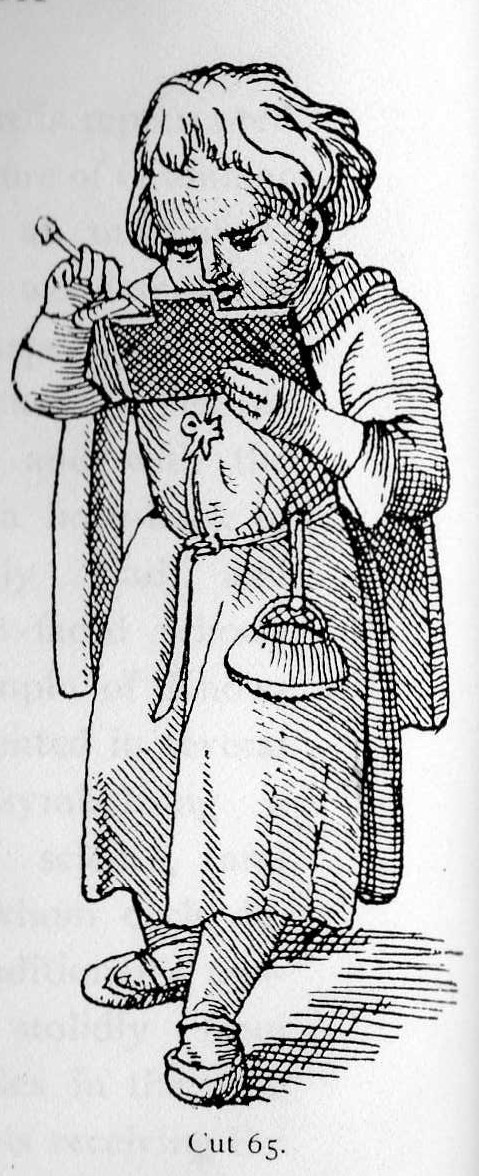
A child studying his letters on a hornbook, Jost Amman, Kunstbuch, Frankfurt, 1580,
 (Tuer, History of the Hornbook, 1896)
Francis Seager describes the 16th century schoolboy in a popular school text, The Schoole of Vertue and book of good nourture for children and youth to learne theyr dutie by, 1557.  Shakespeare was probably attending Stratford-upon-Avon grammar school about this time, and might have had to learn it by heart:
  '...thy satchel and thy books take,
and to the school hast see thou make.
But ere thou go with thyself forethink
That thou take with thee pen, paper and ink,
These things thus had, Take straight thy way
Unto the school without any stay...
Thy master there being Salute with all reverence
Declaring thereby thy duty and ovedience
Unto thy place appointed for to sit
Straight go thou to and thy satchell unknit,
Thy books take out, thy lesson then learn...
Apply thy mind to learning and science
For learning in need will be thy defence...'
   (Francis Seager, Schoole of Vertue...EETS Vol. 32 op cit)

John Brinsley (1581-1624) has left an example of a typical grammar school timetable in his Ludus Literarius or, The Grammar Schoole, 1612. The scholar's day began at six or seven am, an hour later in winter.  although Brinsley says, sympathetically that 'it is hard for the little children to rise so early' early rising was generally the rule for labourer and prince.

Lily's Latin Grammar, the standard Latin grammar book from 1540.

A 1687 edition of William Lily's Latin Grammar

Students would have studied their Latin from William Lily's Latin Grammar, in use right up to the 19th century, and first authorised as the standard Latin text book by Henry VIII.

In many schools day scholars and boarders were both taken and some boys would be lodged in the town.  At 9am, according to Brinsley's timetable, they went home to breakfast.  He allows them fifteen minutes.  Lessons, according to Brinsley, continued after breakfast to eleven, when there was a long break t one o'colck followed by two further periods of lessons with a fifteen minute break between them, finishing with a Bible reading and psalms around five thirty.  Bedtime was around nine.  This timetable was followed at Westminster School  Philip Henry, who was there from 1643, has described the pupils' habit of studying through the night, two or more sitting up till eleven or twelve, then waking a second group and so on through the night. (Diary and letters of Philip Henry, 1631-1696 ed Matthew Henry Lee, 1882)

It was common until the 19th century for several forms to be taught in the same room.  The original schoolroom at Rugby can still be seen, and in it each class would have taken a corner.  Charles Hoole in his book Scholastick discipline, 1659, talks of six or seven forms using one room, and suggested the use of folding doors to reduce the noise which must have been terrible when oral repetition was still a common teaching method.  If the pupils were well disciplined, however, noise does not seem to have been a problem. Cordier, comparing the school in Geneva with small country schools, says, 'There is more silence in our school of six hundred than of forty, yea thirty in those pesty schools' (Cordier, op.cit)
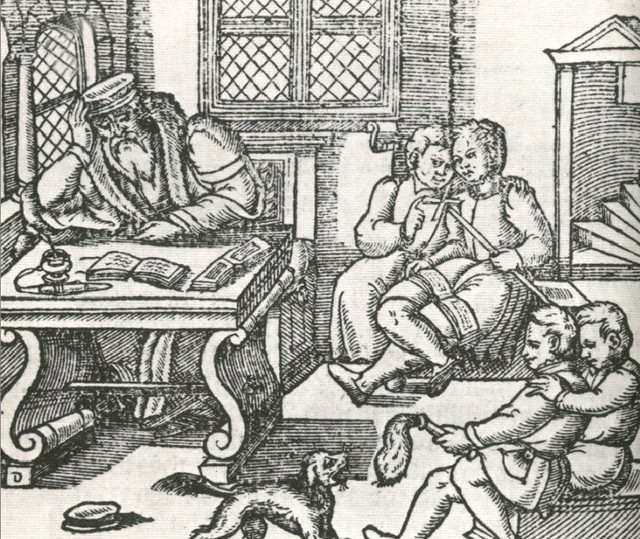
Contemporary woodcuts often show the teacher sitting raised up above the class in a kind of pulpit, with the scholars on what must have been extremely hard wooden benches facing him, no desks.  Right through the 18th century Eton scholars still used their hard top hats, resting on their knees, as writing tables.

Udalricus Ebrardi, Modus Latinus, Nuremberg 1500, showing the tutor and the class.
Note the birch twigs in the tutor's hand (from Percy Muir, Early Children's Books and their Illustration, 1975)

Many of the collections of colloquies mention gambling, with nuts among the small boys, but also with cards and dice, especially at Christmas.  According to the colloquies from Magdalen School, Oxford, 'They do wysely that send no Children to the Universite but they put them under Creansers (censors) to have the rule
 of them and of their money, for yf they wer not so ordeuynede, they sholde waste all their money att dyss and Cardys in Cristmas tyme.'
   (Magdalen School colloquies, op.cit)

In one of Vives' dialogues a scholar is tempted to play truant with the cobbler's son to play dice, while smaller boys propose:  '"Let us play at nuts, at throwing them into holes."
Scipio: "Nut-shells are good for making little houses to put ants into."'
    (Tudor schoolboy life.  The dialogues of Juan Luis Vives.  Translated...by Foster Watson, 1908)

The boys were often allowed to keep pets at school.  John Evelyn (1620-1706) mentions the pets' corner in the well known Jesuit school at Antwerp which he visited, and was much impressed by, in 1641.  A boy at Magdalen School, Oxford, complained in a colloquy   '...thei say that I kepe a dawe in my chamber, but iwys thei lye falsly upon me for it is but a pore Conye.  'Unfortunately he does not explain why rabbits were permitted but not jackdaws.

A typical Latin class (National Education Network)
Food, of perennial interest to school children, forms the subject of several colloquies.  The meals at Peter Erondell's school do not sound too bad:
'Pisan:"Our breakfast in the morning is, a little peice of bread made of meale not bulted, but with all the bran in it, and a little butter, or some fruits...To dinner, we have herbes, or every one a messe of porridge.  Sometimes turneppes, coleworts, wheate and barly in porridge, a kind of delicate meate made of fine wheate flower, and eggs.  Upon fishe-dayes, fleeted milke, in deepe poengers...with some bread put in it.  Some fresh fische, if in Fish Streate it can be had at a reasonable price.  If not, salt fishe, well wattered.  After, pease, or fitches, or beanes, or lupins (sic)...Some drinke small biere, and a few, but seldome, drink winne, well alaqyed with water.  Our drinking at after none is, a litle bread, and almonds, drie figges, or reasens.  Or if it be Sommer tiem, pears, or apples, cheries, or prunes.  After, whenb we go to the farme, for plesure, then we eate, either new milke, or curded, frech cheese, creame, lupins alayed...The first dish of thge supper is a salat cut small with salt upon it, and moistened with oile of olives...and with vinaiger...And mutton sodde in a large platter, with dry prunes, or small rootes, or chopped herbes.  Sometimes a very good gallimafrie, now and then a minced meat..a little roset-meate, specually veale, and sometime kidde.  Upon fasting dayes, we have egges rosted, fired, or poached...or made ufter the fashion of a pannecake...Thereto is added sometimes a little fische, and after the cheese come nuttes.'
 (Erondell, op.cit)
Another Latin text book., 1673(Yale University)
At the school in Geneva the pupils came and went in what now seems a very casual fashion, drifting back after the school holidays in dribs and drabs, going off to help with the grape harvest or to family occasions, making excuses to visit their doting mothers, who aided and abetted them and defended them from the consequences.  Cordier's colloquies include an account of a boy who tries to use his lice as an excuse to go home:
'Master "Have you any lice?"
 Caius" I, and a great many indeed."
Master "Why do you not tell my wife so much?"
Caius "We durst not."
Master "As though indeed shee was so hard to be spoken to.  She hath a maid chiefly for that purpose, to see you be all kept cleanly...ye are glad ye have an occasion offered you to go and see your mother."'
 (Mathurin Cordier, op.cit)

This was, of course, the school which many Puritans attended in exile. Cordier wrote his colloquies for their use to ensure that their exercises had the correct religious stance. In Geneva the boys prayed together several times during the day and, in addition, according to Puritan practise, 'the Master doth oft admonish us, that every one go aside sometimes some whither into a private place and pray for himself.'
  (Cordier, colloquies, op.cit)
They were also encouraged to 'admonish' the local peasants and remind them of their religious duties.  The peasants did not always take this well: 'There were some that threatened to beat me when I admonished them very kindly.'
  (Cordier, colloquies, op.cit)


nikyrathbone@blogspot.com
childhoodblog@gmail.com