Showing posts with label boy's education. Show all posts

Saturday, 19 November 2016

Parenting gets more relaxed: the Restoration and the Georgians

'Ann desires her love and thanks you for the little wax doll, which, I am sorry to say she soon made share the like fate of the King and Queen of France.'
(Geraldine Mozeley, Letters to Jane from Jamaica, 1788-1796)

In the late 17th century, after the Restoration in 1660, childhood began to be seen not only as preparation for adult life but also time to enjoy.  In Britain it is possible that the overturn of the political order in the Civil War (1642-51) also shook up the social order allowing new concepts to emerge. Lord Clarendon (1609-1674) attributed the change to many families going abroad during the troubles, some to France, having their children educated at French academies, exposed to French fashions, cookery, Catholicism, and manners.  'Children have lost reverence for their parents; parents have neither authority nor any sense of responsibility for their children...' he lamented
(The life of Edward, Earl of Clarendon...written by himself, Oxford edition, 1759 Edward Hyde was chief minister to Charles II)

Charles II dancing at the Hague, c.16670. Gonzalez Coques,
National Maritime Museum
Since the French aristocracy lived by rules still more formal than those of the English court, Lord Clarendon's views are possibly coloured by prejudice.  However it is possible that British exiles were also affected by contact with the far more informal small courts of the Netherlands and Germany, and with the households of the Dutch merchant middle classes where, wealthy though they were, rigid formal manners had never been the fashion.  The difference in attitude between the Dutch and British before the Civil War can easily be seen by comparing the many delightfully informal paintings of Dutch and Flemish interiors with British 17th century equivalents.  Perhaps the charm of that way of life was not lost on the British exiles.

Like Lord Clarendon, Roger North (1651-1734) deplored Restoration laxity and approvingly described his own mother's strictness in his memoirs:
'We had, as I say'd, stubborn spirits, and which was more grievous, (she) would force us to leave crying and condiscend to the abject pitch of thanking the Good Rail, which, she say'd, was to break our spirits, which it did effectively.'
(Autobiography of the Hon. Roger North, ed. A. Jessopp, 1887)

John Aubrey's well known comparison of family life before and after the Restoration was written about 1660:
'...In those days fathers were not acquainted with their children...for whereas one's child should be one's nearest Friend, and the time of growing-up should be most indulged, they were as severe to their children as their schoolmaster; and their Schoolmasters as masters of the House of Correction.  The child perfectly loathed the sight of his parents as the slave his Torturer.  Gentlemen of 30 and 40 years old, fitt for any employment in the commonwealth, were to stand like great mutes and fools, bare headed before their Parents; and the Daughters (grown women) were to stand at the Cupboards side during the whole time of the proud mothers visitt, unless (as the fashion was) 'was desired there leave (forsooth) should be given them to kneele upon cushions...'
(John Aubrey, Brief lives, ed. from the original manuscripts...ed. Oliver Dick, 1949 edition)
Although Aubrey condemned any form of indulgence, he felt that the selfishness and bad habits caused by over-indulgence was preferable to breaking their spirits with over-strictness

John Locke in his very influential Thoughts on Education,  upholds strict discipline, but the changing attitude to relationships between parents and children is evident in this passage:
'Would you have your Son obedient to you when past a Child; be sure to establish the Authority of a Father as soon as he is capable of Submission, and can understand in whose Power he is...as he approaches more to a Man, admit him nearer to your Familiarity; so shall you have him your obedient Subject (as is fit) whilst he is a Child, and your affectionate Friend when he is a Man.'
(John Locke, Some thoughts concerning education, 1693)
Title page of the first edition (Wikipedia)
However, relationships through the 18th century remained frequently quite formal by later 19th century standards.  The well-know writer Mrs. Sherwood, born in 1775, never sat down in her mother's presence, (The life of Mrs Sherwood,  1857)
The title page is from Mrs. Sherwood's History of the Sherwood Family, one of her best known improving stories for children.  It includes the famous account of Mr. Fairchild taking his children to see the dead body of a man, a murderer, hanging on a gibbet till it should rot away, as a lesson on what can happen to disobedient children who grow up to be wicked, passionate people who do wrong to others and break the law.

History of the Fairchild Family,
(Wikipedia)
The novelist Elizabeth Gaskell, writing in the mid-19th century, was struck by an old Shropshire lady's account of her childhood which interestingly resembles the quotation from John Aubrey.  She wrote it up for Sartain's Union Magazine, 1849 as The Last Generation in England, and later re-used the material in Cranford:
'Although an only child she had never sat down in her parents' presence without leave until she was married; and spoke with infinite disgust of the modern familiarity with which children treated their parents.
' "In my days," said she, "when we wrote to our fathers and mothers we began 'Honoured Sir', or 'Honoured Madam', none of your 'Dear Mamas', or 'Dear Papas' would have been permitted.'' 'Elizabeth Gaskell, Cranford, OUP 1972 Appendix)

A few children's letters which have been preserved from the 18th century show that not all families were so strict.  Lord Femanagh's eldest son John wrote to him from school in 1722:
'Dear Papa, I desire you to send for me home on Wednesday night, for to be at home on Thursday for to see the Duke of Marlborough buried.'   and: 'Dear Papa, George brought me some Gingerbread which you were so kind as to send me, as also a couple of Handkerchiefs.
(Verney letters, ed. Lady Verney, 1930, Vol. 2)
John's cousin Betty, aged nine, writes more formally: 'Honoured Sir, I was mightily pleased with your kind letter...My Mama desires if it had not beeen for me to a been in the Contrey before now, all well there, my Grandfather was so kind as to give me a guinie (guinea)...'She had been taken to London to be touched for the King's Evil by Queen Anne.(Verney letters, Vol. 1)

On the other hand, many autobiographical accounts show that although relationships between children and their parents were now often fairly informal, parents were still generally extremely strict:
'We were exceedingly fond of our Father.  t the same time his word was Law.  It never entered our minds, I believe, to disobey him, and I am reputed to have been in the habit of informing visitors that papa required implicit obedience.'  (Augustus Hare, The Gurneys of Earlham, 1895, Vol. 2)  This is an extract from Anna Gurney's reminiscences of her father, John Joseph Gurney, around 1824, and strict obedience was probably more commonly the rule in religious middle class families where, however, it was generally combined with loving concern.

Lord Shaftesbury(1801-1885) on the other hand, scarcely saw his parents when a boy, and said of them:'I and my sisters...were brought up with great severity, moral and physical, in respect of both mind and body, the opinion of our parents being that, to render a child obedient, it should be in constant fear of its father and mother.'
(Edwin Hodder, The life and work of the Seventh Earl of Shaftesbury, 1886, Vol. 1)

The increasing informality of family relationships from the Restoration to the early 19th century is shown not only by children's letters and accounts of their parents, but also in relatives' accounts of their children.  The change is evident in the long series of Verney letters, and is even more striking if these are compared with the extremely formal tone of the15th century Paston letters.  In these and the early Verney letters the children are scarcely mentioned, but by the mid 17th century their affairs are beginning to occupy a considerable amount of space.  Ralph Verney's great grandmother, Lady Denton, who was extremely severe with her own daughters, interceded  at length for her grandson in 1632:
'I heare he is disliked, he is so strange (shy) Sonn, you did see he was not soe, nor is not soe, to any where he is a quanted (acquainted), andhe must be woone with fair menes.  Let me begge of you and his mother that nobody whip him but Mr. Parrye, yf you doe goe a violent waye with him, you will be the first that will rue it, for i veryly beleve he will reserve ingery by it.' ((Verney letters op.cit, Vol. 2)

Another grandmother, Lady Anne North, whose severity to her own children was described by her son (see above) sent her son this particularly charming account of the ceremony of putting little Frank into his first long trousers, aged about eight:
'You cannot beleeve the great concerne that was in the whole family here last Wednesday, it being the day that the taylor was to help to dress little Frank in his breeches...Never had any bride that was to be drest upon her weding night more hands about her, some the legs and some the armes, the Taylor butt'ning and others putting on the sword, and so many lookers on that had I not a finger amongst them I could not have seen him.....But this was not all, for there were great contrivings while he was dressing who should have the first salute (kiss), but he sayd if old Land (his nurse?) had been here she should, but he gave it to me to quiett them all.  They are very fitt, everything, and he looks taler and prettyer than in his coats.  Little Charles rejoyced as much as he did, for he jumpt all the while about him...PS When he was drest he asked Buckle whether muffs were out of fashion because they had not sent him one.'
(Roger North, op.cit. Appendix 1, letters from Anne, Lady North, 10 Oct. 1679)

Among all the alarms and disorders of the Civil War Sir John Oglander, who had been called to London and put under open arrest still wrote home in 1643 '...I play you write me word whether my letters be broken up, and whether you received little Jack's coral...' (Corals were often used for teething)
(Cecil Aspinall-Oglander, Nunwell symphony, 1945)

Parents from the mid 17th century on seem to be able to express far more freely their grief at losing children, which is indication that it has become socially more acceptable to express affection freely and openly.  Although it has often been said that parents in earlier times did not care deeply for their children, because their feelings were rarely publicly expressed, it is more probable that they were acting according to the conventions of an extremely formal society.  John Evelyn's obituary for his five year old son Richard is probably the best known expression of this new freedom:
'...died my dear son Richard to our inexpressible grief and affliction; five years and three days old only but at that tender age a prodigy for wit and understanding; for beauty of body a very angel; for endowment of mind of incredible and rare hopes....(Diary of John Evelyn, Vol. 1, 1658. Edited by W. Bray, 1879)

The Rev. Ralph Josselin wrote in the 1640s, pathetically balancing human grief with correct religious feelings: 'My little sonne in all peoples eyes is a dying child, Lord thy will be done, thou art better to mee than sonnes and daughters, though I value them above gold and jewells.' (Diary of the Rev. Ralph Josselin, 1616-1683, ed. E. Hockliffe, Camden Soc. 3rd series, no. 15 1908)

Another diary entry which shows a parent trying to moderate his feelings in view of the immensely high infant mortality rates is the Rev. Philip Henry's.  While expressing his unbounded delight at the birth of his wife's first child, he writes apprehensively: 'I am bid to expect to see him often at Death's door and must moderate my love for him lest overloving end in overgrieving.'  Five years later it did: 'At sunsett this day hee dy'd our first born...a forward child, manly, loving, patient under correction, oh that I could now bee so under the correction of my heavenly father...'
( Diaries and letters of Philip Henry MA, 1631-1696 ed. Matthew Leu. 1882)

In the 18th century Verney letters the children are frequently referred to by affectionate epithets such as 'Our young Flock' and 'Young Hopeful branches.'  Detailed accounts of their health and doings were constantly passed between members of the family:
'All the three pretty children have had bad coughs that make them look thin.', 'My little girl is very brisk and well, but goes not perfectly Alone.'  'Your Godson is grown a brisk boy...he is the life of this house...he can say most of his Catechise and his prayers, and is so far the Christian you engaged he should be.'
(Verney letters of the 18th century, Vol. 1 op.cit)

Such accounts in family letters are not at all uncommon from the later half of the 17th century on, and give  tantalising glimpses of family life nearly three hundred years ago:
'Charles (aged 3) sed att diner he would call for a glas of Claret as Papa did; and not drink water.'
(Elizabeth Hamilton, The Mordaunts, an eighteenth century family, 1965, based on a collection of family letters and documents dating from end of the 17th century to the 1820s.)

'Pray desire Cousen Peg to buy me a pair of leading strings for Jak, ther is stuf made on purpose that is very strong for he is so heavy I dare not venture him with a comon ribin.'
(Verney letters of the 18th century op. cit, vol. 2)

'I am sorry your dear Boy has beat out his teeth.  Nature I hope will soon suply that defect; mine did not sleep last night till after midnight for want of his marbles, a new purchase that he is very fond of.'
(Verney letters op.cit. vol. 2)

Niky Rathbone: childhoodblog@gmail.com


Tuesday, 19 January 2016

School life in the 16th and 17th centuries


In the Middle Ages when all schools of any importance were run by the church, the scholars rose according to monastic rule, and this pattern of early rising was carried over into secular boarding schools on the 16th and 17th centuries.   A 15th century book of Latin exercises describes the pain of early rising:

'When I was a childe, from III yere old to X (for now I go upon the XII yere)...I was wont to lye still abedde tyll it was forth dais...My brekefaste was brought to by beedys side as oft as me liste to call therefor...But nowe...sat fyve of the clocke by the monelyght I most go to my book...and yff our master hap to awake us, he bryngeth a rode stede of a candle.'
  ( Mathurin Cordier (1479?-1574), Geneva: Corderii colloquiorum centuria selecta)

Mathurin Cordier, in his colloquies, describes the pupil rising in the morning:
  'I took my Breeches and Stockings, I put on both, I put on my shoes, I tied my Breeches to my Doublet with Points (laces), I tied my Stockings with my Garters upon my legs, I girt myself with my Girdle, I combed my head diligently, I fitted my Cap to my Head, I put on my Gown, then going out of my Chamber I went below.  I made water in the Yard against the wall, I took cold water out of the Bucket, I washed myt hands and face, I rinsed out my Mouth and Teeth, I wiped my Hands and Face with the Towel, in the mean Time the Signal is given to Prayer .'
   (Mathurin Cordier, op. cit)

Title page of Mathurin Cordier, Colloquia 1579 ed.

The colloquies, or conversational exercises, are based on life at the Puritan school set up by Calvin in 1559 in Geneva, where many English exiles lived, They are full of boys running home to fetch their 'beaver' or snacks.  The boys also frequently go into town on errands, visiting the 'Botchers' to have their stockings mended, the 'Barber's' to have a septic bite dressed, to the merchants' stalls to buy books and paper, taking care they 'be not cozened(cheated)'  Pens have to be made out of goose quills, an in one colloquy Calvin himself appears making two for a small pupil.

There is a description of making such quill pens in Hollyband and Erondell's dialogues:
  Master:  "Have you brought your weapons?  Have you brought your pennes and incke-horne?  We write with goose quilles,  Cut off the feathers with a penknife..."
Maurice: "My maister taught me to make my penne softe with spitalle, and rubbing it against the inside of my cote."
   (M. St. Clare Byrne.  The Elizabethan home discovered in two dialogues by Claudius Hollyband and Peter Erondell.  1930.  op. cit)

In Erondell and Hollyband's school the older children learened Latin in the mornings and French in the afternoon, by Francis Vives' and Roger Ascham's new method of double translation:'Children, turne your lessons out of French into English, and then out of English into French' (Hollyband and Erondell, op.cit)

The children are lively and naughty, providing an entertaining French vocabulary exercise:
 'Nicholas: "Maister, John Nothing-worth hath sworne by God,
played by the way, solde his poyntes, chaunged his booke, stollen a knife, lied twice, lost his cappe."
Master: "Is it true? Come hether companion, untrusse upi: untie you, put your hosen down, dispatche."
John N. "Nicholas doth mocke me, plucketh me by the heare, by the eares; hath stroken me with his fist upon the head; hath stroken me, hath made me bleede."
Master: "You shall be beaten both..."
    Erondell and Hollyband, op.cit)

The children at the school in Geneva were naughty too, and indulged in midnight feasts:
'"Woe is me! I am almost out of my wits, I am smitten with such fear"
"What is the matter I say?"
"The Master hath caught us"
"In what? In theft?"
"...Private junketing"
"An hainous crime indeed."'

They also pawned each other's belongings:
'A:"Lend me a Virgil for two days...."
B"Truely I cannot"
A"Why not?"
B"Because Garard, who borrowed it lately of me, hath put it in Pawn.'
   (Mathurin Cordier, op.cit)
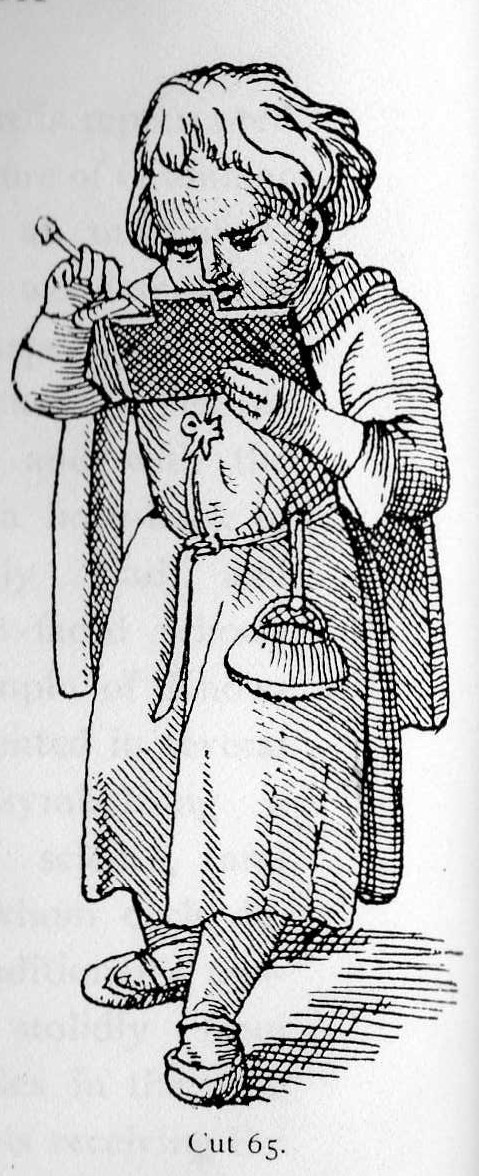
A child studying his letters on a hornbook, Jost Amman, Kunstbuch, Frankfurt, 1580,
 (Tuer, History of the Hornbook, 1896)
Francis Seager describes the 16th century schoolboy in a popular school text, The Schoole of Vertue and book of good nourture for children and youth to learne theyr dutie by, 1557.  Shakespeare was probably attending Stratford-upon-Avon grammar school about this time, and might have had to learn it by heart:
  '...thy satchel and thy books take,
and to the school hast see thou make.
But ere thou go with thyself forethink
That thou take with thee pen, paper and ink,
These things thus had, Take straight thy way
Unto the school without any stay...
Thy master there being Salute with all reverence
Declaring thereby thy duty and ovedience
Unto thy place appointed for to sit
Straight go thou to and thy satchell unknit,
Thy books take out, thy lesson then learn...
Apply thy mind to learning and science
For learning in need will be thy defence...'
   (Francis Seager, Schoole of Vertue...EETS Vol. 32 op cit)

John Brinsley (1581-1624) has left an example of a typical grammar school timetable in his Ludus Literarius or, The Grammar Schoole, 1612. The scholar's day began at six or seven am, an hour later in winter.  although Brinsley says, sympathetically that 'it is hard for the little children to rise so early' early rising was generally the rule for labourer and prince.

Lily's Latin Grammar, the standard Latin grammar book from 1540.

A 1687 edition of William Lily's Latin Grammar

Students would have studied their Latin from William Lily's Latin Grammar, in use right up to the 19th century, and first authorised as the standard Latin text book by Henry VIII.

In many schools day scholars and boarders were both taken and some boys would be lodged in the town.  At 9am, according to Brinsley's timetable, they went home to breakfast.  He allows them fifteen minutes.  Lessons, according to Brinsley, continued after breakfast to eleven, when there was a long break t one o'colck followed by two further periods of lessons with a fifteen minute break between them, finishing with a Bible reading and psalms around five thirty.  Bedtime was around nine.  This timetable was followed at Westminster School  Philip Henry, who was there from 1643, has described the pupils' habit of studying through the night, two or more sitting up till eleven or twelve, then waking a second group and so on through the night. (Diary and letters of Philip Henry, 1631-1696 ed Matthew Henry Lee, 1882)

It was common until the 19th century for several forms to be taught in the same room.  The original schoolroom at Rugby can still be seen, and in it each class would have taken a corner.  Charles Hoole in his book Scholastick discipline, 1659, talks of six or seven forms using one room, and suggested the use of folding doors to reduce the noise which must have been terrible when oral repetition was still a common teaching method.  If the pupils were well disciplined, however, noise does not seem to have been a problem. Cordier, comparing the school in Geneva with small country schools, says, 'There is more silence in our school of six hundred than of forty, yea thirty in those pesty schools' (Cordier, op.cit)
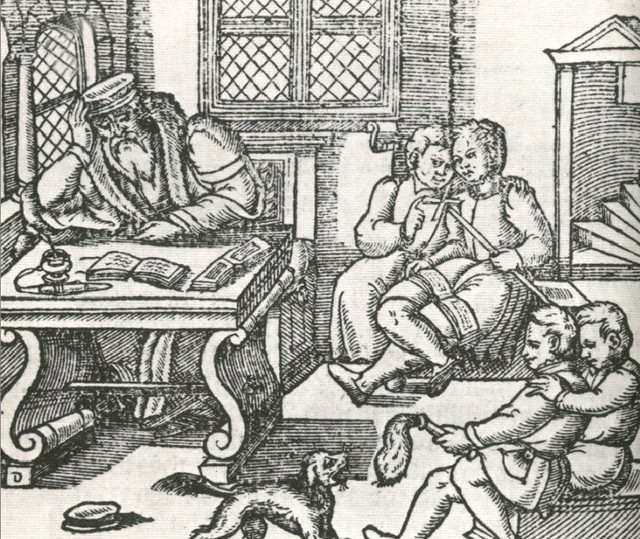
Contemporary woodcuts often show the teacher sitting raised up above the class in a kind of pulpit, with the scholars on what must have been extremely hard wooden benches facing him, no desks.  Right through the 18th century Eton scholars still used their hard top hats, resting on their knees, as writing tables.

Udalricus Ebrardi, Modus Latinus, Nuremberg 1500, showing the tutor and the class.
Note the birch twigs in the tutor's hand (from Percy Muir, Early Children's Books and their Illustration, 1975)

Many of the collections of colloquies mention gambling, with nuts among the small boys, but also with cards and dice, especially at Christmas.  According to the colloquies from Magdalen School, Oxford, 'They do wysely that send no Children to the Universite but they put them under Creansers (censors) to have the rule
 of them and of their money, for yf they wer not so ordeuynede, they sholde waste all their money att dyss and Cardys in Cristmas tyme.'
   (Magdalen School colloquies, op.cit)

In one of Vives' dialogues a scholar is tempted to play truant with the cobbler's son to play dice, while smaller boys propose:  '"Let us play at nuts, at throwing them into holes."
Scipio: "Nut-shells are good for making little houses to put ants into."'
    (Tudor schoolboy life.  The dialogues of Juan Luis Vives.  Translated...by Foster Watson, 1908)

The boys were often allowed to keep pets at school.  John Evelyn (1620-1706) mentions the pets' corner in the well known Jesuit school at Antwerp which he visited, and was much impressed by, in 1641.  A boy at Magdalen School, Oxford, complained in a colloquy   '...thei say that I kepe a dawe in my chamber, but iwys thei lye falsly upon me for it is but a pore Conye.  'Unfortunately he does not explain why rabbits were permitted but not jackdaws.

A typical Latin class (National Education Network)
Food, of perennial interest to school children, forms the subject of several colloquies.  The meals at Peter Erondell's school do not sound too bad:
'Pisan:"Our breakfast in the morning is, a little peice of bread made of meale not bulted, but with all the bran in it, and a little butter, or some fruits...To dinner, we have herbes, or every one a messe of porridge.  Sometimes turneppes, coleworts, wheate and barly in porridge, a kind of delicate meate made of fine wheate flower, and eggs.  Upon fishe-dayes, fleeted milke, in deepe poengers...with some bread put in it.  Some fresh fische, if in Fish Streate it can be had at a reasonable price.  If not, salt fishe, well wattered.  After, pease, or fitches, or beanes, or lupins (sic)...Some drinke small biere, and a few, but seldome, drink winne, well alaqyed with water.  Our drinking at after none is, a litle bread, and almonds, drie figges, or reasens.  Or if it be Sommer tiem, pears, or apples, cheries, or prunes.  After, whenb we go to the farme, for plesure, then we eate, either new milke, or curded, frech cheese, creame, lupins alayed...The first dish of thge supper is a salat cut small with salt upon it, and moistened with oile of olives...and with vinaiger...And mutton sodde in a large platter, with dry prunes, or small rootes, or chopped herbes.  Sometimes a very good gallimafrie, now and then a minced meat..a little roset-meate, specually veale, and sometime kidde.  Upon fasting dayes, we have egges rosted, fired, or poached...or made ufter the fashion of a pannecake...Thereto is added sometimes a little fische, and after the cheese come nuttes.'
 (Erondell, op.cit)
Another Latin text book., 1673(Yale University)
At the school in Geneva the pupils came and went in what now seems a very casual fashion, drifting back after the school holidays in dribs and drabs, going off to help with the grape harvest or to family occasions, making excuses to visit their doting mothers, who aided and abetted them and defended them from the consequences.  Cordier's colloquies include an account of a boy who tries to use his lice as an excuse to go home:
'Master "Have you any lice?"
 Caius" I, and a great many indeed."
Master "Why do you not tell my wife so much?"
Caius "We durst not."
Master "As though indeed shee was so hard to be spoken to.  She hath a maid chiefly for that purpose, to see you be all kept cleanly...ye are glad ye have an occasion offered you to go and see your mother."'
 (Mathurin Cordier, op.cit)

This was, of course, the school which many Puritans attended in exile. Cordier wrote his colloquies for their use to ensure that their exercises had the correct religious stance. In Geneva the boys prayed together several times during the day and, in addition, according to Puritan practise, 'the Master doth oft admonish us, that every one go aside sometimes some whither into a private place and pray for himself.'
  (Cordier, colloquies, op.cit)
They were also encouraged to 'admonish' the local peasants and remind them of their religious duties.  The peasants did not always take this well: 'There were some that threatened to beat me when I admonished them very kindly.'
  (Cordier, colloquies, op.cit)


nikyrathbone@blogspot.com
childhoodblog@gmail.com

Sunday, 10 January 2016

Schooling from Medieval to Tudor times.

'We children beg you, teacher, to show us how to speak Latin correctly...We would rather be flogged for the sake of learning than be ignorant...I am by profession a monk, and every day I sing seven hour services with the brethren and am occupied with reading and writing'
    Aelfric's Colloquy.  A.S. Cook and C.B. Tinker, Select translations from Old English prose, 1908.

This is a glimpse of an Anglo-Saxon schoolboy.  Until the Renaissance, monastic schools would have been the source of scholarly education.  The pattern of boys;' education was more or less the same all over Europe from the late Middle Ages to the Renaissance.  Most schools were run by the Church and varied considerably in size and standards.  A common expression of piety was the founding of chantries, small chapels with a resident priest paid to say prayers for the benefactor.  Such an endowment often included free schooling for poor scholars.  Many chantry priests also supplemented their generally small incomes by taking paying pupils. These small schools would teach basic reading and writing skills to children under the age of seven.  For many this was all the instruction they would receive, or need, to fit them for their working lives.
More advanced education was provided for boys by the grammar schools which cannon law required every cathedral to maintain after 1300 AD.

In addition to the Church schools, many secular schools were endowed both by individuals and by townsmen's guilds.  Some of these schools in England eventually becoming exclusive public schools.  A certain number of places were traditionally reserved for the free education of the poor. Some which continue to offer these scholarships today are  the King Edward VI grammar schools, founded by Edward VI, son of Henry VIII.
Edward VI, (1537-1553) Guillim Scrots, Guys & St.Thomas's Charity.

The grammar school curriculum and teaching methods were, before the invention of printing, largely dictated by lack of books.  There was an enormous emphasis on learning by heart and oral work, and also on the importance of rhetoric, logic and disputations.  This probably led to the students being very articulate. Even after the invention of printing books were scarce and precious and education remained mainly oral.

But the Renaissance had enormous and far-reaching effect on what was taught.  The re-discovery of classical texts led to a widening of the school curriculum to cover many new subjects.
Henry VIII and his first Queen, Catherine of Aragon, played an important part in attracting prominent scholars to England where they encouraged the spread of the new learning.  Catherine brought with her from Sapin Jan Luis Vives who had been her overseer of studies and her mother's educational advisor.  His friend Erasmus also worked in England for a time and maintained a correspondence with scholars here, and Sir Thomas More was a third scholar of international reputation.  More's  'best beloved children'  both girls and boys received an upbringing which embodied all that was best in the spirit of the Renaissance.  Their charming letters reveal that they studied not only Latin and Greek but philosophy, astronomy, physic, arithmetic, logic, rhetoric and music.
 
They formed part of the close-knit influential group of Renaissance scholars centred on the court of Henry VIII and encouraging the spread of Renaissance thought and the widening of the curriculum to include many new subjects.  They were, of course, all Catholic, and the King's divorce effectively broke up the group, sending Vives overseas again and Sir Thomas More to his death.  Other scholars chose to follow their king or the returning Puritans rather than the {ope, and after the English Reformation maintained the development of the new scholastic tratition.  Prominent members of this second generation of scholare were Roger Ascham, tutor to Princess Elizabeth, Henry Cheke and Richard Mulcaster.  They were all educated at Cambridge which had become noted for its scholars' puritan sympathies.


 Sir Humphrey Gilbert proposed the following scheme for the education of Queen Elizabeth's wards, mostly the sons of noblemen:
'Grammar, Latin and Greek, Hebrew, logic and rhetoric, moral philosophy, natural philosophy, arithmetic, geometry, riding, arms, geography, astronomy, the principles of navigation, science, modern languages, French, Spanish and Italian, dancing, music and heraldry.'
    Lansdowne MS 98, EETS extra series vol. 8 ed. F.J. Furnivall, 1869

In spite of the enormous widening of the curriculum Latin continued to be considered the most important subject studied.  The chief purpose of a classical education was the forming of character through the Classical authors, an idea which remained current right up to the 20th century.  So Dean Colet gave his reason for founding St. Paul's School in 1518 as:
  'by this school specially to increase knowledge and worshiping of God and our Lord Christ Jesus and good Christian life and manners in the children.
  F.  Watson The English grammar schools to 1660.  1968.

There were strong reasons for boys to study Latin. It was the common language of Europe, the language of politics, the Church, and the professions.  Some schools made the upper forms talk Latin at all times, the regulations for Harrow, written in 1580, stated that :
'None above the first form shall speak English in the school or when they are together at play'
   F. Watson op. cit.

As the colloquies of Magdalen School, Oxford, put it:
  'Here we may drynke of the pure well of latyne tongue and eloquence, which is nothynge fayrer, o gracious children that wetith ther lypps therin.'
    British Library MS 249 Arundel Collection. 
    Quoted in W. Nelson, ed. A fifteenth century school book, 1956

There was considerable controversy over the use of beating.  Although individual teachers had, from time to time, condemned the universal practise of beating children who could not learn their lessons, beating was pretty universal. However, the rediscovery of the Institute Oratoria of Quintillian in 1416 was very influential with Renaissance educationalists. This enlightened Roman (c.95CE) believed in the importance of the moral example of the teacher and the use of praise and reproof rather than floggings. These ideas were exploited by Erasmus:
   'Pupil: "The entire company of your pupils beg you to let them play."
   Master:  That's all you do even without permission."
  Pupil:'Your wisdom is aware that wits are stimulated by moderate play, as you have taught us from Quintillian."'
    Colloquies of Erasmus (original in Latin) translated by C.R. Thompson. U. Chicago Press, 1965


Erasmus, Hans Holbein the Younger,.  National Trust

In Europe the Jesuit Catholic schools also used the ideas of Quintillian, and were the first to systematically use competition.  Boys in lower forms were arranged as rivals, in pairs, while each class was divided into two camps, Rome and Carthage, to compete against each other, see the influence of Roman history.  Religion was no barrier to good teaching methods, and th ideas of the Jesuites were adopted by Protestant educators.  The Puritan John Brinsley took the system further, suggesting yearly examinations and an elaborate system of punishments which depended on the loss of place in the form, loss of privileges and use of tasks and detentions. (John Brinsley, Ludus Literarius or The Grammar Schoole, 1627, ed. E.T. Campagnac, Liverpool U.P. 1917, )

An enlightened humanist who had considerable influence on teaching methods in England was Roger Ascham, the Princess Elizabeth's tutor, a Puritan, appointed by her father Henry VIII who took great interest in education and the new Renaissance learning. Ascham's book on educational theory, The Scholemaster, 1570, is full of genuine understanding and love of children.  To judge from the performance of his royal charge, Ascham had a natural gift for teaching, and like all the best teachers he understood that not all children were suited to a classical education, and that they should study according to their abilities: 'Children who are quiet, steady, but slow to learn are not sent to school or driven to hate learning by beating.  Such a child, if he later becomes a student of the common law, or page in the court, or servingman, or bound apprentice to a merchant or to some handicraft, he proveth in the end, wiser, happier, and many times honester too, than many of these quick wits do by their learning.'

The Scholemaster was inspired by Sir William Cecil's reporting to Ascham that 'divers scholars of Eton be run away from the school for fear of beating'
   Ascham, The Scholmaster, 1570, ed. Rev. Giles, 1867

 Theme writing on a moral or political subject and composing Latin verse were methods of teaching which became popular with the English Puritans.  This led many scholars to reading English poetry which they would probably not have read otherwise, since scholars used English models and practised in English before attempting Latin.

Two children, artist unknown, National Museum of Wales.

All Protestants agreed, and differed from their Catholic predecessors, in making the Bible the centre of their religious teaching.  A direct result of the Reformation in England under Herny VIII was the imposition of a government approved English primer or prayerbook in place of the Catholic Latin prayers.  A standard English Bible was also introduced.  For Protestants religious instruction in the vernacular was an integral part of their doctrine and teachers placed greater importance on reading and writing English 'now that we are returned home to our English ABC as most natural to our soul and most proper to our faith.'
   Richard Mulcaster, Positions, 1581, quoted on F. Watson, op.cit

Further injunctions in the reign of Elizabeth I concerning the duty of parents to instruct and catechise their children according to the Church of England show that politicians as well as religious leaders recognised the importance of early training.  There was steady pressure to maintain religious conformity among teachers, culminating in their having, like preachers, to take the Oath of Uniformity.

Wen from the schoole ye shall take your waye
Or orderly then go ye, two in aray...
Not runnynge on heapes as a swarme of bees
As at this day Every man it nowe sees
Not usynge but refusynge Such foolyshe toyes
As commonly are used In these dayes of boyes
As hoopynge and halowynge as in hyntynge the foxe
That men it hearynge Deryde them with mockes'
         Seager, The Schoole of Vertue, 1557

nikyrathbone.blogspot.com
childhhoodblog@gmail.com