Showing posts with label Juan Luis Vives. Show all posts

Saturday, 29 October 2016

A bit less education for the Girls: Puritans and Cavaliers

'Those that think one language enough for a woman may forbear the languages, and learn only Experimental Philosophy'

A 17th century book of instruction for girls
By the Restoration educational horizons  for well-bred upper class girls had narrowed down to preparation for marriage and a life of leisure. those learned Tudor ladies were no more.  The prospectus for Mrs Makin's school for young ladies reads:
'Gentlewomen of eight or nine years old that can read well may be instructed in a year or two (according to their Parts) in the Latin and French Tongues...Those that please may learn Limning (a kind of painting), Preserving, Pastry and Cookery.  Those that will allow longer time may attain some general knowledge in Astronomy, Geography, but especially in Arithmetick and History.  Those that think one language enough for a woman may forbear the languages, and learn only Experimental Philosophy.' (Mrs. Makin's school prospectus, c. 1673, Dorothy Gardiner, English Girlhood at School, 1929)

This is the prototype for the girls' school in the 17th century.  By the time of Charles I the daughters of Royalist families were regularly being sent to such establishments as noble families gradually ceased to maintain large private courts where young girls could be sent to be suitably 'finished'. With the Civil War, the execution of Charles I, and the establishment of the Commonwealth in the mid 17th century all that was swept away by the strict moral code of the Puritans for a time, but such establishments returned to favour, along with a more lax moral attitude, with the Restoration of the Monarchy under Charles II (1660)

In these schools for young ladies great emphasis was placed on manners and deportment.  Hannah Woolley,  in her advice to 'The Female Younger Sort' takes the line familiar from the books of courtesy:
'...be courteous and mannerly to all who speak with you...When you come to School salute your Mistress in a reverent manner and be sure to mind what she injoyns you to do or observe...Having done this, salute civilly your Schoolfellows...Show not your ill-breeding and want of manners by eating in the school, especially before your Mistress.'
(Hannah Woolley, The Gentlewoman's Companion or a Guide to the Female Sex, 1675, Gardiner op.cit)

Needlework and embroidery formed an important part of the curriculum, although most of it appears to have been not practical but  the kind elegant young ladies might use to occupy themselves.  The subjects advertised have a curious similarity to the occupations of Victorian girls, and show indirectly that well-to-do young ladies were being released from the necessity of running the household, and had time on their hands:  in the past young girls learned cooking, preserving, spinning, weaving, sewing, cleaning.  Mrs. Woolley's prospectus, however, advertises:  'All works wrought with a Needle, all transparent works, Shell-work, Moss-work, also cutting of Prints and adorning Rooms or Cabinets or Stands with them.  All kinds of Beagle-works upon Wyers or otherwise.  All manner of pretty toys for Closets, Rocks made with Shells or in Sweets.  Frames for looking-glasses, Pictures or the like.  Feathers of Crewel for the Corner of Beds.'

Hackney became popular for such schools, because of its healthy situation, just outside London.  Pepys went on an excursion there to see them on 20th April 1667:
'That which I went chiefly to see was the young ladies of the schools whereof there is great store, very pretty' (Pepys Diary 20 April 1667)
Many condemned these schools as worldly and kept their daughters at home employing governesses and tutors.  Aubrey in his Miscellanies calls the finishing schools 'places where young maids learn pride and wantonness' (John Aubrey, Miscellanies upon various subjects, 1626)
and Thomas D'Urfey's popular and scurrilous play Love for Money; or, The boarding school, 1691, was a severe blow to their popularity.

The daughters of devout Puritans were not to be found in such dubious establishments.  They were usually educated at home, frequently by their parents, generally along traditional lines, emphasising their domestic role.  Anthony Walker, a Puritan, but writing after the Restoration of the Monarchy says of his daughters' upbringing:
'her (his wife's) first Care was, to keep their Minds uncorrupted by Vanity or Pride, therefore kept them at home, not to save Charges, but avoid Inconveniences.'
(Anthony Walker, The Holy Life of Mrs. E. Walker, 1690)

Puritan parents would have been as one with the influential Tudor Catholic Juan Vives who had been tutor to the Princes Mary, daughter of Henry VIII, in emphasising  domesticity, piety and seclusion in the education of girls, for although Vives did believe in a wider curriculum for girls than most Puritans would accept, he did not mean  it to be at the expense of their chief role: 'Let her both learn her book and besides that to handle wool and flax (Vives, Instruction of a Christian Woman c.1529) This is a sentiment any Puritan would have echoed, or any ancient Greek or Roman for that matter.

The education of the Puritan Walker girls  included some surprisingly liberal, even frivolous subjects, which would not have been taught in the strictest Puritan households or have been approved of.  In addition to housewifery taught by their mother, they had a 'French Dancing Master in the House, and had a Writing and Singing-Master come to them.'

The upbringing of Lady Grace Mildmay was more typical of a Puritan girl's education.  Born in 1552, so being educated in the Tudor period, but a good example of a Puritan education, she was brought up by a poor relation governess and her mother, who used to beat her severely, and 'never so much as for lying'.  She studied writing, accounts, the herbal, needlework, and the lute, to which she sang psalms.  She read the Bible every day, and in her notes for the upbringing of her own daughter says, 'it is not possible for parents to be good or to have any virtues in them who seek not to make their children good.' and 'It is a matter of great importance to bring up children unto God, and to cause them to forsake the vanities and follies of this short and momentary lyfe.'. (Diary of Lady Grace Mildmay,  quoted in Quarterly Review, vol. 215, 1911)

Nor was religion neglected in non-Puritan households.  Lady Anne Halkett,  born in 1622, daughter of Thomas Murray, tutor to the future Charles I, says of her childhood: 'for many years together I was seldome or never absent from divine service, at five a'clocke in the morning in the summer, and at sixe a'clocke in the winter, till the usurped power (ie the Puritans who beheaded Charles I and set up the short-lived Commonwealth) putt a restraint to that pubicke worship so long owned and continued in the Church of England, where, I blese God, I had my education.' ( Autobiography of Anne, Lady Halkett, Camden Society Publications, 2nd series, no. 13 1875)
Lady Anne Halkett was educated at home and had masters to teach her and her sister French, to play the lute and virginals and to dance, a gentlewoman to teach them all kinds of needlework.  Incidentally, this is the lady who rescued Charles I's second son James from captivity during the Civil War.  As James II he rewarded her with a pension.

It is interesting that even in Puritan families music still remained an important part of the curriculum, although its role might be suitably adapted.  It was clearly an enormously important part of everyday life, and in girl's schools retained its importance for some time; Purcell;s Dido and Aeneas was originally written for a girls' school to perform to parents and friends, which gives some indication of the general musical standards expected.  In boys' schools, however, music was rapidly driven out by the expansion of the curriculum.

Niky Rathbone: childhoodblog@gmail.com


Tuesday, 19 January 2016

School life in the 16th and 17th centuries


In the Middle Ages when all schools of any importance were run by the church, the scholars rose according to monastic rule, and this pattern of early rising was carried over into secular boarding schools on the 16th and 17th centuries.   A 15th century book of Latin exercises describes the pain of early rising:

'When I was a childe, from III yere old to X (for now I go upon the XII yere)...I was wont to lye still abedde tyll it was forth dais...My brekefaste was brought to by beedys side as oft as me liste to call therefor...But nowe...sat fyve of the clocke by the monelyght I most go to my book...and yff our master hap to awake us, he bryngeth a rode stede of a candle.'
  ( Mathurin Cordier (1479?-1574), Geneva: Corderii colloquiorum centuria selecta)

Mathurin Cordier, in his colloquies, describes the pupil rising in the morning:
  'I took my Breeches and Stockings, I put on both, I put on my shoes, I tied my Breeches to my Doublet with Points (laces), I tied my Stockings with my Garters upon my legs, I girt myself with my Girdle, I combed my head diligently, I fitted my Cap to my Head, I put on my Gown, then going out of my Chamber I went below.  I made water in the Yard against the wall, I took cold water out of the Bucket, I washed myt hands and face, I rinsed out my Mouth and Teeth, I wiped my Hands and Face with the Towel, in the mean Time the Signal is given to Prayer .'
   (Mathurin Cordier, op. cit)

Title page of Mathurin Cordier, Colloquia 1579 ed.

The colloquies, or conversational exercises, are based on life at the Puritan school set up by Calvin in 1559 in Geneva, where many English exiles lived, They are full of boys running home to fetch their 'beaver' or snacks.  The boys also frequently go into town on errands, visiting the 'Botchers' to have their stockings mended, the 'Barber's' to have a septic bite dressed, to the merchants' stalls to buy books and paper, taking care they 'be not cozened(cheated)'  Pens have to be made out of goose quills, an in one colloquy Calvin himself appears making two for a small pupil.

There is a description of making such quill pens in Hollyband and Erondell's dialogues:
  Master:  "Have you brought your weapons?  Have you brought your pennes and incke-horne?  We write with goose quilles,  Cut off the feathers with a penknife..."
Maurice: "My maister taught me to make my penne softe with spitalle, and rubbing it against the inside of my cote."
   (M. St. Clare Byrne.  The Elizabethan home discovered in two dialogues by Claudius Hollyband and Peter Erondell.  1930.  op. cit)

In Erondell and Hollyband's school the older children learened Latin in the mornings and French in the afternoon, by Francis Vives' and Roger Ascham's new method of double translation:'Children, turne your lessons out of French into English, and then out of English into French' (Hollyband and Erondell, op.cit)

The children are lively and naughty, providing an entertaining French vocabulary exercise:
 'Nicholas: "Maister, John Nothing-worth hath sworne by God,
played by the way, solde his poyntes, chaunged his booke, stollen a knife, lied twice, lost his cappe."
Master: "Is it true? Come hether companion, untrusse upi: untie you, put your hosen down, dispatche."
John N. "Nicholas doth mocke me, plucketh me by the heare, by the eares; hath stroken me with his fist upon the head; hath stroken me, hath made me bleede."
Master: "You shall be beaten both..."
    Erondell and Hollyband, op.cit)

The children at the school in Geneva were naughty too, and indulged in midnight feasts:
'"Woe is me! I am almost out of my wits, I am smitten with such fear"
"What is the matter I say?"
"The Master hath caught us"
"In what? In theft?"
"...Private junketing"
"An hainous crime indeed."'

They also pawned each other's belongings:
'A:"Lend me a Virgil for two days...."
B"Truely I cannot"
A"Why not?"
B"Because Garard, who borrowed it lately of me, hath put it in Pawn.'
   (Mathurin Cordier, op.cit)
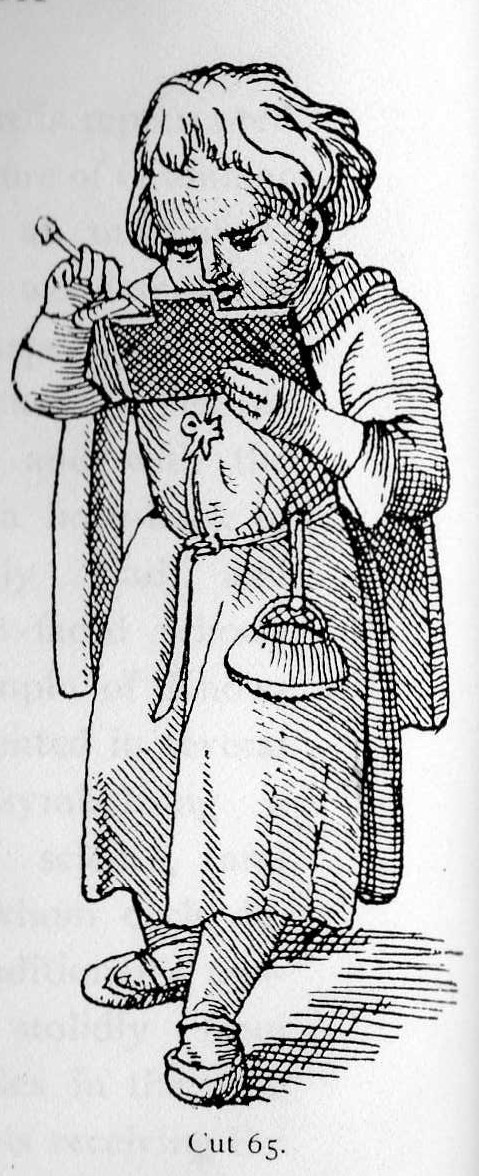
A child studying his letters on a hornbook, Jost Amman, Kunstbuch, Frankfurt, 1580,
 (Tuer, History of the Hornbook, 1896)
Francis Seager describes the 16th century schoolboy in a popular school text, The Schoole of Vertue and book of good nourture for children and youth to learne theyr dutie by, 1557.  Shakespeare was probably attending Stratford-upon-Avon grammar school about this time, and might have had to learn it by heart:
  '...thy satchel and thy books take,
and to the school hast see thou make.
But ere thou go with thyself forethink
That thou take with thee pen, paper and ink,
These things thus had, Take straight thy way
Unto the school without any stay...
Thy master there being Salute with all reverence
Declaring thereby thy duty and ovedience
Unto thy place appointed for to sit
Straight go thou to and thy satchell unknit,
Thy books take out, thy lesson then learn...
Apply thy mind to learning and science
For learning in need will be thy defence...'
   (Francis Seager, Schoole of Vertue...EETS Vol. 32 op cit)

John Brinsley (1581-1624) has left an example of a typical grammar school timetable in his Ludus Literarius or, The Grammar Schoole, 1612. The scholar's day began at six or seven am, an hour later in winter.  although Brinsley says, sympathetically that 'it is hard for the little children to rise so early' early rising was generally the rule for labourer and prince.

Lily's Latin Grammar, the standard Latin grammar book from 1540.

A 1687 edition of William Lily's Latin Grammar

Students would have studied their Latin from William Lily's Latin Grammar, in use right up to the 19th century, and first authorised as the standard Latin text book by Henry VIII.

In many schools day scholars and boarders were both taken and some boys would be lodged in the town.  At 9am, according to Brinsley's timetable, they went home to breakfast.  He allows them fifteen minutes.  Lessons, according to Brinsley, continued after breakfast to eleven, when there was a long break t one o'colck followed by two further periods of lessons with a fifteen minute break between them, finishing with a Bible reading and psalms around five thirty.  Bedtime was around nine.  This timetable was followed at Westminster School  Philip Henry, who was there from 1643, has described the pupils' habit of studying through the night, two or more sitting up till eleven or twelve, then waking a second group and so on through the night. (Diary and letters of Philip Henry, 1631-1696 ed Matthew Henry Lee, 1882)

It was common until the 19th century for several forms to be taught in the same room.  The original schoolroom at Rugby can still be seen, and in it each class would have taken a corner.  Charles Hoole in his book Scholastick discipline, 1659, talks of six or seven forms using one room, and suggested the use of folding doors to reduce the noise which must have been terrible when oral repetition was still a common teaching method.  If the pupils were well disciplined, however, noise does not seem to have been a problem. Cordier, comparing the school in Geneva with small country schools, says, 'There is more silence in our school of six hundred than of forty, yea thirty in those pesty schools' (Cordier, op.cit)
Contemporary woodcuts often show the teacher sitting raised up above the class in a kind of pulpit, with the scholars on what must have been extremely hard wooden benches facing him, no desks.  Right through the 18th century Eton scholars still used their hard top hats, resting on their knees, as writing tables.

Udalricus Ebrardi, Modus Latinus, Nuremberg 1500, showing the tutor and the class.
Note the birch twigs in the tutor's hand (from Percy Muir, Early Children's Books and their Illustration, 1975)

Many of the collections of colloquies mention gambling, with nuts among the small boys, but also with cards and dice, especially at Christmas.  According to the colloquies from Magdalen School, Oxford, 'They do wysely that send no Children to the Universite but they put them under Creansers (censors) to have the rule
 of them and of their money, for yf they wer not so ordeuynede, they sholde waste all their money att dyss and Cardys in Cristmas tyme.'
   (Magdalen School colloquies, op.cit)

In one of Vives' dialogues a scholar is tempted to play truant with the cobbler's son to play dice, while smaller boys propose:  '"Let us play at nuts, at throwing them into holes."
Scipio: "Nut-shells are good for making little houses to put ants into."'
    (Tudor schoolboy life.  The dialogues of Juan Luis Vives.  Translated...by Foster Watson, 1908)

The boys were often allowed to keep pets at school.  John Evelyn (1620-1706) mentions the pets' corner in the well known Jesuit school at Antwerp which he visited, and was much impressed by, in 1641.  A boy at Magdalen School, Oxford, complained in a colloquy   '...thei say that I kepe a dawe in my chamber, but iwys thei lye falsly upon me for it is but a pore Conye.  'Unfortunately he does not explain why rabbits were permitted but not jackdaws.

A typical Latin class (National Education Network)
Food, of perennial interest to school children, forms the subject of several colloquies.  The meals at Peter Erondell's school do not sound too bad:
'Pisan:"Our breakfast in the morning is, a little peice of bread made of meale not bulted, but with all the bran in it, and a little butter, or some fruits...To dinner, we have herbes, or every one a messe of porridge.  Sometimes turneppes, coleworts, wheate and barly in porridge, a kind of delicate meate made of fine wheate flower, and eggs.  Upon fishe-dayes, fleeted milke, in deepe poengers...with some bread put in it.  Some fresh fische, if in Fish Streate it can be had at a reasonable price.  If not, salt fishe, well wattered.  After, pease, or fitches, or beanes, or lupins (sic)...Some drinke small biere, and a few, but seldome, drink winne, well alaqyed with water.  Our drinking at after none is, a litle bread, and almonds, drie figges, or reasens.  Or if it be Sommer tiem, pears, or apples, cheries, or prunes.  After, whenb we go to the farme, for plesure, then we eate, either new milke, or curded, frech cheese, creame, lupins alayed...The first dish of thge supper is a salat cut small with salt upon it, and moistened with oile of olives...and with vinaiger...And mutton sodde in a large platter, with dry prunes, or small rootes, or chopped herbes.  Sometimes a very good gallimafrie, now and then a minced meat..a little roset-meate, specually veale, and sometime kidde.  Upon fasting dayes, we have egges rosted, fired, or poached...or made ufter the fashion of a pannecake...Thereto is added sometimes a little fische, and after the cheese come nuttes.'
 (Erondell, op.cit)
Another Latin text book., 1673(Yale University)
At the school in Geneva the pupils came and went in what now seems a very casual fashion, drifting back after the school holidays in dribs and drabs, going off to help with the grape harvest or to family occasions, making excuses to visit their doting mothers, who aided and abetted them and defended them from the consequences.  Cordier's colloquies include an account of a boy who tries to use his lice as an excuse to go home:
'Master "Have you any lice?"
 Caius" I, and a great many indeed."
Master "Why do you not tell my wife so much?"
Caius "We durst not."
Master "As though indeed shee was so hard to be spoken to.  She hath a maid chiefly for that purpose, to see you be all kept cleanly...ye are glad ye have an occasion offered you to go and see your mother."'
 (Mathurin Cordier, op.cit)

This was, of course, the school which many Puritans attended in exile. Cordier wrote his colloquies for their use to ensure that their exercises had the correct religious stance. In Geneva the boys prayed together several times during the day and, in addition, according to Puritan practise, 'the Master doth oft admonish us, that every one go aside sometimes some whither into a private place and pray for himself.'
  (Cordier, colloquies, op.cit)
They were also encouraged to 'admonish' the local peasants and remind them of their religious duties.  The peasants did not always take this well: 'There were some that threatened to beat me when I admonished them very kindly.'
  (Cordier, colloquies, op.cit)


nikyrathbone@blogspot.com
childhoodblog@gmail.com

Saturday, 16 January 2016

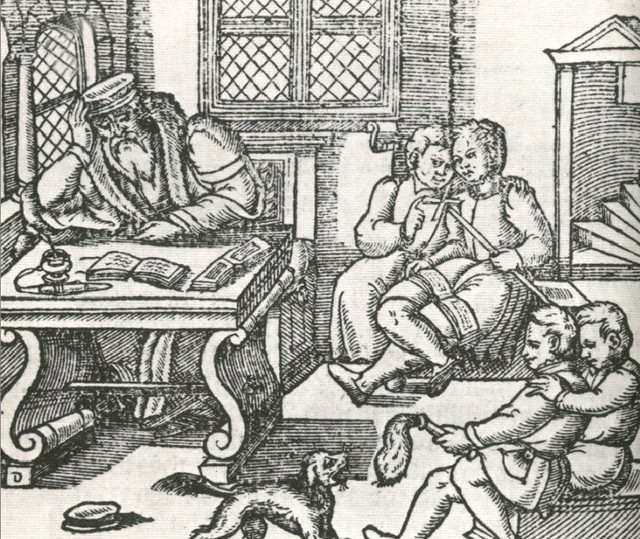
Spare the Rod, Spoil the Child: more on 16 and 17th century schooling

'My master peppered my arse with well good speed
it was worse than a fennel seed (hot)
he would not leave till it did bleed
much sorrow have he for this deed
what availeth it me though I say nay?
The birched schoolboy,c.1500  EETS original series vol. 32 ed. F.J. Furnival, 

Opinions differed on whether children were best sent to schools or kept at home with tutors.  While at school children might benefit from the society and competition of other children, they were also more exposed to bad examples.  Vives believed that boys were better off at school, but only when they were old enough to have formed good habits when, it was assumed, they would be safe from being corrupted.  Daughters, on the other hand, being 'frail things, and of weak discretion ' should rarely be allowed out of the house.  (Foster Watson,  Vives and the Renascence education of women, 1912)  Rabelais believed that children were best educated in a one-to-one relationship with a tutor, and he had considerable influence on French education.  After the restoration of the English monarchy French ideas were brought to England with the returning exiles.

In practise many parents seen to have combined the two systems, as Queen Elizabeth I's astrologer Dr. John Dee did.  In 1587 he 'covenanted with John Basset to teach the children the Latyn tong, and I do give him seven duckats by the quarter.'  His youngest son was then five.  In 1590 the children were at Mr. Lee's school in Mortlake where 'I gave him his house-rent and forty shillings yerely for my three sons and my daughter.'  (For comparison Shylock, in Merchant of Venice lends Antonio three thousand ducats for Bassanio to woo Portia so schooling must have been quite cheap)
  (The private diary of Dr. John Dee ed. J.O. Halliwell.  Camden Soc. ist series no. 19, 1842)
In 1596, however, John Dee engaged a governess for his younger daughters:  'Mary Goodwyn came to my servyce to govern and teach Medina and Margaret.'

Dame school. From Tuer, History of the Hornbook, 1896

If taught at home little children generally learned their first letters at the knee of some neighbour who taught a small group of children to read for a small sum; the traditional 'dame school', which continued to be common right into the 19th century.  William Stukeley, for example, says that:'  About 1690 I lernt the first Rudiments of Letters of Mrs. Collingwood, an old decay'd Gentlewoman at Holbeach who taught all the Children in the Parish.'
     (.Memorials of the Holles Family, 1493-1656, Camden Soc. 3rd series vol. 55, 1937)

Children were generally taught their letters with the hard-wearing hornbook.  These seem to have first appeared in the late 14th century (see Andrew Tuer, The history of the hornbook, 1897)
'Qan a chyld to scole shall set be
A bok hym is brout
Naylyd on a brede of tre,
That men callyt an abece'
   (Tuer, op.cit)
Miss Campion with her hornbook,. Tuer, History of the Hornbook

They were in use until the early 19th century.  Usually they were a rectangular piece of wood with a handle at the bottom on which was pasted a printed sheet of paper.  At the top this had the alphabet, then the numbers one to ten, followed by the Lord's Prayer, in English.  The paper was protected from wet and sticky little fingers by a thin transparent sheet of horn, then often used instead of expensive glass, and fastened down with strips of brass.  The backs were sometimes covered with leather, stamped with the figure of St. George, or carved.  Leather hornbooks are also known, while rich people's children sometimes had expensive and beautiful hornbooks of ivory with the letters painted on, or holders made of silver filigree.
There is a description of children learning to read with a hornbook in The Reading Lesson: a dialogue for children learning to read:
  'Tsake the table of the crosse-row in thy left hand, and festraw wherewith thou shalt touche the letters one by one.  Stand upright.  Hold thy cap under thy arme, attentively how I move my mouth.'
  ( M.St. Clare Byrne, The Elizabethan Home, discovered in two dialogues by Claudius Hollyband and Peter Erondell.  rev. ed. 1930 Hollyband and Erondell were French Huguenot refugees, arriving in England around 1564.)
Hornbooks (Wikipedia)

So after learning their basic letters children might be sent to school.  By the time of the English Civil War, 1642, and from then on into the 18th century, there were many small schools for the education of local children, run by groups of trustees. William Stukely went to one after his dame school, and this was probably common:
  'In 1692 I was put to the Free-School at the Church there, which was founded by the family of the Farmers...my Father being one of the trustees of that Charity.'
   (Stukely, op.cit)

These small schools were normally fee-paying with some free places provided for the poor, subsidised by charity and providing an elementary level of education.  They flourished until most of them were gradually incorporated into a state system in the 19th century.

The alternative was one of the small schools run by local clergymen to supplement their incomes, much as priest had done before the Reformation.  These inevitably varied in quality and probably did not provide as good a basic grounding as a proper school.  Sir John Bramstone remembers the Vicar of Blackmore, Andrew Walmsley, sending the pupils into the fields with their tasks  'to see that his catle trespassed noe bodie.' (Autobiography of Sir John Bramstone, K.B. Camden Soc. 1st series vol. 32)

The vicar was not all that a vicar should be as a moral guardian either: 'he suffered his boyes to rob ponds, and kill...the pidgons of his neighbours...He at first seemed angrie, but the pidgeons were baked and we eate them.'  Sir John contrasted this with the tuition he and his brother later received at Thomas Farnaby's school:' Oh Heuens! Where has thou binn bread?'  asked Farnaby on seeing their first Latin exercise.

Sir John Bramstone also described the Vicar as 'of a temper very unfitt for a schoolmaster, very passionate, and being ouer angrie with any one, he was like a furie to wife, children, seruants, scholars, all the house.'  Sir John's younger brother, having the ill luck to encounter the Vicar in one of his passions, 'he gave 50 blows with the great rod...he sayd to me, 'Your brother hath binn a very naughtie boy, and I was forct to correct him a little'  (Bramstone, op.cit)


The schoolmaster and his pupils, note the birch.  Informatio Puerorum, c.1500
(Percy Muir, Early Children's books and their illustration, 1975)

Another survivor of the clergy-schools was the Rev. Richard Baxter, Puritan divine:
'In the village where I was born there was four readers successively in six years tyme, ignorant men, and two of them immoral in their lives, who were all my schoolmasters...they taught school and tippled on weekdays, and whipped the boys when they were drunk.'
    (Autobiography of Richard Baxter...abridged from the Folio (1696)  ed. J.M. Lloyd, 1925.)

Educational theorists had only limited success in restricting the use of beating in schools.  Even the colloquies of Erasmus describes masters as 'ready and generous as possible with floggings'
  (Colloquies of Erasmus, trans. Craig R. Thompson, 1965)
Some respected authorities such as Vives strongly recommended its use:  'Never have the rod off the boys' back; especially the daughters should be handled without any cherishing'
    (Vives, Instruction of Christian Women, op.cit)

The famous biographer John Aubrey(1626-1697), who was very interested in children's upbringing, disapproved of this, but perhaps it is fortunate that he never had the opportunity to put his own disciplinary methods into practise on children, for he recommended the use of thumb-screws rather than boxing the ears which, he thought, might injure the brain.  (John Aubrey, A Plan of Education, in  John Aubrey's Brief Lives, ed. Oliver Lawson, 1949)

All too many schoolmasters used the rod as an educational aid, or quite indiscrinately Some like Dr. Gill were well known for their 'whipping fitts'  (Aubrey, op.cit)  Whipping schoolmasters and over severe parents gradually come to be mentioned with general disapproval, however.  Sir Robert Burton (1577-1640)criticised over severity on  the Anatomy of Melancholy:  Parents and such as have the tuition of and oversight of children offend many times in that they are too stern, always threatening, chiding, brawling, whipping or striking; by means of which their poor children are so disheartened and cowed that they never after have any courage.' (Robert Burton, The Anatomy of Melancholy, 1st ed. 1621)

so Sir Thomas Raymond (b. c.1610) blamed his father and masters for 'nipping in the bud of a tender masculyne spiritte' by their harsh treatment 'I being not soe quick at repeating without books as my younger brother was...not only harshly used by the pedagugui (teacher) but to my great shame and discouragement, placed in the form belowe my younger brother...It being indeed greate pitty that no better care is taken for choyce of able men to have the care of instructing and educateing of youth.'
    (Autobiography of Thomas Redmond and memoirs of the family of Guise of Elmore, Gloucestershire, ed. G. Davies, Camden Soc. 3rd series, vol. 28)

A schoolboy learning his letters from a hornbook.
  (Tuer, History of the Hornbook, 1896)

Sir Roger North's brother Dudley, although his spirit was not ruined by harsh treatment, nevertheless remembered his master's severity all his adult life.  Although his other brothers got on well at Mr. Stephens' school, 'The master took a great aversion to him, and most brutally abused him; correcting him at all turns, with or without a fault, till he was driven within an ace of despair, and(as I have often heard him declare) making away with himself'
   ( Roger North (1651-1734) Lives of the Right Hon. Francis North, Baron Guildford...The Hon. Dudley North...And the Hon. and Rev. Dr. John North...1st pub. 1744)

However, severe discipline tempered with kindness does not seem to have done more robust children hamr.  Thomas Ellwood was quite unaffected by attempts to disciplin him:
  'I could not easily conform my self to the grave and sover Rules and (as I then thought) severe Orders of the School; but was often playing one waggish Prank or another among my Fellow Schollars, which, subjected me to correction, so that I have come under the Discipline of the Rod twice in a Forenoon.  which yet brake no Bones.'
   Life of Thomas Ellwood, written by his own hand,  1714.

nikyrathbone.blogspot.com
childhoodblog@gmail.com