Tuesday, 14 February 2017

John Newbery: Instruction and Delight in the 18th century

'Giles Gingerbread, he lov'd Cream, Custard and Curds,
And Good Books so well, that he eat up his Words'.
(The Renowned History of Giles Gingerbread, Newbery, 1764

John Newbery was the most influential publisher of children's books in mid to late 18th century.
Catherine Hutton of Birmingham, born in 1756, remembered his little books with delight:
'I read all of Mr. Newbery's gilt books, as they were called...Christmas box, New Year's Gift, Goody Two Shoes & etc...I trembled for Bluebeard's wife when she was so naughty as to open the forbidden closet; and when I came to her kneeling at her husband's feet, he with his uplifted scimitar ready to strike, and sister Anne looking out from the window I could read no more.  I burst into tears, laid down the book, and exclaimed "Mama I never will be married."...it was many years before I dared venture to resume the tale, or know that Bluebeard's wife was saved.'
   (Catherine Hutton, Reminiscences of a gentlewoman of the last century...Letters of Catherine Hutton, ed. C.H. Beale, Birmingham 1891)

 Newbery was not the first to publish amusing yet instructive children's books but he was the first to make them a large enough part of his business for many copies to have survived and so he may be considered the first to make a commercial success of his publishing venture.  By the turn of the century he had been joined by others. One of Newbery's most important rivals was  John Marshall of 4 Aldermary Churchyard.  He published quite a range of work, from flimsy chapbook collections of nursery rhymes to attractive little stories like The Christmas Present by 'Solomon Sobersides'.  He also published 'infant libraries', complete sets of matching miniature books in little wooden bookcases.

Newbery knew well that the way to a child's heart is through its stomach and was a great believer in the reward system:
'As (Tommy Trip) rides through the town, he frequently stops at the doors to know how the little children do within; and if they are good and learn their book? and then leaves an apple, an orange, or a plumb-cake at the door, and away he gallops, again, tantivy, tantivy, tantivy.'
(The Lilliputian Magazine, Newbery, 1752, British Library 1387.9.5)
He also used the edible alphabet with great success in the story of Giles Gingerbread, 'the little boy who lived upon learning' :
'Giles Gingerbread, he lov'd Cream, Custard and Curds,
And Good Books so well, that he eat up his Words'.

The little boy's letters were cut out of gingerbread for him, and he learned them as he ate.
(The Renowned history of Giles Gingerbread, Newbery, 1764, S. Roscoe, John Newbery and his successors, 1973)
Giles Gingerbread. From a later, 1820 ed.pub. J. Kendrew, York,
(Osborn Collection, UCLA)

 Andrew Tuer says in The History of the Hornbook that gingerbread letters and gingerbread hornbooks became popular some time in the 18th century.  He quotes Matthew Prior's  poem Alma, Canto II, from Poems upon several occasions, 1721:
'To Master John the English maid
A Horn-book gives of Ginger-bread;
And that the Child may learn the better,
As he can name, he eats the letter...'
(Andrew Tuer, The History of the Hornbook, 1897 vol. 2)

Since Janeway's Token for Children, 1671,  the emphasis seems to have changed a bit from heavenly to earthly rewards for being a good boy or girl.  Little Goody Two Shoes is recommended as a mentor:

'From a state of rags and care
And having shoes but half a pair
Their fortune and their fame would fix
And gallop in a coach and six'
(The History of Little Goody Two-Shoes, Newbery, 1765)

History of Little Goody Two Shoes, 1768 ed. (Wikipedia)
This still represented the just reward of honesty and hard work, rather than the activities of a Fanny Hill or a Moll Flanders. Newbery's exemplary stories were firm supporters of traditional morality; 'She never told a lie in her life.  No, No!  she knew that was a naughty pau-pau Trick
 (Nurse Truelove's New-Year's Gift, Newbery, c.1770)

'See Virtue here, with Wealth and Glory crown'd
And all the busy Crowd admiring round;
While she to Church with pious Zeal reapirs
To hear the Sermon, and to say her prayers'.
(The history of Miss Polly Friendly, Newbery, Nurse Truelove...c.1770)

'All Boys and Girls, who are not dutiful and obedient to their Parents , never come to any Good, but are, as they ought to be, always neglected and despised.' 
(A Pretty Play-thing for Children of all Denominations, Newbery, c.1759, Roscoe op.cit. p.226))

John Newbery also sold other educational aids, and, good salesman that he was, promoted them through his story books:
 'When he has learnt the Roman letters, you may teach him the Italic letters in the same Manner, and then the Figures; Afterwards it will be proper to give him a Sett of the Squares sold at the Bible and Sun in St. Paul's Churchyard, by playing with which he will soon learn to read.'  
(A Little Lottery Book for Children, containing a new Method of playing them into a Knowledge of the letters, Figures etc.  Newbery c. 1765? Roscoe p, 171) 
The Little Lottery Book was an original reading aid with a picture on one side of the page and a letter on the other; the child learned his letters by sticking a pin through the picture into the letter which corresponded to it.  Few copies survived such rough treatment.  

Newbery's little books were just as popular in America.  There numerous pirated editions were published by Isiah Thomas of Worcester (Mass) the founder of the American Antiquarian Society, and by Mahlon Day of New York.  Isiah Thomas adopted Newbery's use of advertising, changing the wording to fit his own business and slightly Americanising the text:
'Why! he got all the little books by rote that are sold by Mr. Thomas in Worcester, when he was but a very little boy.  Then he never missed church...He is chosen Congressman already and yet he is not puffed up...'
(Alice Morse Earle, Child life in Colonial Days 1899)

Tuesday, 31 January 2017

Little books to amuse and instruct....18th century children's books

'The Child's Plaything
I recommend for Cheating
Children into Learning'
     N. Lovechild, Tommy Thumb's Pretty Song Book, 1744)

Mrs Trimmer credited the development of instructive yet amusing books for children to the educational pioneer and philosopher John Locke.  (Mrs. Trimmer, The Guardian of Education, 1802-6 vol. 1 This was the first journal to review books for children)

Sarah Trimmer, the influential critic of children's literature,
Painted by Henry Howard, 1798
(Wikipedia)
Before the 18th  century there had never been many books designed specifically for children, and those that were tended to be a bit uninviting.  Perhaps the earliest writer to write amusing little stories for children was Sir Roger L'Estrange, who adapted the famous Fables by the Ancient Greek author Aesop(c. 620-564 BCE).  L'Estrange's famous 1692 edition is too large and too splendid to have been intended as a children's book.  He observed in the preface, however:

'...it is beyond Dispute, I suppose, that the Delight and Genius of Children, lies much towards the Hearing, learning, and Telling of Little Stories...we love to be instructed, as well as physick'd with Pleasure'
(Quoted in F.J. Harvey Darton Children's books in England, 1931 p.21)

Cheaper children's editions of his sugared pills, illustrated with crude woodcuts, became one of the books most widely read by children in the first twenty years of the 18th century, although his version of Aesop was eventually largely superseded by Samuel Croxall's, first published in 1722 with an extremely underhand attack on his rival translator in the preface:
'Pensioner to a Popish Prince..the Tool and Hireling of the Popish Faction.'(see Harvey Darton op.cit above)

The Croxall edition was, however, the one to be illustrated with woodcuts by Thomas Bewick around 1774 and is the many-times reprinted version most lucky children would have known.
'It is a maxim in the schools
That Flattery's the food of fools'
(Bewick illustration for Aesop, Aesopica.)
Croxall's edition was published by  John Newbery, to whom Mrs. Trimmer gives the credit for the great increase in the variety of books available for children by the end of the 18th century:
'But at length Mr. Newbery, of famous memory, stepped forth the professed friend of infancy and childhood...and he furnished a great supply of engaging books, by which curiosity was gratified, at the same time that religion, loyalty, and good morals were inculcated. '
(The Guardian of Education vol 1. p.62)

Newbery was active as a children's book publisher from c.1750 but he was not the first though he is the best known 18th century publisher of children's books.  Harvey Darton mentions A little book for little children by T.W., a spelling book dating from between 1702 and 1712, of which only one known copy survives.  It includes the famous rhyme 'A was an Archer and shot at a Frog' and the punctuation puzzle:

                                           'I saw a Peacock with a fiery tail
                                            I saw a blazing star that dropt down hail
                                            I saw a Cloud begirt an Ivy round
                                            I saw a sturdy Oak creep on the Ground...'
                                            (see Harvey Darton op.cit p. 60 and
                                             Thwaite, M.F. From Primer to Pleasure, 1963)

A Little Book for Little Children, 1702,
with a picture of Queen Anne, reigned 1702-14
(British Library
William Ronksley's The Child's Week's work, or,
Page showing 'A was an Archer'
(British Library)
A Little Book, so nicely suited to the Genius and Capacity of a Little Child...that it will infallibly allure and lead him onto a Way of reading, published in 1712 by George Conyers is a similar work, and so is William Jole's The Father's Blessing, also published by Conyers.  This suggests there may have been others published of which not a single copy has survived the rough handling of small owners and the other hazards which threaten the life of small, cheap books.
(see Harvey Darton op.cit p. 62-3)

The publisher Thomas Boreman's miniature books for children also predate the earliest known children's books published by Newbery.  His 'Gigantick histories', less that two inches high, describe the sights of London, and their aim is set out in the preface to Curiosities in the Tower of London, 1741:

                                        'Too rigid precepts often fail,
                                         Where short amusing tales prevail.
                                         That author, doubtless aims aright,
                                         Who joins instruction with delight...!'

One of Thomas Boreman's little books
(Parker collection, Library of Birmingham)

Mrs. Trimmer herself was fond of fairy tales as a child.  She was born in 1741 and remembers 'as the delight of our childish days' Mother Goose's Fairy Tales, Aesop,  Gay's Fables and The Governess, or Little Female Academy by Sarah Fielding, sister of the novelist Henry Fielding, first published in 1749, a narrative containing several linked fairy stories. (Guardian of Education op.cit p.62)
Mrs. Trimmer also mentions reading as a child The Spectator, The Guardian, The Tatler and, 'we are sorry to add', she says, novels.

Mrs. Thwaite in From Primer to Pleasure (1963)  describes The Child's New Plaything, published by Mrs. Mary Cooper at the Sign of the Globe, Paternoster Row.  A copy of the 2nd edition, 1743, has survived.  The first surviving collection of nursery rhymes for children was also published by Mrs. Cooper.
 A single copy of volume two of Tommy Thumb's Pretty Song Book, 1744? is in the British Library.  It is bound in coloured and gilded paper boards of the kind later known as 'Dutch flowered' and printed in red and black on alternate pages, decorated with crude woodcuts.  It includes the well known Lady Bird, Lady Bird fly away home, Oranges and lemons, Hickere, Dickere Dock, and London Bridge is falling down.  On the last page is an advert for The Child's Plaything:

                                                   'The Child's Plaything
                                                    I recommend for Cheating
                                                    Children into Learning'
                                                                    N. Lovechild
                                                                    Sold by M. Cooper
                                                                    Price one shilling
                                                          THE END

Tommy Thumb's Pretty Song Book, 1744?
(British Library)


Friday, 27 January 2017

Children's board games and jigsaws


'Dear Papa...I beg the favour of you...that you will desire my dear Mama to send me a little Tea and Sugar, as also a pair of Battledores & Shuttlecock...'
(Verney letters of the 18th century, Vol. 2)
Board game: Historical pastime or, A new game of the History of England...London, J. Harris 1803.
Hand coloured.  A very popular historical board game reprinted many times.  It is a race game played with dice or a teetotum and counters
(Parker collection, Library of Birmingham)
Dice and bat and ball games are mentioned in documents such as letters from the 16th century on.
For example the bills for little Lord Tavistock and his sister Lady Caroline Russell for 1751-53 include battledores and shuttlecocks, paint and prints, a box of drawings, fireworks, whips and tops, cups and balls; the game was to catch the ball in the cup.  Also peewits, a kind of bird, and a dormouse.  (Gladys Scott Thomson The Russells in Bloomsbury 1669-1771, 1940)

Children also enjoyed building bricks, the predecessors of Lego.  John Ruskin (1819-1900) had two magnificent sets with which it was possible to build something as complex as a replica of Waterloo Bridge, complete with steps down to the water. (Ruskin, Praeterita, Vol. 1.  1900) Games such as this were popular with educationalists because they taught children the principles of construction.

The Golden Bottom of Trade, c.1850.  A game intended to teach children
to value necessary trades and despise the unnecessary,
and to teach the names of occupations in French and German.
The delightful hand coloured figures are designed to stand upright.
(Parker collection, Library of Birmingham)
By 1800 large numbers of educational games were available.  Mrs. Trimmer, writing in 1802 gives the credit for this new development to the educational philosopher John Locke (1632-1704) :
'When the idea of uniting amusement with instruction was once started by such a writer as Mr. Locke, books for children were soon produced of various sorts; Fables, fairy tales, &c &c.  Every spelling book had now pictures and stories, as incitements to learning; and Infants were taught the alphabet by means of ivory letters and teetotums.' ( Mrs. Trimmer, Guardian of Education Vol. 1, 1802)  A teetotum is a four to eight sided spinning top with numbers or, I suppose, letters, round the sides. She is probably wrong to give all the credit for this idea to John Locke, although he was certainly extremely influential.

The New Parlour Spelling Game; or, Reading made Easy.  c.1870?
(Parker collection, Library of Birmingham)
Probably the most significant educational games to emerge in the 18th century were board or table race games and  jigsaws, originally known as dissected maps.
A selection of 19th wooden century jigsaw boxes and board game wallets
(Parker Collection, Library of Birmingham)

Children's board games were an offshoot of gambling games for adults such as the Game of Goose which had been popular in pubs for some time.   Gambling, once a quite acceptable pastime even in quite strict religious circles, was now frowned on in strict circles and  considered unsuitable for children, leading them into dishonest and extravagant habits, though, reading between the lines of the extract below many adults were quite happy to include children in on gambling games.  Says John Newbery's Master Telescope:
'...he started from his seat, and begged they would think of some more innocent amusement.  Playing at cards for money, says he, is so nearly allied to covetousness and cheating that I abhor it, and have often wondered, when I was at Bath wit my papa, how people seemingly of years of discretion, could so far mistake themselves, and abandon common sense, as to lead a young urchin just breeched, or a little doodle-my-lady in hanging sleeves (like leading reins) up to a gaming table, to play and bet for shillings, crowns and perhaps guineas, among a circle of sharpers.' John Newbery, (Tom Telescope). The Newtonian system of   philosophy, Newbery, 1761)  The use of board games as educational aids was first pioneered  in France and  a shopkeeper and printer, John Jeffery, introduced the idea to London.

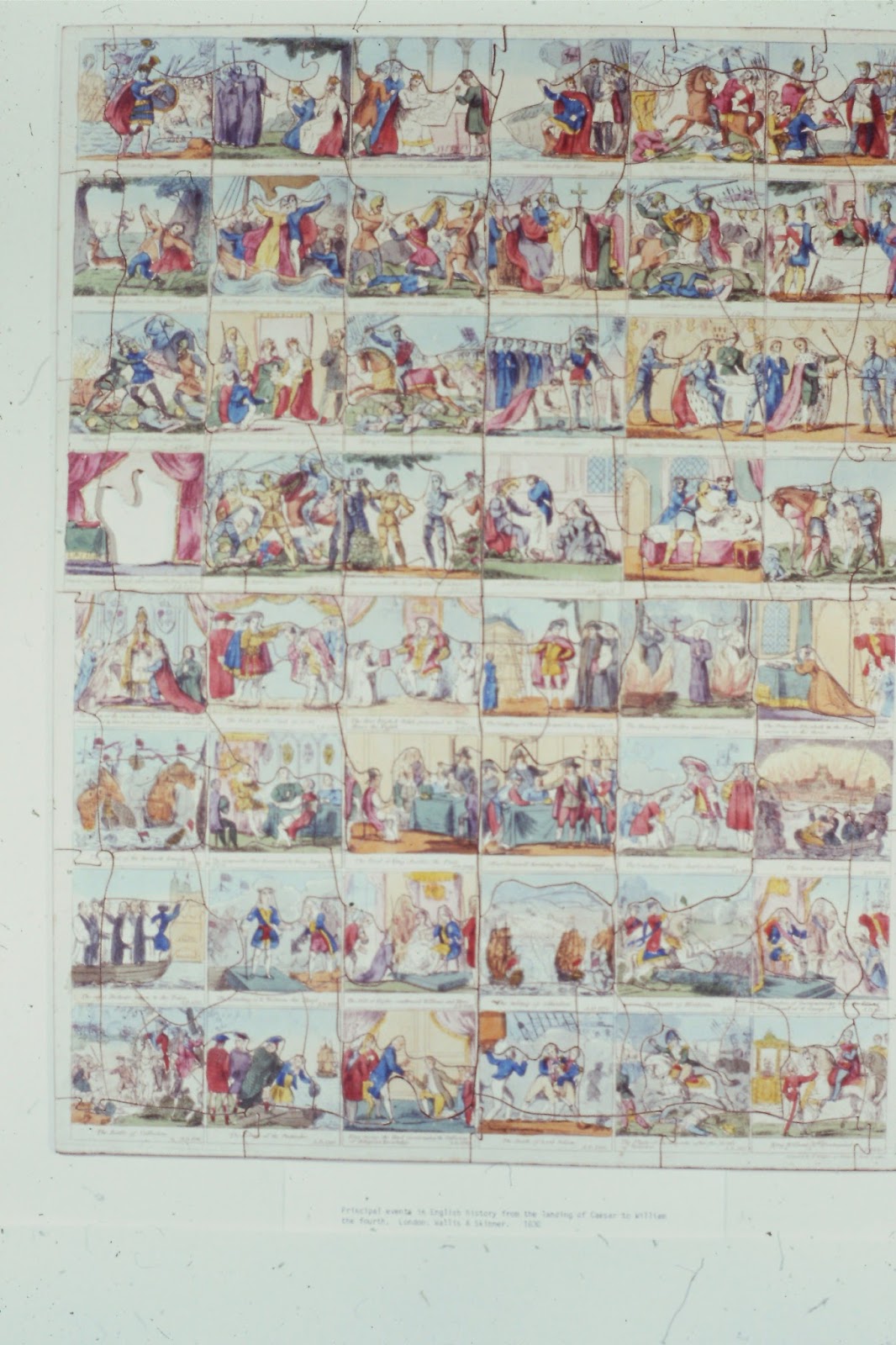
Jigsaw. The Principal Events in English History, Wallis & Skinner, 1830
(Parker Collection, Library of Birmingham)

Children's board games were consequently often played not with dice like adult versions but with a teetotum, a six or eight sided top. Like the earliest jigsaws they were generally geographical or historical in content; beautifully hand coloured engraved paper pictures with the racing tracks, backed onto linen to strengthen them and sold, like maps, folded into small wallets.  Players moved counters or 'pillars' round the map of Europe or Britain with accounts of the chief manufactures and places of interest cunningly inserted into the rule book, or spiralled round and round a series of little pictures showing scenes from English history, ending at a central portrait of George III in a blaze of glory.

Or the games might be morally edifying.  A very well known one is the Game of Human Life c. 1790, which takes the player from babyhood to old age through the different stages of life and different characters; the Mischievous Boy, shown chasing hens, the Volunteer, in scarlet military uniform, the Trifler with a love-letter between his fingers.  Various careers are shown; the Tragic Author, the Geographer, the Thoughtful Man, the Ambitious Man, represented by the Prince Regent, the Orator, represented by William Pitt the politician.  The final square shows Heaven, with a blaze of light and the one word GLORY!

The New Game of Human Life, Wallis, London, c.1820, invented c. 1790
(Parker Collection, Library of Birmingham)
A moral board game which slightly resembles Snakes and Ladders is The Mount of Knowledge, c.1820 which starts with the Horn Book, for learning the alphabet and Lord's Payer, and has 'ladders' such as Application and Patience and pitfalls such as 'Truants' Corner, Pride, Rocks of Difficulty and Castle of Indolence, and a beautifully engraved Flowery Path of Pleasure. The rule book is full of the terrors of the schoolroom eg: 'No. 21, Truant's Corner.  Having been unfortunately seen by the Schoolmaster while peeping round the corner, you must be flogged back to Birch Wood, and there stay 2 turns to recover, and also pay 2 counters to the Pool, for having wasted your time.'
Board game: The New Game of the Mount of Knowledge, Greenwich, W. Richardson, c.1820.  Hand coloured game, rather like Snakes and Ladders with moral pitfalls instead of snakes.
(Parker collection, Library of Birmingham)
The value of these board games purely for amusement was soon recognised and in the 19th century many delightful variants were introduced. The Locomotive Game of Railroad Adventures, c., 1845, published by the firm of Wallis, celebrates the coming of railways.  It has delightful pictures of primitive engines, trucks and carriages all round the board.  The rule book illustrated the pleasure and pain of early rail-travel:
'Derby Terminus.  This is the largest station in the kingdom.'  'Train run away with the bride.  Alas poor Bridegroom! You had better have lost your luggage.  Stop while all draw, and mourn your misfortune.'  'Take in coke and water.  Receive one from each player.' (Examples from games in the Parker Collection, Library of Birmingham  see also F.R.B Whitehouse Table games of Georgian and Victorian days, 1951)

Wooden jigsaw, A New Map of the World, London, Wallis c.1800.
Cut round the countries.
(Parker collection, Library of Birmingham)
It is possible that it was the appearance of children's board games which stimulated John Spilsbury's invention, the jigsaw, for his shop in London was near John Jeffery's and they may have had other connections.  For whatever reason, in the 1760s John Spilsbury, who was a map-engraver, hit upon the idea of pasting down a map onto a sheet of wood and cutting round the outlines. He called the results dissected maps and they were sold as geographical aids, like many of the early board games.  As with the board games, their other possibilities were gradually realised and historical and religious subjects appeared. They were generally cut round each scene shown, with the caption separate, or cut round the edges of countries or counties, or even simply cut at random.  With historical and religious subjects a paper picture sheet was provided as a guide.  The firm of Peacock did a profitable line in 'double dissections', a map jigsaw with a historical one on the reverse side.  The earliest jigsaws came in plain wooden boxes until the attraction of a coloured picture on the lid was realised. By the mid 19th century they were associated as much with pure pleasure as with education, and numerous different designs were available. (Examples from the Parker Collection, see also Linda Hannas The English Jigsaw Puzzle, 1760-1890, 1972) 
Wooden jigsaw, Coming out of School, c.1820?  Hand coloured.
A very early example of a non-educational jigsaw
(Parker collection, Library of Birmingham)

Friday, 6 January 2017

Children's toys: Dolls and Dolls Houses

'Trade and Plum-Cake forever. Huzza!'
(John Newbery, Nurse Truelove's New-Year's Gift, c. 1770)

Louise Juliana of Orange-Nassau
 by Daniel van den Queborn, 1582
(Pinterest)
Not only were adults clearly getting much enjoyment from their children but the gradual appearance of a larger leisured class with the money and inclination to indulge their children encouraged the development of a new market in products to please and satisfy their demands.  Leslie Gordon,  in Peepshow into paradise, a history of children's toys says the first toy shop to open in London was the Parrot and Star, set up in the 1720s by Robert Waite in Bow Lane, Cheapside, London.

Cheap toys were being hawked and sold by pedlars long before this, and were probably also sold in other shops, while many children had home-made toys.  Sir William Petty in his Epistle to...Master Samuel Hartlib, 1647, described children playing games of make-believe with guns made from elder sticks and ships of nut shells.  Both British and American family portraits from the mid 16th century often show little girls clasping a doll and occasionally show other toys.  There is one much-travelled Puritan doll in Kirkstall Abbey Museum, Leeds, who appeared in a portrait of 1688 wit her owner, then went with the family to America, returning with a descendant of the same family after the American War of Independence.  Simple carved wooden dolls were among the presents Sir Walter Raleigh took for the Native Americans on his ill-fated attempt to colonise Virginia in 1607, and there, as well as in Britain there were already home made dolls made from a variety of materials.  The Native Americans were said to be 'greatlye delighted with puppets and babes which are brought oute of England (Mary Hillier, Pageant of toys, 1965)

Florence Upton's Dutch dolls, 1895
Florence Upton grew up in Britain and America.  Her 1895 children's book about the adventures of two Dutch dolls included  Golliwogg, based on an American black rag doll.  Her success led to a whole series which were very popular till the 1960s when the racist implications were finally realised and led to Gollowog's sudden disappearance from the toy-cupboard and children's book shelves.

Hitty, The life and adventures of a wooden doll, 1932 by the American children's author Rachel Field describes the adventures of a doll carved from mountain ash which must have been typical of the playthings of 17th century British and American children.  She stood six and a half inches high and had a painted face like what were later called Dutch dolls.  Her first clothes were of stout calico and were sewn by her little owner, for little girls were encouraged to dress their dolls as a way of getting them to practise their needlework, much more interesting than sewing shirts for the poor or hemming handkerchiefs.

Ann Proctor by Charles Willson Peale, 1789
(RubyLaneblog)
Charlotte Yonge, the Victorian novelist, was given a wooden Dutch doll, Miss Eliza as a reward for completing a piece of needlework as a child in the 1820s:
'My biggest doll would be scorned nowadays.  She was made of apple-wood, with a painted face, black eyes inserted, a wig nailed on, and a pair of leathern arms, much out of proportion.'
 (Georgiana Battiscombe, Charlotte Mary Yonge.  1943, quoted from an autobiographical fragment by Charlette Yonge)

Charlotte Yonge had an ungratified yearning for one of the really splendid and expensive dolls with china heads.  However, Charlotte 'was told how many poor children could be fed on the price, and knew it must be given up.'  She had about sixteen others, 'some about a foot long with waxen heads, some of the old-fashioned Dutch dolls, but the most beloved was Anna, who was well made of white leather with a very pretty papier mache face, a novelty sixty years since...'
German doll with a china head,
(Pinterest)
Dolls, which at this date were called 'babies' are quite often mentioned in everyday letters from about 1700 on:
'Mrs. Richardson would lend her a wax baby in swadels which she was very fond of but att last down came ye baby and broke to peces; your daughter did fall astorming and squeaking that ye baby was broke...there was to have ben a great cristning of it and Pen was to have been ye Godmother but ye life was very short.' Elizabeth Hamilton, The Mordaunts, 1965.  Quote from 1701)
'My children buried one of their Babbies with a great deal of Formallity.  They had  a Garland of flowers carried before it, and at least twenty of their playfellows and others that they invited were at the Buriall. (1712.  Margaret Blundell ed., Blundell's diary and letter book, 1702-1728. 1952)

Dolls with delicately mounded wax faces  would unfortunately melt if left too near the fire, or in the sun:

'One summer's day, 'was in the month of June,
The sun blaz'd down in all the heat of noon:
My waxen doll, she cry'd, my dear! my charm!
You feel quite cold, but you shall soon be warm.
She plac'd it in the sun, - misfortune dire!
The wax ran down, as if before the fire!
Each beauteous feature quickly disappeared
And melting left a blank all soil'd and smear'd...'
  (Ann and Jane Taylor, Original poems for infant minds, 1804)

Wax headed doll, c.1890
(e.bay)
Many accidentally shared the fate of Jane Carlyle's doll, which, inspired by the story of Dido of Carthage, she formally sacrificed when she began to study the Aeneid.  Changing her mind, Jane rushed to save her doll from the flames, too late!
(in Mrs. F. Neville Jackson, Toys of other days, 1908)

Dolls with china heads were fairly common by the mid 19th century and in 1825 speaking mechanisms and eyes that opened and shut were available.  In spite of being called 'babies', dolls at this time were generally modelled as adult women, often with generously curved figures.

In 1902 the Teddy Bear was created when Morris Michtom, in the USA, made a toy teddy bear and named it after President 'Teddy' Roosevelt.  He founded the Ideal Novelty and Toy Company to produce them.
The German firm of Steiff hit on the idea at almost the same time in 1903.

A Golliwog, a French doll with a china head, and a c.1908 Steiff Teddy Bear
The dolls house, as we know it, seems to have begun life as an extremely elaborate work of art.  The earliest recorded example was commissioned by Duke Albrecht V of Bavaria for his daughter in 1558 but ended up in his art collection.  It has four floors, seventeen doors, and sixty-three windows all fitted up in the first style of elegance with embroidered and gold tapestries, gold and silver fitments in the state rooms, even a well fitted bathroom and a lion house for the 'Bavarian armorial animal'.
(Flora Gill Jacobs, A history of dolls' houses, 1954)  Quoted from Karl Grober, Children's toys of bygone days, trans. Philip Hereford, 1928)

Although there may have been unrecorded dolls houses made for children in the 16th and 17th centuries adults do seem to have kept the best for themselves.  In 16th century Germany, Augsburg, Nuremburg and Ulm were particularly celebrated for their production and fitments in the 16th and 17th centuries, but dolls houses were not common in Britain till the 18th century.  The earliest British example is probably Mrs. Humphrey's dolls house, a copy of the 1567 Sparrowe's House in Ipswich, complete with elaborate pargetering, which may have been made for the owners at any time during the first 200 years after the house was built.
In 2016 a very important early British dolls house turned up on the BBC Antiques Roadshow.  It was made in 1705 on the Isle of Dogs for a Miss E. Westbrook, has panelled, well-furnished rooms, and dolls in their original Georgian clothing.
BBC Antiques Roadshow dolls house
It became fashionable to commission architects to design elaborate dolls houses, replicas of actual town or country houses.  A specially fine one at Uppart was described in Country Life: 'The house itself has an accurately designed Palladian facade, of three storeys, seven bays wide, resting on a stand modelled on the arcade of Covent Garden paizza...'  Inside are some delightful dolls:  'Taking an  unpardonable liberty, we discovered that the ladies are wearing three petticoats...The party, their heads flung back, saeem to be enjoying a joke.  These Georgians have a hearty sense of humour.  Can it have anything to do with the lady upstairs?  Poor thing, she is confined to bed, and we can see why: at the foot of the gorgeously canopied bed is a wicker cradle, within is an nobviously very young doll...'
(Christopher Hussey, Country Life 6 March 1942, quoted in Flora Gill Jacobs A history of dolls houses 1954)
The Uppark dolls house, (National Trust Archives)
A proper children's dolls house is mentioned in the Mordaunt letters, 1726 when Peg or Dolly was given a piece of furniture for it:  'Miss desires her Duty to her aunt and a great many thanks for her fine hearth which is put in the Drawing room in her baby house.' (op.cit)

Queen Anne gave her god-daughter Ann Sharp, born in 1691, a nine room dolls house, described in detail in Flora Jacobs History of dolls houses.  In the kitchen there was a plum pudding in a copper pot bubbling on the fire, and a sucking pig roasting on a spit.  The dolls who lived in it were My lord Rockett, his lady, his son and daughter, Sarah Gill, 'ye child's maid', Fanny Long, the chambermaid, Roger, 'ye butler, Mrs. Hannah, ye housekeepers', cook, footman, Lady Jemima Johnson, Mrs. Lemon, Sir William Johnson and a lady.  (op cit)

The dolls house Queen Victoria had as a little girl was described in Girl's Realm for 1899.  It was well played with and a little tatty by then but had all the right dolls' furniture.  In the kitechn 'An ample dresser shows rows of shining pewter plates, and there are frying pans, saucepans and other culinary utensils placed neatly upon the walls or shelves.  There is a capacious knife-box, filled with iron spoons and forks and wooden-handled knives.  There are flat-irons, an iron-stand, a warming-pan, a coffee mill, and a clock.  The grate is one of the old-fashioned kind, and an iron kettle is on the hob.  On each side of the fireplace stand doll servants.  I grieve to state that they are neither clean or trim...'
(Jacobs op.cit, quoted from Girl's Realm 1899)

 Princess Victoria was also very fond of full size dolls and had a hundred and thirty-two, of which she dressed thirty-two herself.
Princess Victoria's dolls house
(BBC archives)


Saturday, 19 November 2016

Parenting gets more relaxed: the Restoration and the Georgians

'Ann desires her love and thanks you for the little wax doll, which, I am sorry to say she soon made share the like fate of the King and Queen of France.'
(Geraldine Mozeley, Letters to Jane from Jamaica, 1788-1796)

In the late 17th century, after the Restoration in 1660, childhood began to be seen not only as preparation for adult life but also time to enjoy.  In Britain it is possible that the overturn of the political order in the Civil War (1642-51) also shook up the social order allowing new concepts to emerge. Lord Clarendon (1609-1674) attributed the change to many families going abroad during the troubles, some to France, having their children educated at French academies, exposed to French fashions, cookery, Catholicism, and manners.  'Children have lost reverence for their parents; parents have neither authority nor any sense of responsibility for their children...' he lamented
(The life of Edward, Earl of Clarendon...written by himself, Oxford edition, 1759 Edward Hyde was chief minister to Charles II)

Charles II dancing at the Hague, c.16670. Gonzalez Coques,
National Maritime Museum
Since the French aristocracy lived by rules still more formal than those of the English court, Lord Clarendon's views are possibly coloured by prejudice.  However it is possible that British exiles were also affected by contact with the far more informal small courts of the Netherlands and Germany, and with the households of the Dutch merchant middle classes where, wealthy though they were, rigid formal manners had never been the fashion.  The difference in attitude between the Dutch and British before the Civil War can easily be seen by comparing the many delightfully informal paintings of Dutch and Flemish interiors with British 17th century equivalents.  Perhaps the charm of that way of life was not lost on the British exiles.

Like Lord Clarendon, Roger North (1651-1734) deplored Restoration laxity and approvingly described his own mother's strictness in his memoirs:
'We had, as I say'd, stubborn spirits, and which was more grievous, (she) would force us to leave crying and condiscend to the abject pitch of thanking the Good Rail, which, she say'd, was to break our spirits, which it did effectively.'
(Autobiography of the Hon. Roger North, ed. A. Jessopp, 1887)

John Aubrey's well known comparison of family life before and after the Restoration was written about 1660:
'...In those days fathers were not acquainted with their children...for whereas one's child should be one's nearest Friend, and the time of growing-up should be most indulged, they were as severe to their children as their schoolmaster; and their Schoolmasters as masters of the House of Correction.  The child perfectly loathed the sight of his parents as the slave his Torturer.  Gentlemen of 30 and 40 years old, fitt for any employment in the commonwealth, were to stand like great mutes and fools, bare headed before their Parents; and the Daughters (grown women) were to stand at the Cupboards side during the whole time of the proud mothers visitt, unless (as the fashion was) 'was desired there leave (forsooth) should be given them to kneele upon cushions...'
(John Aubrey, Brief lives, ed. from the original manuscripts...ed. Oliver Dick, 1949 edition)
Although Aubrey condemned any form of indulgence, he felt that the selfishness and bad habits caused by over-indulgence was preferable to breaking their spirits with over-strictness

John Locke in his very influential Thoughts on Education,  upholds strict discipline, but the changing attitude to relationships between parents and children is evident in this passage:
'Would you have your Son obedient to you when past a Child; be sure to establish the Authority of a Father as soon as he is capable of Submission, and can understand in whose Power he is...as he approaches more to a Man, admit him nearer to your Familiarity; so shall you have him your obedient Subject (as is fit) whilst he is a Child, and your affectionate Friend when he is a Man.'
(John Locke, Some thoughts concerning education, 1693)
Title page of the first edition (Wikipedia)
However, relationships through the 18th century remained frequently quite formal by later 19th century standards.  The well-know writer Mrs. Sherwood, born in 1775, never sat down in her mother's presence, (The life of Mrs Sherwood,  1857)
The title page is from Mrs. Sherwood's History of the Sherwood Family, one of her best known improving stories for children.  It includes the famous account of Mr. Fairchild taking his children to see the dead body of a man, a murderer, hanging on a gibbet till it should rot away, as a lesson on what can happen to disobedient children who grow up to be wicked, passionate people who do wrong to others and break the law.

History of the Fairchild Family,
(Wikipedia)
The novelist Elizabeth Gaskell, writing in the mid-19th century, was struck by an old Shropshire lady's account of her childhood which interestingly resembles the quotation from John Aubrey.  She wrote it up for Sartain's Union Magazine, 1849 as The Last Generation in England, and later re-used the material in Cranford:
'Although an only child she had never sat down in her parents' presence without leave until she was married; and spoke with infinite disgust of the modern familiarity with which children treated their parents.
' "In my days," said she, "when we wrote to our fathers and mothers we began 'Honoured Sir', or 'Honoured Madam', none of your 'Dear Mamas', or 'Dear Papas' would have been permitted.'' 'Elizabeth Gaskell, Cranford, OUP 1972 Appendix)

A few children's letters which have been preserved from the 18th century show that not all families were so strict.  Lord Femanagh's eldest son John wrote to him from school in 1722:
'Dear Papa, I desire you to send for me home on Wednesday night, for to be at home on Thursday for to see the Duke of Marlborough buried.'   and: 'Dear Papa, George brought me some Gingerbread which you were so kind as to send me, as also a couple of Handkerchiefs.
(Verney letters, ed. Lady Verney, 1930, Vol. 2)
John's cousin Betty, aged nine, writes more formally: 'Honoured Sir, I was mightily pleased with your kind letter...My Mama desires if it had not beeen for me to a been in the Contrey before now, all well there, my Grandfather was so kind as to give me a guinie (guinea)...'She had been taken to London to be touched for the King's Evil by Queen Anne.(Verney letters, Vol. 1)

On the other hand, many autobiographical accounts show that although relationships between children and their parents were now often fairly informal, parents were still generally extremely strict:
'We were exceedingly fond of our Father.  t the same time his word was Law.  It never entered our minds, I believe, to disobey him, and I am reputed to have been in the habit of informing visitors that papa required implicit obedience.'  (Augustus Hare, The Gurneys of Earlham, 1895, Vol. 2)  This is an extract from Anna Gurney's reminiscences of her father, John Joseph Gurney, around 1824, and strict obedience was probably more commonly the rule in religious middle class families where, however, it was generally combined with loving concern.

Lord Shaftesbury(1801-1885) on the other hand, scarcely saw his parents when a boy, and said of them:'I and my sisters...were brought up with great severity, moral and physical, in respect of both mind and body, the opinion of our parents being that, to render a child obedient, it should be in constant fear of its father and mother.'
(Edwin Hodder, The life and work of the Seventh Earl of Shaftesbury, 1886, Vol. 1)

The increasing informality of family relationships from the Restoration to the early 19th century is shown not only by children's letters and accounts of their parents, but also in relatives' accounts of their children.  The change is evident in the long series of Verney letters, and is even more striking if these are compared with the extremely formal tone of the15th century Paston letters.  In these and the early Verney letters the children are scarcely mentioned, but by the mid 17th century their affairs are beginning to occupy a considerable amount of space.  Ralph Verney's great grandmother, Lady Denton, who was extremely severe with her own daughters, interceded  at length for her grandson in 1632:
'I heare he is disliked, he is so strange (shy) Sonn, you did see he was not soe, nor is not soe, to any where he is a quanted (acquainted), andhe must be woone with fair menes.  Let me begge of you and his mother that nobody whip him but Mr. Parrye, yf you doe goe a violent waye with him, you will be the first that will rue it, for i veryly beleve he will reserve ingery by it.' ((Verney letters op.cit, Vol. 2)

Another grandmother, Lady Anne North, whose severity to her own children was described by her son (see above) sent her son this particularly charming account of the ceremony of putting little Frank into his first long trousers, aged about eight:
'You cannot beleeve the great concerne that was in the whole family here last Wednesday, it being the day that the taylor was to help to dress little Frank in his breeches...Never had any bride that was to be drest upon her weding night more hands about her, some the legs and some the armes, the Taylor butt'ning and others putting on the sword, and so many lookers on that had I not a finger amongst them I could not have seen him.....But this was not all, for there were great contrivings while he was dressing who should have the first salute (kiss), but he sayd if old Land (his nurse?) had been here she should, but he gave it to me to quiett them all.  They are very fitt, everything, and he looks taler and prettyer than in his coats.  Little Charles rejoyced as much as he did, for he jumpt all the while about him...PS When he was drest he asked Buckle whether muffs were out of fashion because they had not sent him one.'
(Roger North, op.cit. Appendix 1, letters from Anne, Lady North, 10 Oct. 1679)

Among all the alarms and disorders of the Civil War Sir John Oglander, who had been called to London and put under open arrest still wrote home in 1643 '...I play you write me word whether my letters be broken up, and whether you received little Jack's coral...' (Corals were often used for teething)
(Cecil Aspinall-Oglander, Nunwell symphony, 1945)

Parents from the mid 17th century on seem to be able to express far more freely their grief at losing children, which is indication that it has become socially more acceptable to express affection freely and openly.  Although it has often been said that parents in earlier times did not care deeply for their children, because their feelings were rarely publicly expressed, it is more probable that they were acting according to the conventions of an extremely formal society.  John Evelyn's obituary for his five year old son Richard is probably the best known expression of this new freedom:
'...died my dear son Richard to our inexpressible grief and affliction; five years and three days old only but at that tender age a prodigy for wit and understanding; for beauty of body a very angel; for endowment of mind of incredible and rare hopes....(Diary of John Evelyn, Vol. 1, 1658. Edited by W. Bray, 1879)

The Rev. Ralph Josselin wrote in the 1640s, pathetically balancing human grief with correct religious feelings: 'My little sonne in all peoples eyes is a dying child, Lord thy will be done, thou art better to mee than sonnes and daughters, though I value them above gold and jewells.' (Diary of the Rev. Ralph Josselin, 1616-1683, ed. E. Hockliffe, Camden Soc. 3rd series, no. 15 1908)

Another diary entry which shows a parent trying to moderate his feelings in view of the immensely high infant mortality rates is the Rev. Philip Henry's.  While expressing his unbounded delight at the birth of his wife's first child, he writes apprehensively: 'I am bid to expect to see him often at Death's door and must moderate my love for him lest overloving end in overgrieving.'  Five years later it did: 'At sunsett this day hee dy'd our first born...a forward child, manly, loving, patient under correction, oh that I could now bee so under the correction of my heavenly father...'
( Diaries and letters of Philip Henry MA, 1631-1696 ed. Matthew Leu. 1882)

In the 18th century Verney letters the children are frequently referred to by affectionate epithets such as 'Our young Flock' and 'Young Hopeful branches.'  Detailed accounts of their health and doings were constantly passed between members of the family:
'All the three pretty children have had bad coughs that make them look thin.', 'My little girl is very brisk and well, but goes not perfectly Alone.'  'Your Godson is grown a brisk boy...he is the life of this house...he can say most of his Catechise and his prayers, and is so far the Christian you engaged he should be.'
(Verney letters of the 18th century, Vol. 1 op.cit)

Such accounts in family letters are not at all uncommon from the later half of the 17th century on, and give  tantalising glimpses of family life nearly three hundred years ago:
'Charles (aged 3) sed att diner he would call for a glas of Claret as Papa did; and not drink water.'
(Elizabeth Hamilton, The Mordaunts, an eighteenth century family, 1965, based on a collection of family letters and documents dating from end of the 17th century to the 1820s.)

'Pray desire Cousen Peg to buy me a pair of leading strings for Jak, ther is stuf made on purpose that is very strong for he is so heavy I dare not venture him with a comon ribin.'
(Verney letters of the 18th century op. cit, vol. 2)

'I am sorry your dear Boy has beat out his teeth.  Nature I hope will soon suply that defect; mine did not sleep last night till after midnight for want of his marbles, a new purchase that he is very fond of.'
(Verney letters op.cit. vol. 2)

Niky Rathbone: childhoodblog@gmail.com


Saturday, 29 October 2016

A bit less education for the Girls: Puritans and Cavaliers

'Those that think one language enough for a woman may forbear the languages, and learn only Experimental Philosophy'

A 17th century book of instruction for girls
By the Restoration educational horizons  for well-bred upper class girls had narrowed down to preparation for marriage and a life of leisure. those learned Tudor ladies were no more.  The prospectus for Mrs Makin's school for young ladies reads:
'Gentlewomen of eight or nine years old that can read well may be instructed in a year or two (according to their Parts) in the Latin and French Tongues...Those that please may learn Limning (a kind of painting), Preserving, Pastry and Cookery.  Those that will allow longer time may attain some general knowledge in Astronomy, Geography, but especially in Arithmetick and History.  Those that think one language enough for a woman may forbear the languages, and learn only Experimental Philosophy.' (Mrs. Makin's school prospectus, c. 1673, Dorothy Gardiner, English Girlhood at School, 1929)

This is the prototype for the girls' school in the 17th century.  By the time of Charles I the daughters of Royalist families were regularly being sent to such establishments as noble families gradually ceased to maintain large private courts where young girls could be sent to be suitably 'finished'. With the Civil War, the execution of Charles I, and the establishment of the Commonwealth in the mid 17th century all that was swept away by the strict moral code of the Puritans for a time, but such establishments returned to favour, along with a more lax moral attitude, with the Restoration of the Monarchy under Charles II (1660)

In these schools for young ladies great emphasis was placed on manners and deportment.  Hannah Woolley,  in her advice to 'The Female Younger Sort' takes the line familiar from the books of courtesy:
'...be courteous and mannerly to all who speak with you...When you come to School salute your Mistress in a reverent manner and be sure to mind what she injoyns you to do or observe...Having done this, salute civilly your Schoolfellows...Show not your ill-breeding and want of manners by eating in the school, especially before your Mistress.'
(Hannah Woolley, The Gentlewoman's Companion or a Guide to the Female Sex, 1675, Gardiner op.cit)

Needlework and embroidery formed an important part of the curriculum, although most of it appears to have been not practical but  the kind elegant young ladies might use to occupy themselves.  The subjects advertised have a curious similarity to the occupations of Victorian girls, and show indirectly that well-to-do young ladies were being released from the necessity of running the household, and had time on their hands:  in the past young girls learned cooking, preserving, spinning, weaving, sewing, cleaning.  Mrs. Woolley's prospectus, however, advertises:  'All works wrought with a Needle, all transparent works, Shell-work, Moss-work, also cutting of Prints and adorning Rooms or Cabinets or Stands with them.  All kinds of Beagle-works upon Wyers or otherwise.  All manner of pretty toys for Closets, Rocks made with Shells or in Sweets.  Frames for looking-glasses, Pictures or the like.  Feathers of Crewel for the Corner of Beds.'

Hackney became popular for such schools, because of its healthy situation, just outside London.  Pepys went on an excursion there to see them on 20th April 1667:
'That which I went chiefly to see was the young ladies of the schools whereof there is great store, very pretty' (Pepys Diary 20 April 1667)
Many condemned these schools as worldly and kept their daughters at home employing governesses and tutors.  Aubrey in his Miscellanies calls the finishing schools 'places where young maids learn pride and wantonness' (John Aubrey, Miscellanies upon various subjects, 1626)
and Thomas D'Urfey's popular and scurrilous play Love for Money; or, The boarding school, 1691, was a severe blow to their popularity.

The daughters of devout Puritans were not to be found in such dubious establishments.  They were usually educated at home, frequently by their parents, generally along traditional lines, emphasising their domestic role.  Anthony Walker, a Puritan, but writing after the Restoration of the Monarchy says of his daughters' upbringing:
'her (his wife's) first Care was, to keep their Minds uncorrupted by Vanity or Pride, therefore kept them at home, not to save Charges, but avoid Inconveniences.'
(Anthony Walker, The Holy Life of Mrs. E. Walker, 1690)

Puritan parents would have been as one with the influential Tudor Catholic Juan Vives who had been tutor to the Princes Mary, daughter of Henry VIII, in emphasising  domesticity, piety and seclusion in the education of girls, for although Vives did believe in a wider curriculum for girls than most Puritans would accept, he did not mean  it to be at the expense of their chief role: 'Let her both learn her book and besides that to handle wool and flax (Vives, Instruction of a Christian Woman c.1529) This is a sentiment any Puritan would have echoed, or any ancient Greek or Roman for that matter.

The education of the Puritan Walker girls  included some surprisingly liberal, even frivolous subjects, which would not have been taught in the strictest Puritan households or have been approved of.  In addition to housewifery taught by their mother, they had a 'French Dancing Master in the House, and had a Writing and Singing-Master come to them.'

The upbringing of Lady Grace Mildmay was more typical of a Puritan girl's education.  Born in 1552, so being educated in the Tudor period, but a good example of a Puritan education, she was brought up by a poor relation governess and her mother, who used to beat her severely, and 'never so much as for lying'.  She studied writing, accounts, the herbal, needlework, and the lute, to which she sang psalms.  She read the Bible every day, and in her notes for the upbringing of her own daughter says, 'it is not possible for parents to be good or to have any virtues in them who seek not to make their children good.' and 'It is a matter of great importance to bring up children unto God, and to cause them to forsake the vanities and follies of this short and momentary lyfe.'. (Diary of Lady Grace Mildmay,  quoted in Quarterly Review, vol. 215, 1911)

Nor was religion neglected in non-Puritan households.  Lady Anne Halkett,  born in 1622, daughter of Thomas Murray, tutor to the future Charles I, says of her childhood: 'for many years together I was seldome or never absent from divine service, at five a'clocke in the morning in the summer, and at sixe a'clocke in the winter, till the usurped power (ie the Puritans who beheaded Charles I and set up the short-lived Commonwealth) putt a restraint to that pubicke worship so long owned and continued in the Church of England, where, I blese God, I had my education.' ( Autobiography of Anne, Lady Halkett, Camden Society Publications, 2nd series, no. 13 1875)
Lady Anne Halkett was educated at home and had masters to teach her and her sister French, to play the lute and virginals and to dance, a gentlewoman to teach them all kinds of needlework.  Incidentally, this is the lady who rescued Charles I's second son James from captivity during the Civil War.  As James II he rewarded her with a pension.

It is interesting that even in Puritan families music still remained an important part of the curriculum, although its role might be suitably adapted.  It was clearly an enormously important part of everyday life, and in girl's schools retained its importance for some time; Purcell;s Dido and Aeneas was originally written for a girls' school to perform to parents and friends, which gives some indication of the general musical standards expected.  In boys' schools, however, music was rapidly driven out by the expansion of the curriculum.

Niky Rathbone: childhoodblog@gmail.com


Tuesday, 25 October 2016

The English Puritans and their children

'My pretty Child, remember well,
you must your ways amend;
For wicked Children go to Hell,
that way their courses tend.'
(Henry Jessey, A looking glass for children, 1673)

The influence of the Reformation and of the slowly gathering strength of the Puritans took far longer to be felt than the effects of the Renaissance on education.  Although the Reformation had immediate consequences in the reign of Henry VIII ,as far as religious doctrine was concerned one of the most profound effects was the general increase in the intensity of religious feeling brought about by sectarian controversy.  This did not begin to show its full effect until the 17th century, when, through the Civil War and Interregnum the beliefs of the Puritan minority had a profound effect on the religious attitudes of the nation.  Nor did the influence of the Puritans on religious life cease after the restoration of the Monarchy in spite of the various Acts of Parliament passed against those who did not conform to the practices of the Church of England; the various Nonconformist sects gained rather than lost strength and from the late 17th century played an increasingly important part in improving social conditions as well as having an important effect on religious attitudes, and children's education.

Puritanism grew steadily in England from the end of the reign of Queen Mary I in 1558 when many Puritans who had gone into exile returned to England.  A prominent Puritan, Hugh Rhodes, wrote a book of courtesy printed in 1577 which is is interesting to compare with the earlier examples.  The advice on manners is much the same, but there is far more advice to parents on the spiritual upbringing of their children.  Rhodes placed great importance on this, like all Puritans, saying: 'The cause of the world being so euill of lyuing as it is, is for lack of vertue, and Godly bringing up of youth.'
He advised parents to keep a very strict watch over where they go and who they meet, to prevent them from becoming corrupted: 

'nor let your Chyldren go whether they will, but know whether they goe, in what company...Take hede they speake no wordes of villany...nor shew them much familiaritye...Mark well what vice they are specially inclined unto, and break it betymes.'.  Of course he advised parents to carechise their children frequently: 'Take them often with you to heare Gods work preached and then enquyyre of them what they heard, and use them to reade in the Bible and other Godly Bokes.'  Rhodes also voices the Puritan prejudice against fairy tales and romances which was to become so general in the 19th century among all right-minded parents and teachers: 'but especially keepe them from reading of fayned fables, vayne fantasyes, and wanton stories and songs of loue, which bring much mischiefe to youth...'
(Hugh Rhodes, The boke of Nurture, or schoole of good manners for men, servants and children...1577 EETS original series no. 32)

 Puritans addressed themselves with a particular sense of urgency to the salvation of children.  Lady Grace Mildmay expressed this sense of responsibility when she wrote: 'It is not possible for parents to be good or to have any virtue in them who seeke not to make theyre children good'
(Lady Grace Mildmay Diary, quoted in Quarterly Review 1911, vol. 15 p.128)

Mrs. Elizabeth Jocelin wrote The Mother's Legacie to her Unborn Child out of this sense of spiritual duty: 'Yet still I thought there was some good office I might do for my Childe more than onely to bring it forth
(tho' it should please God to take me.) When I considered our frailty, our apt inclinations to sin, the Devil's subtilty, and the world's deceitfulness; against these how much desired I to admonish it?'
(Elizabeth Joceline 1625)

In Puritan families adults and children were encouraged to keep spiritual diaries noting their progress towards salvation, or otherwise, and any evidence of divine grace.  (Similarly, Catholic children would be expected to go to Confession.) As a result of this regular diary-keeping many more details of day to day life are available from the 17th century onwards.  Evidence of divine grace seems to have given some diarists trouble, and God is credited with some curious interventions:
'I find we have another mercy to praise the Lord for. Thea has voided abundance of worms, some almost a quarter of a yard long...The Lord be praised'
(Dorothy Oglander to her husband, 1663, in Aspinall-Oglander, Cecil Nunwell Symphony, Hogarth Press, 1945)
 'This last night Matthew fell out of bed, not hurt, a wonderful preservation, blessed bee God, even our God' (Diaries and letters of Philip Henry MA 1631-1696 ed. Matthew Henry Leu, 1882)

At the beginning of the reign of Queen Elizabeth (1558-1603) legislation had been passed requiring heads of families to catechise their children and instruct them in the principles of religion according to the Church of England.  The reasons for this were political, since religious schism was one of the principal causes of political dis-unity in th 17th century.  Most heads of families regarded catechising their children as one of their most important duties towards them, and Puritans were particularly scrupulous about this.  Catechising children is noted regularly in their journals and diaries: 'Nov. 1 1661.  I catechised & instructed my children after supp, and wee had family duty, & went to bed,...'
(Diary of the Rev. Henry Newcome...ed. Thomas Heywood, Chetham Soc. Vol. 18 1849)

Children in Puritan households like that of Mrs.Walker learned to read at an early age, so that they could begin to study their catechism and Bible: 'To promote and forward their religious instruction she taught them to Read as soon as they could pronounce their Letters,.,,and sowed the Seed of early Pious Knowledge in their tender Minds, by a plain, familiar catechism.'
(Anthony Walker The Holy Life of Mrs. E. Walker...1690)

The best known Puritan work addressed to children, which remained in common use throughout the 19th century in both Britain and America is the Nonconformist minister James Janeway's Token for Children, Being an exact account of the conversion, Holy and Exemplary Lives, and Joyful Deaths of several young Children, 1671-2.
(British Library)
This was an attempt to terrify both parents and children into salvation. It contains two prefaces, one addressed to parents asking: 'Are the souls of your children of no value? Are you willing that they should be brands of hell?'  The second preface is addressed to the children:

  'You may now hear (my dear lambs) what other good children have done, and remember how they wept ad prayed by themselves...Did you ever get by yourself and weep for sin and pray for grace and pardon?...How dost thou spend thy time?  Is it is play and idleness, and with wicked children?...Were not these sweet children, which feared God and were dutiful to their parents?...What do you think is become of them, now they are dead and gone? Why, they are gone to heaven, and are saying hallelujahs with the angels...they shall never be sick, or in pain any more...And are you willing to go to hell to be burnt with the devil and his angels?  Would you be in the same condition as naughty children?  Oh hell is a terrible place, that's worse a thousand times than a whipping...Would you not do anything in the world to get Christ, grace and glory?  Did you never hear of a little child that died?  And if other children die, why may you not be sick and die? (James Janeway A Token for Children, 1671-2)

At a time when early death was only too common the effect on sensitive children of constant threats of hellfire may be imagined. John Bunyan, author of The Pilgrim's Progress,  has left one of the best known accounts from this period of his childhood fears of hell:
'Even in my childhood he (God) did scare and affrighten me with fearful dreams...Also I should, at these years, be greatly afflicted and troubled with the thoughts of the fearful torments of hell-fire.  These things, I say, when I was but a child, but nine or ten years old, did so distress my soul that then, in  the midst of my many sports and childish vanities, amidst my vain companions, I was often much cast down and afflicted in my mind.'
Bunyan, however, in spite of the dreadful warning of his nightmares, admits he 'had but few equals (especially considering my years, which were tender, being but few) both for cursing, swearing, lying and blaspheming the holy name of God...'(Bunyan, Grace Abounding, 1666)

Bunyan's account calls to mind the most dramatic of Janeway's little biographies:
 'of a notorious wicked Child, that was taken up from begging, and admirably converted, with an account of his Holy Life and Joyful Death, when he was nine Years old.'
He was, says Janeway, 'a very monster of wickedness, and a thousand times more miserable and vile by his sin than by his poverty.  He was running to hell as soon as he could go, and was old in naughtieness when he was young in years...He would call filthy names, take God's name in vain, curse, and swear, and do almost all kind of mischief, and as to any thing of God's worse than a heathen.' (James Janeway, A Token for Children, 1671-2)

Another well known Nonconformist, Abraham Chear, wrote the well-known To a young Virgin, 1663:

'When by Spectators I am told
what Beauty doth adorn me,
Or in the glass when I behold,how sweetly God did form me.
Hath God such comliness display'd
and on me made to dwell
'Tis pitty such a pretty maid
As I should go to Hell'
(In Henry Jessey A looking-glass for children 1673)

It seems surprising that a strict Nonconformist should encourage a young girl to think about her looks; one of the characteristics of Nonconformist writing for children is that girls were constantly assured that a good nature shining out is all the beauty a face needs.  The first Puritans seem to have believed, until they were undeceived, that good Christian principles are all that is needed and god nature will follow.  But those little children did need lots of reminding:

'My little Cousin, if you'll be
your Uncle's dearest Boy;
You must take heed of every deal
that would your Soul destroy.
You must not curse, nor fight, nor steal
nor spend your time in games,
Nor make a lie, what e'ere you ailes,
nor call ungodly names.
With wicked Children do not play,
for such to Hell will go;
The Devil's children sin all day
but you must not do so.'
(Abraham Chear, 1673 op.cit)

The Nonconformist minister John Angier had a typical Puritan upbringing.  His mother, 'being a choice and gracious Christian, often spake to him of Soul concerns, wept and prayed much for him.'  He experienced religious conviction of being saved at about twelve, but after that he often had doubts which, he says, 'he kept to himself, and often retired into a corner, being ashamed that anyone should know of his heart-grief'  To him this would have been a sign that his spiritual re-birth had not been genuine.  He had a brother with the good Biblical name of Bezaleel.
(Oliver Heywood, Narrative of the life of John Angler, Minister of the Gospel at Denton, 1685,  Chetham Soc.  vol. 97, 1937)

The spiritual sufferings of children were welcomed as signs of their impending spiritual redemption:
 'The briny tears for the natural Death of one very desirable Child were swallowed up by the Tears of Gladness for the lively symptoms of the Spiritual Birth of another...The Pathetick Earnestness with which the Child cried for Pardon and supplies of grace, enflamed and melted all that heard her.'
(The Holy Life of Mrs. E. Walker, 1690)
This child's parents went on to record, with deep satisfaction, their little daughter's spiritual forwardness, much as a modern parent might describe signs of great intelligence:
'About four Years of Age, on days of Prayer and Fasting, she would sit by me the whole Day, and at Prayer hold up her little Hands...' ((op. cit. )

There seems to have been little attempt to distinguish between degrees of sinfulness, the thoughtlessness of childhood being as sure a path to hell as the misdeeds of the most hardened criminal.  Elizabeth Joceline makes a determined effort to equate disobedience with breaking all the Ten Commandments:
...thou canst not bee a disobedient child but thou art a murderer...of thy father...by thy disobedience his gray head brought with sorrow to the grave...'(E. Joceline The mother's legacie to her unborne childe.  1625)
As a result children often became morbidly over-anxious over relatively trivial faults:
'If I desired any thing that was grateful to my Appetite, when it was brought to me I durst not make use of it, because I thought it to be the satisfaction of a base sensual Appetite'  (Walker, op. cit)

'When his child was about five or six years old, she had a new plain Tammy Coat...having looked upon her Coat, how fine she was, she presently went to her Chair, sate down, her tears running down her eyes, and she wept seriously to herself.  Her Mother...said to her, How now? What is the matter that you weep?  The Child answered... I am afraid my fine Cloaths will cast me down to Hell.  Her Mother said, it's not our Cloaths but wicked hearts that hurt us.  She answered, "Aye, Mother, fine Cloaths make our hearts proud."'(Jessey, op. cit)

It is not surprising that  children often had no sense of proportion about their faults when adults accepted such confessions completely seriously. The spiritual sins of the Rev. Ralph Josseline when a child, though unspecified, sound more promising work for the Devil:  '...oh ye strange prodigious unclean lusts when I was yett a child; how often have I walkt with delight to meditate upon such courses, being too well acquainted with those scenes by books which I had; yett I bless God who kept mee from all outw'd uncleanness; praise bee to him, and for this I desire to loath and abhorre my selfe.' (Diary of the Rev. Ralph Josselin 1616-1683, Camden Soc. 3rd series, vol. 15 1908)

The famous reverend Richard Baxter has also listed the chief 'sins' of his youth:
'I was somewhat excessively addicted to play, and that with covetousness, for money.  I was guilty of much idle foolish chat, and imitation of boys in scurrilous foolish words and actions (though I durst not swear)
I was too proud of my masters' commentations for learning.
I was too bold and unreverent towards my parents.'
(Autobiography of Richard Baxter, Reliquiae Baxterianae abridged from the folio, 1696, ed. J.M. Lloyd, 1925)

Like Lydgate, Baxter 'was much addicted to the excessive gluttonous eating of apples and pears...To this end, and to concur with naughty boys that gloried in evil, I have oft gone into other men's orchards and stolen their fruit, when I had enough at home.'  Like most children he loved fairy tales, but as an adult disapproved of them.
'I was extremely bewitched with a love of romances, fables, and old tales, which corrupted my affections and lost my time.' (Baxter op.cit)

The Rev. Henry Newcombe reveals in his diary that as a boy he spent his Sundays 'going nutting' and 'playing bandy ball' (op.cit) and when John Angier went up to Cambridge, away from his mother's influence, he 'fell off to vain companie and loose practises...see the slippperiness of youth.'Oliver Heywood's Life of John Angier, op.cit)

It is something of a relief to read these accounts of backsliding and irreligious behaviour; conformation of the essential normality of Puritan youth.  


e-mail childhoodblog@gmail.com