Friday, 31 July 2015

Lessons in Good Behaviour for Medieval and Tudor children

'In bed if thou fall harboured to be
With fellow, master or highte degree
Thou shalt enquire by courtesy
In what part of the bed he will lie.
Be honest and lie thou far him from
Thou art not wise but thou do so.'
  The Boke of Curtasye ed, J.O. Halliwell, Percy Soc. Tracts Vol. 4 1849 (c. 1430-40)

This sounds like a delicate warning about sexual molestation which books of manners give no advice on but which was probably a common problem in the promiscuous living conditions of medieval Europe.
Sharing a bed with a stranger was quite normal both in private houses and crowded inns.  The 5th Earl of Northumberland's Gentlemen and Children of the Chapel, for instance, are descriped in the household accounts of Henry VIII as normally sleeping two gentlemen or three children to a bed.
(EETS Vol. 32, Extracts from the Household books of the Earl of Northumberland..c. 1510-11)

Four children of Sir Thomas Lucy III, 1619.  National Trust

Some of the general advice to children in the books of courtesy of the Middle Ages and Tudor times has been popular with parents and teachers from time immemorial, and brings these long ago children vividly to life:

'Child I warn thee in all wise
That thou tell troth and make no lies.....
Child, climb thou not over house nor wall
Forno fruit, birds nor ball
And, child, cast no stones over mens houses
Nor cast stones at no glass windows.
       EETS vol. 32 Symon's lesson of wysdome for all maner chyldren

Several books of courtesy suggest that under fourteens were more mature than most boys that age are now:

And son of one thing I the warn
And on my blessing take good heed
Beware of using of the tavern
And also the dice I thee forbid
And flee all lecherie in will or deed'
  How the wise man taught his son, ca. 430,  EETS vol. 32

'....ye shall nhot you excuse
From breecheles feast (beating) and I may you espy
Playing at any game of Ribaldry
  Caxton, advice to Lytle John ca. 1477-8, ed. F.J. Furnivall, EETS extra series 5, 1868

O Little childe Eschewe thou ever game
For that hath brought many one to shame
As dicing, and carding And such other plays
Which many undoeth as we see nowadays.'
'Tale a Toppe, if though would playe
And not at the hasadrye'
   F.S. Seagar The schoole of vertue...1557 EETS Vol. 32

And be ware and wyse how that thou lokys
Ouer any brynk, well or brokys...
For many chyld without drede
Is dede or dysseyuyd throw ywell hede...
And but thou do thou shat fare the worse
And therto be bete on the bare ers....'
   Symon's lesson of wysdome EETS Vol. 32

As might be expected in a society where the church was very much a part of everyday life, most books of manners impress on children the importance of observing their religious duties.  Symonds in his Lesson of Wysdome says:
  'For make no crying, Japes nor plays
In holy church on holy days.

Symonds also advises, with an eye to the child's future career:
'And lerne as fast as thou may and can
For owre byschope is an old man
And therefor thou most lern fadst
If thou wolt be bysshop when he is past...
  Symon's lesson of wysdome...EETS Vol. 32
 

Monday, 6 July 2015

Table Manners

'Grace being said low curtesy make thou
Saying "much good may it do you"
Of stature then if thou be able
It shall become thee to serve at the table...'
   Seagar, The Schools of Vertue,  ed. F. J. Furnivall,  Early English Text Society Vol. 32

Table manners are dealt with in a lot of detail on books of courtesy, both eating at table and serving since this was one of the  principal duties of a page.  Relationships were very formal.  Coming into the dining hall the page should:

'Say first "good speed" And all that be before
You in this stead salute with humble Face
Start not Rudely; come In an easy pace
Hold up your head, and kneel but on one knee
To your sovereign or lotd, whoever he be...'
    The Babees Book, c. 1475, EETS Vol. 32

Here are some instructions for children serving their parents at table:

'Don't fill the dishes so full as to spill on your parents' dress or they'll be angry.  Have spare trenchers ready for guests.  See that there's plenty of everything wanted.  Empty the bones from the voiders often.  Be at hand if anyone calls.  When they have finished clear the table.  First cover the salt...Put a voider on the table to take the trenchers and napkins.  Sweep the crumbe together into a voider.  Set a clean trencher before everyone.  Then set fruit and cheese on the table with biscuites or caraway seeds.  Serve wine, ale or beer, but wine is best.  When your parents have finished clear the table and fold up the cloth.  Then spread a clean towel, bring basin and ewer, and when your parents are ready to wash take up the water.  Don't be rash and pour out more water than necessary.  Then clear the table so that they may rise.  All things done don't forget thy duty, before the table make a low curtesy.'
   The Babees Book EETS Vol. 32

On table manners Seager also gives the advice so popular with the Victorians:

'Silence is metest
In a child at the table.'

The 14th century Lytylle Childrenes Lytil Boke  gives advice on table manners which make medieval children sound remarkably like modern ones:

'Don't pick your ears or nose, or drink with your mouth full, or cram it full.'
      ETS Vol. 32

Perhaps 'Don't pick your teeth with your knife' is no longer necessary.
The author continues:

'Don't spit over on on the table, that's not proper...don't rush at the cheese or throw your bones on the floor...take salt with your knife....'

Trenchers in early, times and poorer households, would be flat hunks of bread though by the Renaissance plates were in use. Forks were also introduced from Italy then; previously everyone ate with their fingers, a knife and maybe a spoon.  It is interesting to see that, contrary to popular belief, the bones were not thrown into the rushes strewn to cover the floor in polite society but put into big dishes or voiders.  Everyone, including children, drank wine., ale or beer, not because they were a nation of alcoholics but because fermented drinks were more wholesome that the water.  Tea and coffee, of course, were still unheard of in Europe.   Salt was kept in a large, lidded container and added to food to make it taste better.

Caxton gives similar advice to Lyttle John:

'Blow not in your drink nor in your potage (soup)
Nor farse (fill) your dish too full of bread
Bear not your knife towards your visage (face)
...Claw not your visage touch not your head
With your bare hand sitting at table...
Lean not upon the table for that rude is
And if I shall to you plainly say
Over the table ye shall not spittle convey.

He adds that famous saying:
'manners make man.'
   Caxton's Book of Curtesy c. 1488  EETS extra series Vol. 3

The Babees Book gives advice which is a lovely mixture of the outdated and the modern:

'lan a clean trencher before you, and eat your broth with a spoon, don;'t sup it up.  Don't leave your spoon in your dish.  Don't lean on the table or dirty the cloth.  Don't hang your head over your dish, or et with a full mouth, or pick your nose, teeth and anils...Don't dip your meat into the salt cellar, or put your knife in your mouth...Eat properly.
     EETS Vol. 32.

Dining at home 17th century Roxburghe Ballads, ed. J.O. Collier 1847


Contemporary accounts of life in the courts of nobles and princes show it to have been colourful, rich and highly formalised, like a splendid pageant.  On the other hand, as these books of advice indicate, it was also crude and dirty.  The medieval and Renaissance page must have moved from one extreme to the other, as his parents did, and although here and there we may see similarities, would have been much rougher and tougher than the modern child of equivalent background.  It is easy forget when reading such familiar advice on how to behave at table that these children soon grew into powerful, ruthless over-mighty subjects who frequently plunged the country into chaos over their quarrels, and were the leaders of the private armies the king drew on for his foreign wars.  The niceties of the chivalric code might make life more pleasant when they were at peace, but the real business of boys, when they grew up, was fighting.   Edward the Black Prince went on his first campaign with his father Edward III at the age of 15, as a squire, having attended numerous tournaments and mock fights from an early age.  He saw no important fighting on this occasion, but the following year, 1346, he played an important part in the Battle of Crecy and was knighted.  Knighthoods were normally granted to several of the most deserving squires after a victorious battle.


Thursday, 2 July 2015

Life as a Page


'......And teach him to harp
With his nails sharp
Before me to carve
And of the cup serve...'
    Caxton's Book of Curteseye, c. 1488, ed. F.J. Furnival. EETS extra series vol. 3 1868

The education of upper class boys was mainly intended to fit them for leadership, particularly in war. Consequently great emphasis was placed on physical sports, hunting and fighting.  Gradually more scholarly subjects and skills such as music, dancing and poetry were gradually added to the curriculum as they were seen to be useful for the advancement of a gentleman's career in more peaceful times.

Dutch family group, 1655, Michiel Nouts, National Gallery

In the early 14th century poem Ipomydone there is a description of a child's education:
'Tholomew a clerk he took,
That taught the child upon the book
Both to sing and to read;
And after he taught him other deed.
Afterward, to serve in hall
Both to great and to small;
Before the king meat to carve
High and low fare to serve
Both of hounds' and hawks' game
After, he taught him all; and same
In sea, in field and also in river
In wood to chase the wild deer
And in filed to ride a stead
That all men had joy of his deed,'
            Life of Ipomydone, Harleian MS 52, in Strutt, Sports and Pastimes of the People of England
            Vol. 1, 1810.

The life of a lord's page is fairly well documented in the many books of manners written to guide little boys on the thorny path from snivelling infant to noble squire with his first proper sword, at about age fourteen.
These are fun for what they say by implication about behaviour.  This for example, is advice for coping with a runny nose.

'Blow not your nose on the napkin
where you should wipe your hand
But cleanse it with your handkercher'
    Hugh Rhodes, Booke of Nurture and Schoole of Good Manners, 1577.  EETS original series vol. 32

William Caxton, who introduced printing to England,  advised his son, 'Lytle John':

'If thy nose thou cleanse, as may befall,
Look thy hand thou cleanse withall
Ptivily with skirt do it away
Or else through thy tepet (tabard) that is so gay'
  ...........
'Kemp your head and look you keep it clean
Your ears twain suffer not foul to be
In your visage wait no spot be seen
Purge your nose, let no man in it see
the file matter it is none honesty
Nor with your bare hand no filth from it fetch
For that is foul and an uncourteous teach
Your hands wash it is an unwholesome thing
Your nails look they be not jetty black...'
    Caxton: The Boke of Curtasye, ed. J.O. Halliwell, Percy Soc. Tracts Vol. 4, 1849

Here is John Russell's rules for the pages he had to train from Duke Humphrey of Gloucester, Henry V's brother:

'Don't claw your head and back as ager a flea, or stroke and pick your hair as if after a louse.  See that your eyes are not blinking and watery.  Don't pick your nose or let it drip.  Don't sniff or blow it too loud lest your sovereign hear. Don't twist your neck.  Don't put your hands in your breeches to scratch your private parts nor pick or fiddle or shrug.  Don't rub your hands, pick your ears, retch or spit too far, or laugh loudly,,,Don't squirt or spout with your mouth, gape, pout or lick your tongue in the dish.  Don't sigh or cough before your sovereign.  Don't hiccup or belch or groan. Don't straddle your legs or rub with your body.  Good son, don't pick, grind or gnash your teeth or cast stinking breath on your sovereign, and always beware of farting...a man might find many other improprieties not named here...'
    John Russell, The Boke of Nurtur Folowynng Englondis Gise c. 1447. EETS Vol 32.

   
e mail: childhoodblog@gmail.com


Sunday, 31 May 2015

Little boys' education in early times

'The want of affection in the English is strongly manifested towards their children.'
(The Venetian Ambassador to the Court of Henry VII, c. 1500. Trans. C.A. Sneyd, Camden Soc. Vol. 37, 1847)

The Ambassador goes on:
'...for having kept them at home till they arrive at the age of seven or nine years at the utmost, they put them out, both males and females, to hard service in the houses of other people, binding them generally for another seven or nine years.  And these are called apprentices, and during that time they perform all the most menial offices; and few are born who are exempted from this fate, for everyone,however rich he may be, sends away his own children to the houses of others, whilst he n return receives those of strangers into his own.  And on enquiring the reason for this severity, they answered that they did it in order that their children might have better manners.'
The Ambassador then gives his own reasons:
'But I, for my part, believe that they do it because they like to enjoy all their comforts themselves, and that are better served by strangers than they would be by their own children.  Besides which, the English being great epicures, and very avaricious by nature, indulge in the most delicate fare themselves and give their household the coarsest bread, and beer, and cold meat baked on Sunday for the week, which, however, they allow them in great abundance.  That if they had their own children at home, they would be obliged to give them the same food as the made use for themselves.'


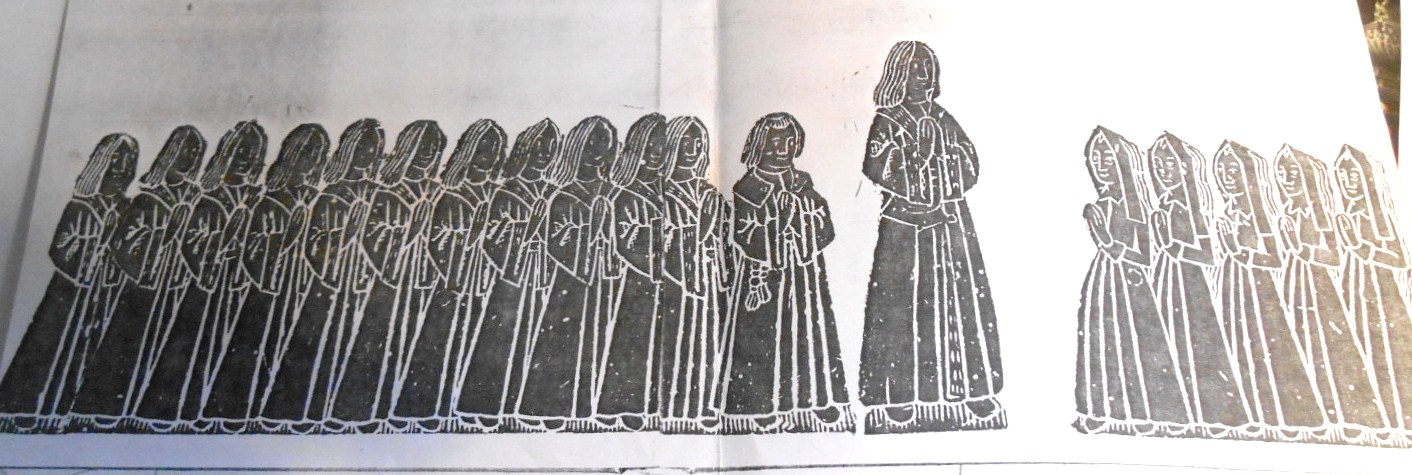
Thirteen sons and five daughters with their father on a monumental brass, 1501. 
 Families could be large.


The exception was the children of unskilled laborours on the land, who were denied even the opportunity of apprenticeship by a statute passed in the reign of Richard II (1367-1400) which tied agricultural workers' children to work on the land:
'It is ordained and assented, That he or she which used to labour at the plough and cart, or other labour or Service of Husbandry till they be of the age of Twelve Yeare, that from thenceforth they shall abide at the same labour, without being put to and Mystery or Handicraft; and if any Covenant or Bond of Apprentice be from henceforth made to the Contrary, the same shall be holden for none.'
(Statutes, Richard II Cap. V 1388.  In: F. J. Furnivall, Introduction, EETS, Vol. 32 p. xlvi)

 Joseph Strutt Sports and Pastimes of the People of England...from the earliest times... 1801etc.

For children higher up the social scale being bound apprentice to a craft was the way to a good living.  It was also quite common for the younger sons of great landowners to be apprenticed, so that their futures were proviced for, as the eldest son would inherit most of the estates.
The apprentices' rights and duties were laid out in a strict legal code and the numbers entering each craft were jealously guarded by the craft unions or guilds to keep up the wages of members and to keep the skill secrets.  A child would usually have to take what was on offer, generally being apprenticed to the same trade as his father, either with another family member or a friend.  So localities became associated with particular skills;  In Europe, where the same system of apprenticeship also applied.  So Nuremberg became famous for its clockwork mechanics and Toledo for its sword blades.

In the cities apprentices often formed strong and unruly bands, a bit like football supporters out on the town, and were quite often involved in riots.  There were a number of local laws which suggest the way they behaved: in Newcastle apprentices were forbidden to 'daunce dice cardfs mum or use any musick in the strets' and they were criticised for their extravagant dress and long hair.  In Carlisle in 1595 the apprentices were forbidden to play football. In London particularly apprentices became involved in national politics, taking to the streets with their cudgels.
)There is a very good detailed account of apprenticeship with a breakdown into trades of part of the Bristol Apprentice Roills 1532- in Dorothy Gardiner's English Girlhood at School, O.U.P. 1929)

                                  The Saltonstall Family c. 1636-7 with well-swaddled baby, Tate Gallery

Upper class children, from the European ruling elite,  could suffer in a way that the children of less important
people would not, because they were  important  family assets.
The practice of taking the children of conquered, or even allied, rulers as hostages is extremely old.  British noble-born children were brought in in Imperial Rome.  Maybe because of this it became normal practise for nobly born children, especially boys to be sent away to the household of a nobleman or equal or greater rank, often their father's overlord, possibly the monarch.  Boys were sent away about seven years old and girls a bit later.  They would serve as pages, then squires, and the girls as ladies in waiting. The Earl of Arundel sent his son to the household of the Bishop of Norwich in 1620 and commanded him:

'You shall in all Things reverence honour and obey my Lord Bishop of Norwich as you would do any of your parents, esteeming whatsoever he shall tell or Command you, as if your Grandmother of Arundell, your Mother or myself should say it; and in all things esteem yourself as my Lord's Page; a breeding which youths of my house far superior to you were accustomed to....'
(EETS original series Vol. 32, p.ix)


                  Sir Walter Raleigh and his son,a miniature version of himself, 1602.  National Portrait Gallery

It could be tough:  Roger de Hoveden, clerk to Henry II in the 12th century, remembered that at the court of Richard I's Chancellor Longchamps, Bishop of Ely:

'All the sons of the nobles acted as his servants with downcast looks, nor dared they to look upward towards the heavens unless it so happened that they were addressing him; and if they attended to anything else they were pricked with a goad, which their lord held in his hand, fully mindful of his grandfather of pious memory who, being of servile condition in the district of Beauvais, had, for his occupation, to guide the plough....'
(EETS Vol. 32 p. vi)
(One of the ways in which children of very poor families might, just, raise to a higher station, was through the Church.)


e-mail: childhoodblog@gmail.com


Thursday, 30 April 2015

Clothes and toilet training for infants in Tudor times

At about one year children were unswaddled.  Guillemeau says:

'About the eighth or ninth month, or at farthest when the childe is a yeare old, he must have coats, and not be kept swathed any longer....And chiefly the Nurse must let him have a hat.'
(Jacques Guillemeau, Childbirth, or The happy deliverie of women...To which is added a treatise of the diseases of infants and young children.  London 1612)

However, children were still quite restricted, either with leading strings or with walking frames:

'...there are stools for children to stand in, in which they can turn around any way, when mothers or nurses see them at it, then they care no more for the child, let it alone, to about their own business, supposing the child to be well provided but they little think on the pain and misery the poor child is in...the poor child ...must stand maybe many hours, whereas half an hour standing is too long...I wish that all such standing stools were burned...'
Felix Wurz, 1563, quoted in Lloyd deMause History of Childhood, 1974


Walking frames were something like a prototype baby bouncer.  They kept the child off the floor or rushes and out of mischief. Since the medieval house was neither particularly safe nor particularly clean this may have been quite necessary.

In medieval times it was normal for a child to be weaned about the age of two or when its teeth appeared.
Some advice on weaning from the second century AD suggests using morsels soaked in honey or other flavouring, or infused with milk, or moistened grits or pap made of wheat.
(Sorani gynaeciorum vetus translation Latina...Valentino Rose, 1882, Bibliotheca Scriptorum Gynecorum et Romanorum Teubrieriana p. 43)

The 16th century French Paedotrophia,advises weaning straight onto wine:

'Nore is it ill to cheer its heart with wine
For of all cordials 'tis the most divine'

This treatise also includes some interesting remedies for teething troubles:
'The sweat that from a goat or cattle's hoof distills is good'
Is this calves' foot jelly?
Also recommended:
'In a hare's brain his little finger dip'
(M. Saint-Marte, Paedotrophia, or The Art of Bringing up Children, translated into English 1718)

Some sort of loose tunic seems to have been normal every day wear, for boys and girls.
Although portraits of infants in the late Middle Ages and Tudor period show little aristocrats very richly dressed, and household accounts show that a great deal might be spent on their clothes, this is probably not a reliable guide to their every day clothing.  Being captured for posterity was a very important formal occasion, and at this date portraits were not intended to show the sitter as he or she really was but to record their position in life, a particular occasion, or even their symbolic value.  Sitters were dressed as richly as possible to show their wealth and power.

Boy aged two Marcus Gheeraerts the younger Compton Verney 1608

Variants of the smock were used for boys and girls at the toddler stage right up to recent times when romper suits and leggings became popular.  When all clothes were made by hand smocks probably lasted a growing child longer, and were easier to keep reasonably clean till children were toilet trained.

There is not much evidence on toilet training but it was probably rather haphazard since adults were not too particular about where they relieved themselves and only large important buildings had any kind of permanent toilet.

At about age seven, when a child's formal education began, boys went into breeches.  This was a quite important occasion, marking the transition from infancy. The dialogues of Claudius Hollyband and Peter Erondell, two Huguenot refugees teaching in Elizabethan London have a nice description of a noble lady preparing her two sons to go visiting.  They are about nine years old:

'Come hether both of you, doe you weare your cloathes Gentleman like?  Where is your hat-band?  Why have you taken your wast-coates?  Is it so colde? Button your Dublet, are you not ashamed to be so untrussed?  Where is your Jerkin?  For this morning is somewhat colde...(to Servat) Goe fetch your Master's silver hatched Daggers.  Put on your garters embroidered with silver...where are your Cuffes and your falls?  Hafve you clean handkerchers? Take your perfumed gloves...Put on your gownes untill we goe, and then you shall take your cloakes lyned with Taffeta, and your Rapiers with silver hilts.  Tye your shooe-strings.  Well, take your boot-hosen, and your gilt spurres.'
(From M. St. Clare Byrne, The Elizabethan Home discovered in two dialogues by Claudius Hollyband and Peter Erondell, 1949)

e-mail: childhoodblog@gmail.com


F

Saturday, 27 December 2014

Babyhood in early British history: swaddling

How now, how does the child...Unswaddle him, undoe his swaddling bands...wash him before me...Pull off his shirt, thou art pretty and fat my little darling...flea-bitten, for the black spots are there yet, is there any Fleas in your Chamber (Nurse)?...Now swaddle him again, but first put on his biggin (bonnet) and his little band with an edge, where is his little petticoat?  Give him his coat of changeable taffeta and his satin sleeves.  Where is his bib?  Let him have his gathered apron with strings, and hand a Muckinder (handkerchief) to it.  You need not yet give him his coral with the small gold chain (for teething) for I believe it is better to let him sleep until the afternoon.'
   Peter Erondell  In the Nursery, dialogue 5, quoted from M. St. Clare Byrne ed. The Elizabethan House discovered..., revised ed. 1930

When the child was born it was washed and generally oiled as a protection against the cold and rashes.  Roesslin advised annointing with oil or acorns, Guillemeau with fresh butter, oil of roses or oil of nuts (Eucharius Roesslin, The Byrth of Mankynd, newly translated out of Latin by R. Jonas, 1540; Guillemeau, Childbirth or the happy delivery of women...2nd ed. 1635)

Rubbing with salt was also recommended.  Oils and wine, which is antiseptic, were used on the baby's skin rather than water for the first few months, that is, if the child was in a well off family.  Guillemeau advised bathing regularly in lukewarm water and wine.

Infants were then swaddled; wrapped from head to toe in bands of cloth.  These, it was advised, should be changed often 'for the Piss and Dung'.  Guillemeau says children were generally changed at 7am, noon and 7pm but advises doing it more often if necessary. It must have been tempting to leave the child as long as possible as swaddling was very time-consuming. Pictures of swaddled babies show them looking like little chrysalids. In the 16th century, under the influence of adult fashions, a small ruff was sometimes added.

There are very few descriptions of swaddling, probably because it was such a universal practise that it was assumed everyone knew how it was done.  After the first few weeks the hands were freed and swaddling could be combined with other clothes.

At about four weeks according to Guillemeau 'He cannot well keep his hands swathed in, and hid any longer...Then must he have little sleeves...and then the Nurse shall begin to carry him abroad to sport and exercise him.'

Swaddling  was probably primarily intended to keep the child warm, not easy when windows were still the 'wind's eye', being, mostly, closed with ill-fitting wooden shutters when they were closed at all.  The peasant hovel might enjoy a primitive form of central heating when the cows were stabled at one end, but castles, Tudor stately homes and the homes of merchants and artisans must have been cold, draughty places in which to rear a young baby.  Doctors also frequently warned of the danger of binding a child's limbs crooked:

'Furthermore when the infant is swaddled and laid in cradle, the nurse must give all diligence and heed that she bind every part right and in his due place and order, and that with all tenderness and gentle entreating and not crookedly and confusedly, the which must also be done oftentimes in the day: for in this it is as it is in young and tender imps, plants, and twigs, the which even as you bow them in their youth so will they evermore remain unto age.  And even so the infant if it be bound and swaddled, the members lying right and straight, then shall it grow straight and upright, if it be crookedly handled it will grow likewise, and to the ill negligence of many nurses may be imputed the crookedness and deformity of many a man and woman...' (Roesslin The Byrth of Mankynde, 1540)

Roesslin's treatise, Rosengarten, was translated into English at The Byrth of Mankynde in 1540 and dedicated to Catherine of Aragon, first wife of Henry VIII.  Maybe interest in child care was stimulated by Henry VIII's attempts to rear a son and heir.

Giraldus Cambrensis made some revealing remarks on the practises of the Irish in the 12th century which are worth quoting for the light they shed by implication on English practises:
'For appart from the nourishment with which they are sustained by their hard parents from dying altogether they are for the rest abandoned to ruthless nature.  They are not put into cradles and swathed; nor are their tender limbs helped by frequent baths or formed by any useful art.  The midwives do not use hot water to raise the nose or pres down the face or lengthen the legs...'
(Giraldus Cambrensis, The Topography of Ireland, Character and habits of the Irish, Chapter 10, quoted Lloyd deMause History of Childhood, 1974)

Another reason for swaddling may have been to keep the child quiet and immobile.  Swaddled babies are more passive, sleep more and cry less. By the 16th century doctors were becoming concerned about this.  Guillemeau recommended that until the child was two he should be allowed to sleep whenever he wished and till he was three or four should spend more time asleep than awake. But he should not sleep more than half the day or he would become dull.

At about one year the child was usually unswaddled completely.


'

Sunday, 7 December 2014

History of Childhood: Babyhood pt. 1

'Tell me daughter Juliet
How stands your dispositions to be married?'
Shakespeare:  Romeo and Juliet Act 1 sc. 3

Early records of the lives and doings of children in early British history begin to appear from around the 14th and 15th centuries.  Children appear briefly in romances written for adults; there were no story books written specifically for children.  Children appear in idealised lives of the saints.  Upper class children appear as stiff little figures in formal portraits and as more lively figures in books for teaching young children proper manners.  They appear in the records of schools and they appear in legal records of births, baptisms, deaths, marriages and divorces.  If marriageable age is considered as childhood's end these records place it as around 12 for girls and 14 for boys.  This in medieval times was the age at which they could consent to or repudiate marriages arranged for them.  It would be misleading to conclude from this that most people married around the age of 14 but   an Elizabethan audience would have seen nothing unusual in Juliet's mother saying to her thirteen year old daughter:

  'Younger than you
Here in Verona, ladies of esteem,
Are made already mothers
By my count
I was your mother much upon these years
That you are now a maid '
 (Shakespeare:  Romeo and Juliet Act I sc.3.)

Marriage, then is childhood's end.  What other landmarks were there in the lives of children at this time?  The 13th century poem Ratis Raving divides childhood intro three periods; babyhood, infancy, from three to seven, and seven to fourteen.about childhood's beginnings? (Ratis Raving and other moral and religious pieces in prose and verse, edited by J. Rawson Lumby, EETS,1870)

Many people have pointed to the practise of apparently dressing children in scaled down versions of adult costume as evidence for the theory that they were regarded as miniature adults, but this is an over-simplification.  It seems clear that children, appart from the children of the poor, did undergo a period of training for adult life during which they were not treated or regarded as adults were.  The apprenticeship period extended from about the age of seven to fourteen, bug could vary considerably, especially for children destined to receive some kind of academic training.  Although people frequently went to university much earlier than they do now the age at which they attended also varied widely.  hugh Latimer, later Bishop of Worcester, went up to Cambridge at fourteen in 1504, John Holles, later Earl of Clare, and Lord Herbert of Cherbury, both went up at the age of twelve, one to Cambridge in 1579, one to Oxford in 1595.  On the other hand, William Paston was writing Latin hexameters at Eton at the age of nineteen in 1479. (Paston Letters, 1422-1509, ed. James Gairdner, 1910, letter 827, William Paston junior to John Paston, 23 Feb. 1479)

It is common knowledge that upper class children, especially boys, were usually sent away from home aged about seven as part of their education.  New-born babies could also be sent away to the care of a wet nurse; upper class mothers did not usually nurse their own children.  From the late 16th century doctors began to recognise the connection between wet nursing and high child mortality.  They often condemned non-nursing mothers but the practise continued right up to the 19th century, maybe even till the invention of powdered baby milk, though in the 18th century it became more common for the wet nurse to live in where she could be kept under closer supervision.  Just how many stories of changeling children were based on wet-nurses substituting another baby for their charge?

Parents then as now often found themselves with a howling, puking, crapping, apparently uncontrollable infant who would not conform to early theories of proper behaviour.  One solution was to rationalise the his saying the child was a changeling, left in place of their own sweet baby which had been spirited away by fairies or witches.  The Mallem Maleficarum, 1487, says that changelings could be recognised because they 'always howl most piteously and even if four of five mothers (wet nurses) are set to suckle them they never grow.'  According to Martin Luther 'They often take the children of women in childbirth and lay themselves in their place and are more obnoxious than ten children with their crapping, eating and screaming' (Quoted in DeMause, History of Childhood)

The practise of hiring wet-nurses goes back to antiquity.  One of the Roman Gracci family, returning to Rome from the Punic Wars in the 2nd century BC, is said to have greeted his nurse with more affection than his mother, saying: 'I know that you bore me nine months in your womb, yet that was out of necessitie, because you could do no otherwise, but when I was borne you forsooke me, and my Nurse-mother willingly entertained me, carried me three years in her armes, and nourished mee with her own bloode' (milk was believed to be re-constituted blood:  Jacques Guillemeau.  Childbirth, or the Happy Delivery of Women. 1612)

The wet nurses were usually peasant girls living in comparative poverty.  such girls might have just lost a baby of their own or, if they had plenty of milk, they might try to support two babies.  Of course they would be expected to put their little charges before their own babies and many peasant babies may have been deprived and died like Susan, child of the Nurse in Romeo and Juliet:
'Susan and she - God rest all Christian souls!
Were of an age.  Well, Susan is with God;
She was too good for me...'
Romeo and Juliet Act 1 sc. 3

About a third of all infants generally died in their first year and two thirds before growing to maturity.  In periods of plague the rates must have been far higher.  So normally infants would be baptised as soon as possible as unbaptised babies would not go to heaven if they died.  Often two children would be given the same Christian name, as in the Paston family the two eldest boys were both called John after their father, in this case both survived childhood.