Tuesday, 25 October 2016

The English Puritans and their children

'My pretty Child, remember well,
you must your ways amend;
For wicked Children go to Hell,
that way their courses tend.'
(Henry Jessey, A looking glass for children, 1673)

The influence of the Reformation and of the slowly gathering strength of the Puritans took far longer to be felt than the effects of the Renaissance on education.  Although the Reformation had immediate consequences in the reign of Henry VIII ,as far as religious doctrine was concerned one of the most profound effects was the general increase in the intensity of religious feeling brought about by sectarian controversy.  This did not begin to show its full effect until the 17th century, when, through the Civil War and Interregnum the beliefs of the Puritan minority had a profound effect on the religious attitudes of the nation.  Nor did the influence of the Puritans on religious life cease after the restoration of the Monarchy in spite of the various Acts of Parliament passed against those who did not conform to the practices of the Church of England; the various Nonconformist sects gained rather than lost strength and from the late 17th century played an increasingly important part in improving social conditions as well as having an important effect on religious attitudes, and children's education.

Puritanism grew steadily in England from the end of the reign of Queen Mary I in 1558 when many Puritans who had gone into exile returned to England.  A prominent Puritan, Hugh Rhodes, wrote a book of courtesy printed in 1577 which is is interesting to compare with the earlier examples.  The advice on manners is much the same, but there is far more advice to parents on the spiritual upbringing of their children.  Rhodes placed great importance on this, like all Puritans, saying: 'The cause of the world being so euill of lyuing as it is, is for lack of vertue, and Godly bringing up of youth.'
He advised parents to keep a very strict watch over where they go and who they meet, to prevent them from becoming corrupted: 

'nor let your Chyldren go whether they will, but know whether they goe, in what company...Take hede they speake no wordes of villany...nor shew them much familiaritye...Mark well what vice they are specially inclined unto, and break it betymes.'.  Of course he advised parents to carechise their children frequently: 'Take them often with you to heare Gods work preached and then enquyyre of them what they heard, and use them to reade in the Bible and other Godly Bokes.'  Rhodes also voices the Puritan prejudice against fairy tales and romances which was to become so general in the 19th century among all right-minded parents and teachers: 'but especially keepe them from reading of fayned fables, vayne fantasyes, and wanton stories and songs of loue, which bring much mischiefe to youth...'
(Hugh Rhodes, The boke of Nurture, or schoole of good manners for men, servants and children...1577 EETS original series no. 32)

 Puritans addressed themselves with a particular sense of urgency to the salvation of children.  Lady Grace Mildmay expressed this sense of responsibility when she wrote: 'It is not possible for parents to be good or to have any virtue in them who seeke not to make theyre children good'
(Lady Grace Mildmay Diary, quoted in Quarterly Review 1911, vol. 15 p.128)

Mrs. Elizabeth Jocelin wrote The Mother's Legacie to her Unborn Child out of this sense of spiritual duty: 'Yet still I thought there was some good office I might do for my Childe more than onely to bring it forth
(tho' it should please God to take me.) When I considered our frailty, our apt inclinations to sin, the Devil's subtilty, and the world's deceitfulness; against these how much desired I to admonish it?'
(Elizabeth Joceline 1625)

In Puritan families adults and children were encouraged to keep spiritual diaries noting their progress towards salvation, or otherwise, and any evidence of divine grace.  (Similarly, Catholic children would be expected to go to Confession.) As a result of this regular diary-keeping many more details of day to day life are available from the 17th century onwards.  Evidence of divine grace seems to have given some diarists trouble, and God is credited with some curious interventions:
'I find we have another mercy to praise the Lord for. Thea has voided abundance of worms, some almost a quarter of a yard long...The Lord be praised'
(Dorothy Oglander to her husband, 1663, in Aspinall-Oglander, Cecil Nunwell Symphony, Hogarth Press, 1945)
 'This last night Matthew fell out of bed, not hurt, a wonderful preservation, blessed bee God, even our God' (Diaries and letters of Philip Henry MA 1631-1696 ed. Matthew Henry Leu, 1882)

At the beginning of the reign of Queen Elizabeth (1558-1603) legislation had been passed requiring heads of families to catechise their children and instruct them in the principles of religion according to the Church of England.  The reasons for this were political, since religious schism was one of the principal causes of political dis-unity in th 17th century.  Most heads of families regarded catechising their children as one of their most important duties towards them, and Puritans were particularly scrupulous about this.  Catechising children is noted regularly in their journals and diaries: 'Nov. 1 1661.  I catechised & instructed my children after supp, and wee had family duty, & went to bed,...'
(Diary of the Rev. Henry Newcome...ed. Thomas Heywood, Chetham Soc. Vol. 18 1849)

Children in Puritan households like that of Mrs.Walker learned to read at an early age, so that they could begin to study their catechism and Bible: 'To promote and forward their religious instruction she taught them to Read as soon as they could pronounce their Letters,.,,and sowed the Seed of early Pious Knowledge in their tender Minds, by a plain, familiar catechism.'
(Anthony Walker The Holy Life of Mrs. E. Walker...1690)

The best known Puritan work addressed to children, which remained in common use throughout the 19th century in both Britain and America is the Nonconformist minister James Janeway's Token for Children, Being an exact account of the conversion, Holy and Exemplary Lives, and Joyful Deaths of several young Children, 1671-2.
(British Library)
This was an attempt to terrify both parents and children into salvation. It contains two prefaces, one addressed to parents asking: 'Are the souls of your children of no value? Are you willing that they should be brands of hell?'  The second preface is addressed to the children:

  'You may now hear (my dear lambs) what other good children have done, and remember how they wept ad prayed by themselves...Did you ever get by yourself and weep for sin and pray for grace and pardon?...How dost thou spend thy time?  Is it is play and idleness, and with wicked children?...Were not these sweet children, which feared God and were dutiful to their parents?...What do you think is become of them, now they are dead and gone? Why, they are gone to heaven, and are saying hallelujahs with the angels...they shall never be sick, or in pain any more...And are you willing to go to hell to be burnt with the devil and his angels?  Would you be in the same condition as naughty children?  Oh hell is a terrible place, that's worse a thousand times than a whipping...Would you not do anything in the world to get Christ, grace and glory?  Did you never hear of a little child that died?  And if other children die, why may you not be sick and die? (James Janeway A Token for Children, 1671-2)

At a time when early death was only too common the effect on sensitive children of constant threats of hellfire may be imagined. John Bunyan, author of The Pilgrim's Progress,  has left one of the best known accounts from this period of his childhood fears of hell:
'Even in my childhood he (God) did scare and affrighten me with fearful dreams...Also I should, at these years, be greatly afflicted and troubled with the thoughts of the fearful torments of hell-fire.  These things, I say, when I was but a child, but nine or ten years old, did so distress my soul that then, in  the midst of my many sports and childish vanities, amidst my vain companions, I was often much cast down and afflicted in my mind.'
Bunyan, however, in spite of the dreadful warning of his nightmares, admits he 'had but few equals (especially considering my years, which were tender, being but few) both for cursing, swearing, lying and blaspheming the holy name of God...'(Bunyan, Grace Abounding, 1666)

Bunyan's account calls to mind the most dramatic of Janeway's little biographies:
 'of a notorious wicked Child, that was taken up from begging, and admirably converted, with an account of his Holy Life and Joyful Death, when he was nine Years old.'
He was, says Janeway, 'a very monster of wickedness, and a thousand times more miserable and vile by his sin than by his poverty.  He was running to hell as soon as he could go, and was old in naughtieness when he was young in years...He would call filthy names, take God's name in vain, curse, and swear, and do almost all kind of mischief, and as to any thing of God's worse than a heathen.' (James Janeway, A Token for Children, 1671-2)

Another well known Nonconformist, Abraham Chear, wrote the well-known To a young Virgin, 1663:

'When by Spectators I am told
what Beauty doth adorn me,
Or in the glass when I behold,how sweetly God did form me.
Hath God such comliness display'd
and on me made to dwell
'Tis pitty such a pretty maid
As I should go to Hell'
(In Henry Jessey A looking-glass for children 1673)

It seems surprising that a strict Nonconformist should encourage a young girl to think about her looks; one of the characteristics of Nonconformist writing for children is that girls were constantly assured that a good nature shining out is all the beauty a face needs.  The first Puritans seem to have believed, until they were undeceived, that good Christian principles are all that is needed and god nature will follow.  But those little children did need lots of reminding:

'My little Cousin, if you'll be
your Uncle's dearest Boy;
You must take heed of every deal
that would your Soul destroy.
You must not curse, nor fight, nor steal
nor spend your time in games,
Nor make a lie, what e'ere you ailes,
nor call ungodly names.
With wicked Children do not play,
for such to Hell will go;
The Devil's children sin all day
but you must not do so.'
(Abraham Chear, 1673 op.cit)

The Nonconformist minister John Angier had a typical Puritan upbringing.  His mother, 'being a choice and gracious Christian, often spake to him of Soul concerns, wept and prayed much for him.'  He experienced religious conviction of being saved at about twelve, but after that he often had doubts which, he says, 'he kept to himself, and often retired into a corner, being ashamed that anyone should know of his heart-grief'  To him this would have been a sign that his spiritual re-birth had not been genuine.  He had a brother with the good Biblical name of Bezaleel.
(Oliver Heywood, Narrative of the life of John Angler, Minister of the Gospel at Denton, 1685,  Chetham Soc.  vol. 97, 1937)

The spiritual sufferings of children were welcomed as signs of their impending spiritual redemption:
 'The briny tears for the natural Death of one very desirable Child were swallowed up by the Tears of Gladness for the lively symptoms of the Spiritual Birth of another...The Pathetick Earnestness with which the Child cried for Pardon and supplies of grace, enflamed and melted all that heard her.'
(The Holy Life of Mrs. E. Walker, 1690)
This child's parents went on to record, with deep satisfaction, their little daughter's spiritual forwardness, much as a modern parent might describe signs of great intelligence:
'About four Years of Age, on days of Prayer and Fasting, she would sit by me the whole Day, and at Prayer hold up her little Hands...' ((op. cit. )

There seems to have been little attempt to distinguish between degrees of sinfulness, the thoughtlessness of childhood being as sure a path to hell as the misdeeds of the most hardened criminal.  Elizabeth Joceline makes a determined effort to equate disobedience with breaking all the Ten Commandments:
...thou canst not bee a disobedient child but thou art a murderer...of thy father...by thy disobedience his gray head brought with sorrow to the grave...'(E. Joceline The mother's legacie to her unborne childe.  1625)
As a result children often became morbidly over-anxious over relatively trivial faults:
'If I desired any thing that was grateful to my Appetite, when it was brought to me I durst not make use of it, because I thought it to be the satisfaction of a base sensual Appetite'  (Walker, op. cit)

'When his child was about five or six years old, she had a new plain Tammy Coat...having looked upon her Coat, how fine she was, she presently went to her Chair, sate down, her tears running down her eyes, and she wept seriously to herself.  Her Mother...said to her, How now? What is the matter that you weep?  The Child answered... I am afraid my fine Cloaths will cast me down to Hell.  Her Mother said, it's not our Cloaths but wicked hearts that hurt us.  She answered, "Aye, Mother, fine Cloaths make our hearts proud."'(Jessey, op. cit)

It is not surprising that  children often had no sense of proportion about their faults when adults accepted such confessions completely seriously. The spiritual sins of the Rev. Ralph Josseline when a child, though unspecified, sound more promising work for the Devil:  '...oh ye strange prodigious unclean lusts when I was yett a child; how often have I walkt with delight to meditate upon such courses, being too well acquainted with those scenes by books which I had; yett I bless God who kept mee from all outw'd uncleanness; praise bee to him, and for this I desire to loath and abhorre my selfe.' (Diary of the Rev. Ralph Josselin 1616-1683, Camden Soc. 3rd series, vol. 15 1908)

The famous reverend Richard Baxter has also listed the chief 'sins' of his youth:
'I was somewhat excessively addicted to play, and that with covetousness, for money.  I was guilty of much idle foolish chat, and imitation of boys in scurrilous foolish words and actions (though I durst not swear)
I was too proud of my masters' commentations for learning.
I was too bold and unreverent towards my parents.'
(Autobiography of Richard Baxter, Reliquiae Baxterianae abridged from the folio, 1696, ed. J.M. Lloyd, 1925)

Like Lydgate, Baxter 'was much addicted to the excessive gluttonous eating of apples and pears...To this end, and to concur with naughty boys that gloried in evil, I have oft gone into other men's orchards and stolen their fruit, when I had enough at home.'  Like most children he loved fairy tales, but as an adult disapproved of them.
'I was extremely bewitched with a love of romances, fables, and old tales, which corrupted my affections and lost my time.' (Baxter op.cit)

The Rev. Henry Newcombe reveals in his diary that as a boy he spent his Sundays 'going nutting' and 'playing bandy ball' (op.cit) and when John Angier went up to Cambridge, away from his mother's influence, he 'fell off to vain companie and loose practises...see the slippperiness of youth.'Oliver Heywood's Life of John Angier, op.cit)

It is something of a relief to read these accounts of backsliding and irreligious behaviour; conformation of the essential normality of Puritan youth.  


e-mail childhoodblog@gmail.com


Monday, 29 August 2016

Moral Stories for Children

' A State is civilised in proportion to the number of its members, who have a lively sense of moral obligation... Where such a spirit does not prevail, the most flourishing condition of commerce and manufactures will be found an empty boat....'
(Thomas Beddowes, The History of Isaac Jenkins, preface to the 5th edition, Bristol, 1793)
Most of the source books for this post are now available on the internet, and it is well worth reading some of them.

Her Benny, A tale of Liverpool life.  1890
(Google eds. New York Public Library)
The growing concern of the British public about the living conditions of the poor, and particularly their children, was expressed in poetry and fiction, and quickly became a major theme of British children's books.  Their popularity is a sign of a developing social conscience in the Victorian period.  

In the 18th and the first half of the 19th centuries most children's stories were written to serve a moral purpose by people who were working with the poor.  They saw it as very important to train children to be charitable.  There were very many stories written about the pleasures of giving, and relieving the wants of the needy, rather than selfishly spending pocket money on oneself.  Children were encouraged both by stories and in real life to visit the sick, to provide not only money but also to make and give woolly scarves, baby clothes, plain sewn shirts and warm shawls to the less well off.  There was very little state help for the poor and charity was extremely important.

Since many of these stories were written by people involved in religious movements there is generally a lot about conversion and the power of prayer in them.  Frequently the hero or heroine is exposed to, and resists, terrible temptation to steal or lie, cardinal sins for Victorian children.  Benny, saved from sin by his sister Nelly, prays for forgiveness at her urging: 'If you plaise, Mr. God, I's very sorry I tried to steal but if you'll be a trump an' not split on a poor little chap, I'll be mighty 'bliged to yer.  an' I promise 'e I won't do nowt o'the sort agin. (Silas Hocking, Her Benny, 1879)


Froggy, the crossing sweeper, when offered stolen money cries defiantly: "Take your two bob back again I say.  I'd rather starve than steal...'('Brenda, Georgina Castle Smith, Froggy's Little Brother, 1875) The same innate honesty is apparent in Oliver Twist, an outstanding example of the Victorian belief that gentle birth somehow genetically transmitted such gentlemanly  characteristics as honest, politeness and meekness combined with the ability to stand up fearlessly for the right.  The appealing Oliver probably did as much as a whole series of Parliamentary Reports to arouse public concern for children in the parish workhouses, and for those neglected outcasts begging on the streets whom Fagin and people like him used and corrupted.  The subtle irony of Dickens' description of Oliver's appearance before the Board of Guardians compresses into a few sentences the world of difference between observance of the spirit and the letter of the Acts for the training of pauper children:
  '"Well! you have come here to be educated and taught a useful trade", said the red-faced gentleman in the high chair.
   "So you'll begin to pick oakum to-morrow morning at six o'clock" added the surly one in the white waistcoat.'  (Charles Dickens, Oliver Twist, 1838)

Charles Dickens, Oliver Twist, 1838
(Wikipedia)

It is easy to deride these moral stories and to forget that when there was only very basic state provision for the poor the encouragement of private charity was absolutely essential.  Children's books, rather than adult fiction, pioneered social realism in the portrayal of the conditions of the poor long before the great adult social novels of the 1840s and 1850s.

The History of Isaac Jenkins, by Thomas Beddoes, physician and close friend of the poet Coleridge, was published in 1793.  It describes the great harvest failure of that period and the effect on one poor family.  Here is part of the description of the sufferings of that winter: 

   'What was to become of the poor, now their little store was all eaten and gone?...It was bad already with them and a worse look-out...God be thanked; there are kind charitable folks in the world, or else many an honest poor creature would have perished for want that winter!...Notwithstanding there came great sickness over all the country, and numbers were swept away by the spotted fever, especially among the poor.  It went worst with the little children, for they died, generally one, sometimes two or more, where there were six or seven in a family.  And nothing was to be heard in the dark of the evening, but the church bells tolling for funerals...' (Thomas Beddoes The History of Isaac Jenkins, London, 1793)

Nonconformist Christian groups were particularly active producing moral stories which described the conditions of the poor.  Many of the writers were actively involved in working with the poor, in Sunday schools and ragged schools and various charities.  The moral stories and religious tracts were published by organisations such as the Society for the Promoting of Christian Knowledge and the Religious Tract Society.  It is hard to tell how much influence they had on the children who read them but many autobiographies mention famous titles such as the best-selling Jessica's First Prayer by Hesba Stretton, 1866:

Hesba Stretton (Sarah Smith) Jessica's First Prayer 1882 ed.
(Archive.Org. University of Connecticut)Just one of many editions
'A thin and meagre face belonged to the eyes, which was half hidden by a mass of matted hair hanging over the forehead, and down the neck; the only covering which the head or neck had, for a tattered frock, scarcely fastened together with broken strings, was slipping down over the shivering shoulders of the little girl.  Stooping down to a basket behind his stall, he caught sight of two bare little feet curling up from the damp pavement, as the child lifted up first one then the other, and laid them one over another to gain a momentary feeling of warmth.  Whoever the wretched child was, she did not speak; only at every steaming cupful which he poured out of his can, her dark eyes gleamed hungrily, and he could hear her smack her thin lips, as if in fancy she was tasting the warm and fragrant coffee.'  Jessica the little beggar girl is reclaimed for God by the local chapel, taught to read and keep herself neat and clean, and eventually adopted by the coffee stall owner.

Children were taught to differentiate between the deserving and undeserving poor, between those who kept their children clean and their houses neat as a new pin, whatever the weather, and whether or not hot water was easily available, and those sluts whose houses and children were filthy and whose husbands, if they had them, spent their money at the ale-house or on gin.

The feminist campaigner Mary Wollstonecraft, author of A Vindication of the Rights of Women, also wrote the story of Caroline who has been allowed, as a moral lesson, to spend all her pocket money on finery so that she has none left to help the poor family her guardian confronts her with.  Mrs. Mason, having looked about for a suitable object of charity has found one: 'They ascended the dark stairs, scarcely able to bear the bad smells that flew from every part of a small house, that contained in each room a family, occupied in such an anxious manner to obtain the necessaries of life, that its comfort never engaged their thoughts.  The precarious meal was snatched, and the stomach did not turn, though the cloth on which it was laid was dyed in dirt.  When tomorrow's bread is uncertain, who thinks of cleanliness?  Thus does despair increase the misery, and consequent disease aggravates the horrors of poverty.'
(Mary Wollstonecraft, Original stories from real life, 1788)
Original drawing by William Blake for the 1791 edition,
(Library of Congress)

Children's writers were fond of reminding their readers of the contrast between their comfortable lives and those of poor children, to encourage charity.  The Little Beggar Girl by one of the Taylor sisters is just one of an enormous number of similar poems included in children's anthologies:

'There's a poor beggar going by,
I see her looking in,
She's just about as big as I,
Only so very thin.

She has no shoes upon her feet,
She is so very poor
And hardly anything to eat,
I pity her, I'm sure.

But I have got nice clothes, you know,
And meat, and bread, and fire,
And you, mamma, that love me so,
And all that I desire
.....
Here, little girl, come back again
And hold your ragged had,
For I will put a penny in,
So buy some bread with that.'
 (Jane and Anne Taylor, Select rhymes for the nursery, 1807)

 After the revelations of the series of 19th century Parliamentary Reports on labour conditions, the hardships of poverty were often exaggerated by being described with unrelieved grimness for dramatic effect, while the poor, as fictional characters, were often sentimentalised.  Writers of fiction both for children and adults found in the sufferings of the poor a theme which moved their readers.  The working children of the poor excited particular concern partly because compassion of the weak and helpless was a quality which Victorian society admired, partly because the Victorian middle class was well on the way to creating a cult of cosy, sheltered childhood.  From Jane Eyre to Oliver Twist and Andersen's Little Match Girl, all wrung the heart precisely because they were children enduring sufferings which the reader no longer associated with a rather idealised idea of childhood.

Charles Kingsley's famous book about the moral education of a young chimney sweep boy, The Water-Babies was also inspired by Parliamentary Reports into working conditions, in this case those of chimney sweeps' boys, which had not improved much since the 1817 Report into their conditions, mainly because no adequate system of inspection had been set up.  Lord Shaftsbury pressed for further reforms in the 1840s and Kingsley's book helped to rouse public opinion.  The Water-Babies is a very unusual combination of fantastic fairy tale and social realism, and this is probably why it became a children's classic when most moral stories have been condemned as either too moralistic or too sentimental.  ' "Oh yes" said Grimes, "Of course it's me.  Did I ask to be brought here into the prison?  Did ask to be set to sweep your foul chimneys?  Did I ask to stick fast in the very first chimney of all, because it  was so shamefully clogged up with soot?  Did I ask to stay here - I don't know how long - a hundred years, I do believe, and never get my pipe nor my beer, nor nothing fit for a beast let alone a man."
"No", answered a solemn voice behind, "No more did Tom, when you behaved to him in the very same way."'  (Charles Kingsley The Water-Babies, 1863)

Mr. Grimes and Tom.  Illustrator Anne Grahame Johnstone,
c.1960? This children's classic ran to many editions.

Macdonald, himself from a poor background, included some pointed criticism of the insensitivity of some do-gooders in At the Back of the North Wind:  'I have known people who would have begun to fight the devil in a very different way.  They would have begun by scolding the idiotic cab man; and next they would make his wife angry by saying it must be her fault as well as his, and by leaving ill-bred though well-meant shabby little books for them to read, which they were sure to hate the sight of; while all the time they would not have put out a finger to touch the wailing baby.'  
Few writers who wrote adult novels about the poor concerned themselves with children, but there are a few exceptions.  Dickens used characters such at Tiny Tim in 
A Christmas Carol and Little Nell in The Old Curiosity Shop to heighten pathos in his novels. Arthur Morrison in Child of the Jago wrote the entire novel from the ;point of view of a child brought up in one of London's 'courts'; tenement blocks round a central enclosed square where, in some districts, the police would only venture in twos.

Arthur Morrison A Child of the Jago.
(Illus: Londonfictions.com)
A similar realistic novel is George Moore's Esther Waters, about that shocking unmentionable subject, unmarried mothers.,  It contains an expose of baby-farms, the subject of several Victorian scandals. Unmarried mothers who kept their babies found it very difficult to get jobs except as wet-nurses. Many simply abandoned the babies they could not support, as they had done for centuries. Thomas Coram opened the Foundlings Hospital in London in 1745 out of compassion for the babies whose bodies were to be found on every city dung heap.  In Victorian times infants began to be left in the care of a baby-farmer while the mother went to work.  The baby farmer was tempted to spend as little as possible on their care, to increase her profit, and in several cases these women were actually convicted of murdering their charges, having taken them for a fixed sum saying they would arrange their adoption.  In Esther Waters the baby-farmer Mrs. Spires offers to take Esther's baby off her hands for five pounds, and it is quite clear what will happen to him: '"It goes to my 'eart,'" said Mrs. Spiers, "It do indeed, but, Lord, it is the best that could 'appen to 'em; whoe's to care for 'em?  and there is 'undreds and 'undreds of them - ay, thousands and thousands every year - and they all dies like the early flies.  It is 'ard, very 'ard, poor little dears, but they're best out of the way - they're only an expense and a disgrace. "'
Moore believed that his book helped to remedy this situation by encouraging legislation making baby-farming illegal, and by helping also to create sympathy for unmarried mothers.
(George Moore, Esther Waters, 1894)

The popular best seller Ministering Children, 1854, is not only about the satisfaction to be gained from helping the poor, but about doing it in the right way, not just with money which might be misused, but with visits to the sick, comforting broths, warm clothing and good deeds.  In the preface Maria Charlesworth explains her aim:  'May it not be worthy of consideration, whether the most generally effective way to ensure this moral benefit (of practising charity) on both sides, would not be the early calling forth and training the sympathies of children by personal intercourse with want and sorrow.' (Maria Charlesworth, Ministering Children, 1854)
Ministering Children, 1867 ed.
(University of California, Archive Bookmaker)
Sometimes the writer breaks off the story to make a direct appeal, as in the best seller Froggy's Little Brother by Brenda; Georgiana Castle Smith , 1875:
  'Parents and little children, you especially who are rich, remember it is the Froggys and Bennys of London for whom your clergyman is pleading when he asks you to send money and relief to the poor East End.'  In Flora Thompson's Oxfordshire village where people were relatively poor 'many tears were shed over Christie's Old Organ and Froggy's Little Brother, and everyone wished they could have brought those poor neglected slum children there and shared with them the best they had of everything.' (Flora Thompson, Lark Rise to Candleford, 1945)

Froggy's Little Brother by 'Brenda' 1875
(University of Roehampton)
Children's stories in both Britain and America often included scenes such as the one in Little Women where the girls give their Christmas breakfast to a family of starving immigrants: 'A poor, bare, miserable room it was, with broken windows, no fire, ragged bedclothes, a sick mother, wailing baby, and a group of pale, hungry children cuddled up under one old quilt, trying to keep warm.  How the big eyes stared, and the blue lips smiled, as the girls went in.  "Ach, mein Gott!  it is good angels come to us!" cried the poor woman crying for joy.  "Funny angels in hoods and mittens," said Jo, and set them laughing.!' (Louisa M. Alcott,  Little Women, 1868, an American story which was a best seller on both sides of the Atlantic)

The pathos in  most American  stories about the poor, as in Little Women, derives from the loss of a parent or facing straightened circumstances rather than actual starvation, as in Susan Warner's best-seller Queechy, 1852 which was based on her own experiences.  The popularity of books like this and Little Women may have been partly due to the uncertainties of life in America where fortunes were quickly made and as quickly lost.  The book was hugely popular in Britain with both adults and children; in Susan Warner's biography it says there were ten thousand copies sold at one railway station in England, but the publishers scouted the idea of sending the author a cent!' 

The optomistic, resourceful orphan girl was America's unique contribution to the genre in the late 19th and early 20th centuries.  Heroines such as Pollyanna, Anne of Green Gables, Rebecca of Sunnybrook Farm, or Jo in Little Women faced up to a hard world and made it love them for their impetuous but always good-hearted efforts to please and help others.

Mrs. Francis Hodgson Burnett, a British writer who emigrated to America on her marriage successfully combined the two types of story into one of the classics of its kind, A Little Princess, the story of a little girl whose rich papa leaves her at a select boarding school while he is on an expedition in search of further sources of wealth.  Letters stop coming and the bills remain unpaid.  Vindictive Miss Minchin makes Sara, once the prize pupil, into the school drudge.  Throughout all her trials she behaves with immense unselfishness and nobility.  In this enormously satisfying story the reader can not only enjoy identifying with Sara through miseries that are, masochistically, increased as a result of her immensely noble behaviour, but is rewarded not merely by a happy ending but by even vaster riches than those of which she was abruptly derived at the beginning of the book.  Moreover she magnanimously forgives Miss Minchin for making her the drudge of the school when the bills stopped being paid.
Here is Sara who has found sixpence in the street and bought hot buns when she sees a beggar girl: 'The child was still huddled up on the corner of the steps.  She looked frightful in her wet and dirty rags.  She was staring with a stupid look of suffering straight before her, and Sara saw her suddenly draw the back of her roughened, black hand across her eyes to rub away the tears which seemed to have surprised her by forcing their way from under her lids...Sara opened the paper bag and took out one of the hot buns, which had already warmed her cold hands a little...The child stared up at her; then she snatched up the bun and began to cram it into her mouth with great wolfish bites.  "Oh my! Oh my!" Sara heard her say hoarsely, in wild delight.  "Oh my!" Sara took out three more buns and put them down.  "She is hungrier than I am," she said to herself. "She's starving."But her hand trembled when she put down the fourth bun.  "I'm not starving, "she said, - and she put down the fifth.'  A great piece of writing which never fails to move an audience.

Illustration to an Edwardian edition
(Fotobook.com)
With so very many moral stories on the market 19th century readers may have eventually suffered from benefactor fatigue.  It may have been with some glee that they read parodies of the moral story such as Thackeray's The Rose and the Ring:
   '...there came toddling up to them such a funny little girl!  She had a great quantity of hair blowing about her chubby little cheeks, and looked as if she had not been washed or combed for ever so long.  She wore a ragged bit of a cloak, and had only one shoe on.
"You little wretch, who let you in here?"  asked Gruffanuff.
"Give me dat bun" said the little girl, "Me vely hungry."
"Hungry! What is that?" asked Princess Angelica, and gave the child the bun.
"Oh, Princess!" says Gruffanuff, "How good, how kind, how truly angelical you are !"...
"I didn't want it," said Angelica.
"But you are a darling little angel all the same" says the governess.
"Yes I know I am" said Angelica....' (William Makepeace Thackeray, The Rose and the Ring, 1855)

Edith Nesbit also gave a subtle twist to the Ministering Children theme:
'"Do you mean to say...that you and Alice went and begged for money for poor children and then kept it?"'
(Edith Nesbit, The New Treasure Seekers, 1904)

Friday, 19 August 2016

Child slavery Part II

'Naked to the waist, an iron chain fastened to a belt of leather runs between their legs clad in canvas trousers, while on hands and feet an English girl, for twelve, sometimes for sixteen hours a day, hauls and hurries tubs of coal up subterranean roads'. (Benjamin Disraeli, Sybil or, The Two Nations, 1845)

Children had been used as cheap labour for centuries without remark.  One interesting thing about this passage from Disraeli's Sybil, 1845, is that it was written at all:

(Title page from Wikipedia)
The details of Disraeli's description are taken directly from the recently published Report of the Commissioner for Mines, 1842 ( British Parliamentary Papers.  Industrial Revolution.  Children's Employment, vol. 6) one so shocking that Disraeli has actually toned down his facts.  The Report on conditions in the Lancashire mines breaks for a paragraph out of factual Commissioner's prose: '...any sight more disgustingly indecent or revolting can scarcely be imagined than these girls at work...the girls as well as the boys stark naked down to the waist...their sex was only recognisable by their breasts...at least three-fourths of the men for whom they 'hurry' were stark naked.'

The Commissioners and Disraeli were particularly upset by the conditions in which small children were found working, and by their extreme youth:'Infants of four and five years of age work as trappers in the dark, opening and closing the air doors to the galleries for the coal wagons.'  The children were down there in the pitch dark for hours at a time.  One of the Commissioners was particularly upset by Margaret Leveston, six years old, coal-bearer.  He tells her story in her own words:  'Been down at coal-carrying six weeks; makes 10 to 14 rakes a-day; carries full 56lb of coal in a wooden bachit. "The work s no guid: it is so very sair.  I work with sister Jesse and mother; dinna ken the time we gant (to work in the morning) it is gair dark." A most interesting child, and perfectly beautiful.'

From the mid 19th century onwards a number of British writers went to investigate the condition of the poor for themselves.  Henry Mayhew includes such accounts in his work on the poor in London.  Boys would sweep street crossings, hoping for a few pennies from passers-by.  Mayhew says:
'He was a good looking lad, with a pair of large mild eyes, which he took good care to turn up with an expression of supplication as he moaned for a halfpenny.
    A cap, or more properly, a stuff bag, covered a crop of hair which had matted itself into the form of so many paint-brushes, while his face, from its roundness of feature and the complexion of dirt, has an almost Indian look about it....
    He ran before me, treading cautiously with his naked feet, until I reached a convenient spot to take down his statement, which was as follows:
  "I've got no mother or father; mother has been dead for two years, and father's gone for more than that...(He lived with his sister till she got married, then he and his brother in law did not get on)  One day he hit me and I said I wouldn't be hit about by him, and then at that night sister gave me three shillings, and told me I must go and get my own living.  So I cleaned boots, and I done pretty well with them, till my box was stole from me... (He is fifyteen and has swept crossings for two years)  After the Opera we go into the Haymarket, where all the women are who walk the streets all night.  They don't give us no money, but they tell the gentlemen to..." (Henry Mayhew, Mayhew's London, selections from London Labour and the London Poor, 1851, ed. Peter Quennell, Spring Books, 1969 pp.399-402)

Boy crossing sweepers.
London Labour and the London Poor, 
1865 (British Library)
Mayhew's description of the coster girls is interesting to set against fictionalised accounts:
  'At about seven years of age the girls first go into the streets to sell. A shallow-basket is given to them, with about two shillings for stock-money, and they hawk, according to the tome of year, either oranges, apples, or violets; some begin their street education with the sale of water-cresses.  The money earned by this means is strictly given to the parents.  Sometimes - though rarely - a girl who has been unfortunate during the day will not dare return home at night, and then she will sleep under some dry arch or about some market, until the morrow's gains shall ensure her a safe reception and shelter in her father's room.  (Mayhew, p. 91)
In the hands of a writer such as Hans Andersen this dry description becomes a story to wring the heart,
the story of one little match-girl, afraid to go home on a cold winter's night:
'In the dawn of morning there lay the poor little one with pale cheeks and smiling mouth, leaning against the wall; she had been frozen to death on the last evening of the year; and the New-year's sun rose and shone upon a little corpse!  The child still sat, in the stiffness of death, holding the matches in her hand, one bundle of which was burnt.  "She tried to warm herself," said some!'  (Hans Andersen's Fairy Tales, A new translation by Mrs. Paull...1867.  Hans Andersen is a Danish writer; translations of his work quickly became very popular in Britain)

Other British writers followed Mayhew in making their own investigations in the slums and producing accounts of what it was actually like for the teeming poor of Britain's big cities, maintaining themselves just above subsistence and coming into contact with the classes above them mainly when they failed to do so. Writers were particularly concerned by the working and living conditions of children, in such pitiable contrast to the sheltered childhood most middle class Victorian children were enjoying.  Hidden away in the back kitchens of squalid courts and tenements, mothers and children too young to be sent out to factories or service did long hours of piecework, paid pitifully small sums for what they produced:
   'In a kitchen, in a house of Jennens Row (Birmingham)...late one evening, I found three little children, busy at work at a table on which were heaped up piles of cards, and a vast mass of tangled hooks and eyes.  The eldest girl was eleven, the next was nine, and a little boy of five completed the conmpanionship.  They were all working as fast as their little fingers could work.  The girls sewed, the baby hooked...'The average earnings for a woman and her children at this work was about 8d a day, when a furnished room cost about 5s3d a week, starvation wages.  Other popular piecework trades were putting pins, buttons and safety pins onto card for sale and varnishing pen-holders.  'Three-halfpence may be earned at home by varnishing 144 penholders.  Each penholder must first be rubbed with sandpaper and then varnished, five coats of the varnish being applied with a sponge.  It is dirty and unpleasant work, and you may imagine the comfort of a slum-kitchen full of children in which three pennyworth of sticky penholders - 288 to wit - are lying about in the process of drying.  'One penny a day can be gained by a child bending the tin clasp round safety pins.  The nimble fingers of children are apt at this work.  Worst of all must have been sewing soldiers' and firemen's leather chinstraps: 'Where firemens's chinstraps have to be made, the needle has to be pushed through four thicknesses of leather.  It is hard work for little hands.' In many of these trades the workers had to supply their own needles and thread, the expense of which must be deducted from their pitiful earnings.
(The quotations above are from Robert Sherard  The White Slaves of England,  1887)

Internet Archive Bookreader, University of Toronto copy)
While earlier accounts of the lives of the poor such as Mayhew's are simply factual later ones are full of strongly emotive language.  Robert Sherard and George Sims were both investigating the conditions of the poor in the 1880s and 90s.  They were filled with a passionate sense of injustice at what they saw, and like novelists used exaggeration to capture the sympathies of their audience, using language which would make the reader compare these children with children leading more pleasant lives:

   'I never saw such little arms and her hands were made to cradle dolls.  She was making links for chain-harrows, and as she worked the heavy Oliver she sang a song.  And I saw her owner approach with a clenched fist, and heard him say: "I'll give you some golden hair hanging down her back!  Why don't you get on with your work?"'  Robert Sherard is describing the chain-makers of Cradley Heath in the Black Country near Birmingham, some of the worst paid workers in the country.  'Elsewhere I saw single bellows worked - at 3d a day to the worker and 6d to the employer - by very old men and women or by little boys and girls.  A particular and pitiful sight was that of a sweet lass - such as Sir John Millais would have liked to paint - dancing on a pair of bellows...As she danced her golden hair flew out, and the fiery sparks which showered upon her head reminded me of fireflies....' (Robert Sherard)

In George Sim's descriptions of London life in the 1880s the same emotional language and contrast between two ways of life is used, and he chose to concentrate on the misery of one child:
   'The attic is almost bare; in a broken fireplace are some smouldering embers...There is a broken chair trying to steady itself against a wall black with the dirt of ages.  In one corner, on a shelf, is a battered saucepan and a piece of dry bread.  On the scrap of a mantel still remaining embedded in the wall is a rag; on a bit of cord hung across the room are more rags - garments of Heaven knows what - it is a dirty, filthy sack, greasy and black and evil-looking.  I could not guess what was in it if I tried, but what was on it was a little child, - a neglected, ragged, grimed, and bare-legged little baby girl of four.  There she sat, in the bare, squalid room, perched on the sack, erect, motionless, expressionless, on duty.  She was a 'little sentinel', left to guard a baby that lay asleep on the bare boards behind her, its head on its arm, the ragged remains of what had been a shawl flung over its legs.  ...I should like some of the little ones whose every wish is gratified, who have but to whimper to have, and who live surrounded by loving, smiling faces, and tended by gentle hands, to see the child in the bare garret sitting sentinel over the sleeping baby on the floor and budging never an inch throughout the weary day from the place that her mother had bid her stay in.
(George Sims, How the Poor Live, 1889)

Internet Archive Bookreader,
University of Carolina copy)
Niky Rathbone e-mail childhoodblog@gmail.com
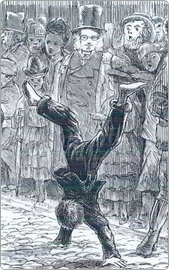
Monday, 6 June 2016

Child slavery: British working children, 18th and 19th centuries

 " Girl number twenty, isn't this a prosperous nation?".....
"I said I didn't know.   I thought I couldn't know whether it was a prosperous nation or not, and whether I was in a thriving state or not, unless I knew who had got the money, and whether any of it was mine."
(Sissy Jupe in  Hard Times, Charles Dickens, 1854)

William Hutton of Birmingham, England, has left an autobiography which gives one of the few detailed accounts of the upbringing of a British working child in the 18th century.  He was born in Derby in 1723 and apprenticed to the local silk mill at the age of seven.  'My parents, through mere necessity, put me to labour before nature had made me able.  Low as the engines were, I was too short to reach then.  In remedy of this defect, a pair of high pattens were fabricated and lashed to my feet, which I dragged after me till time lengthened my stature'.  He did not find work particularly hard, although he had to get up at 5am, but the memory of the severity with which he and the other apprentices were treated remained with him all his long life:  'the severity was intolerable, the marks of which I yet carry, and shall carry to the grave.'  His account has often been quoted of how, on a winter's night, the unnaturally bright moonlight deceived him into thinking he had slept past his time, rose in tears for fear of punishment and ran the the hundred yards to the mill, falling nine times on the icy road, only to find it was not yet two. (Life of William Hutton, written by himself, 1816.)

The Sadler Report of 1832-3 on children's employment in the British textile industry contains a large number of personal accounts of child labour in the mills.  William Cooper entered a flax mill at ten and worked a sixteen hour day in spite of legislation which had already prohibited such hours for children  They were frequently so tired that they fell asleep at their work:  "You say that you were strapped (beaten with a leather strap) when at the mill?"  "When the frames wanted doffing they strapped us to keep us up to it...if we slept or sat down for two or three minutes, they would strap us to it; sometimes we got two or three minutes to sit down, and then we dropped asleep." (Sadler Report from the Committee on the bill to regulate the labour of children in the mills and factories of the United Kingdom, 1832-3, British Parliamentary Papers, Industrial Revolution, Children's Employment, Irish U.P. series 1968 Vol. 2) The mills were hot and humid, to prevent the cotton thread from breaking, and particularly in the carding rooms the air was thick with fluff which got into the stomach and lungs, causing loss of appetite and respiratory diseases.  "Little bits of fluff fly off fro' the cotton when they are carding it, and fill the air till it looks all fine white dust.  They say it winds round the lungs, and tightens them up.  Anyhow, there's many a one as works in a carding-room, that falls into a waste, coughing and spitting blood, because they're just poisoned by the fluff." says Bessie in Mrs. Gaskell's North and South.  From working in these conditions the children grew up unhealthy, stunted, or even deformed, and some were crippled from working, inadequately guarded, machinery.

Children were just as much exploited in other industrial trades, and those remained unprotected by the Factory Acts.  Charles Shaw, on whose account if life in the pottery towns Arnold Bennett's novels are based, wrote: 'When the Queen came to the throne (1837) work was scarce and food was dear.  The Corn Laws were bringing into play their most cruel and evil results.  One of these results was that little children had to compete for the decreasing sum of available work.  As no Factory Act applied in the district where I began to work the work of the children could be used as harsh necessity or harder greed determined.' (Charles Shaw, When I was a child, 1903)  He became a mould-runner, stacking moulds in the stove room, hot and exhausting work, at the age of seven.

(From www.thepotteries.org)
Children in the country were in a healthier environment than children in the city slums, and their rude health by comparison with city children was often commented on, but their lives really were equally hard.  Particularly in the East Midlands and East Anglia gangs of women and children were used to clear the fields of stones, sort potatoes, weed and pick crops such as peas, fruit and potatoes which have to be harvested by hand.  In fact such crops are still harvested in this way but not usually by children.  In the 1850s children and women worked generally under a gang master who paid them a flat rate per day but was himself paid by the amount of work they did.  It was therefore in his interest to see that they worked as hard as they could.  Mrs. Burrows who worked in such a gang near Peterborough says in her memoirs: 'On the day that I was eight years of age, I left school and began to work fourteen hours a day in the fields, with forty to fifty children of whom, even at that early age, I was the eldest.  We were followed all day long by an old man carrying a long whip in his hand which he did not forget to use.  A great many of the children were only five years of age.  You will think that I am exaggerating, but I am not....We always left the town, summer and winter, the moment the old Abbey clock struck six...We had to walk a very long way to our work, never much less than two miles each way, and very often five miles each way...I never remembered to have reached home sooner than six and more often seven, even in winter.' (From Raphael Samuel ed. Village life and labour,  History Workshop series Routledge, 1975 p98-112)

During the 18th century legislators and the public began to be seriously concerned not only for the working conditions of pauper and poor children but also for the living conditions of those in the care of parish workhouses; virtually the only recourse of the destitute.  In 1760 Jonas Hanaway alerted a shocked public to the fact that four out of five infants born or taken into the workhouse died in their first year, and attempts were made to remedy the situation,.  However, increased costs constantly thwarted the efforts of reformers, and since the public is quick to forget even the most shocking mortality figures the workhouses constantly fell back into the general mixed type: 'A place in which the young are trained in idleness, ignorance and vice.'(A detailed account of the workhouses is given in Sidney and Beatrice Webb's English Poor Law History, 1927)

Charles Shaw and his family found themselves driven to apply for assistance in 1842 when, as a result of a strike, their father could not find work.  'The very vastness of it chilled us.  Our reception was more chilling still.  Everybody we saw and spoke to looked metallic, as if worked from within by hidden machinery.  Their voices were metallic, and sounded harsh and imperative.  The younger ones huddled more closely to their parents, as if from fear of these stern officials.  Doors were unlocked by keys, belonging to bunches, and the sound of keys and locks and bars, and doors banging, froze the blood within us.'  In the workhouse they were split up and the children did not see their parents again until Sunday:'Sunday afternoon brought an hour of unspeakable joy.  The children who had mothers were permitted to go to the women's room.' ( (Charles Shaw, op.cit, p. 96, p.121)

Niky Rathbone e-mail childhoodblog@gmail.com


Tuesday, 10 May 2016

Childhood poverty and slavery: America

Writing a blog is much more flexible than publishing a book.  I am going to move forward to the section which was the most important to me; The Poor.  When I was researching this section I sat on the floor in the Social Sciences stacks reading parliamentary reports into education and employment and just cried and cried.  It is a sad fact that for many children the world over conditions are still just as they were in late 18th and 19th century Britain and America.

'Is this a holy thing to see
In a rich and fruitful land, 
Babes reduced to misery,
Fed with cold and usurious hand?

Is that trembling cry a song?
Can it be a song of joy?
And so many children poor?
It is a land of poverty.'
   William Blake, Holy Thursday, Songs of Experience 1794

The children of poor people probably has more chance of knowing real misery in the late 18th and 19th centuries than children at any previous period.  During the late 17th and early 18th centuries Britain and America began the gradual transformation from agricultural to industrial states.  The process was accompanied by an ever-widening division between the labourers who actually produced wealth and those who employed them.  As the whole population increased so did the actual numbers of the poor.  There are very useful accounts of child poverty in Britain in Pinchbeck and Hewitt's Children in English Society, 1969 and the Webb's English Local Government: English Poor Law History, 1929, while Robert Bremner's Children and   Youth in America: A Documentary History  , 1600-1932, American Public Health Association, 1970, is an invaluable source of information on child labour in America, with many quotations from original documents of the time.

Adam Smith in his Inquiry into the causes of the Wealth of Nations, first published in 1766, lays stress on the demand for labour in the expanding American economy, which led to children being highly valued: 'Labour is there so well rewarded that a numerous family of children, instead of being a burden, is a source of opulence and prosperity to the parents.  The labour of each child before it can leave their house is computed to be worth a hundred pounds clear gain to them...'  He goes on to say that whereas in Europe a poor widow left with several children to support faced poverty and was to be pitied, in America she would be sought after since her children were a potential source of wealth.

It was demand for cheap labour, particularly in the South, that led to and sustained the slave trade.  The children of slaves were valued as potential additions to the labour force and sources of wealth for their masters, and although not all black people in America were necessarily slaves, children born of slave mothers were born slaves themselves, regardless of the status of their fathers, a law which undermined the moral structure of the family as it encouraged unscrupulous masters to abuse their female slaves and released the men from their natural obligations to their children.   Many plantation owners kept slave families together, seeing the advantages of a stable family life in keeping the work force contented, and recognising the importance of family ties.  Good masters hesitated to sell children away form their parents and frequently large families would be built up on one plantation.

Slave auction in Virginia (H.History webpage)
In many ways the living conditions of American slaves were better than those of British factory workers at the same date, for their masters had a vested interest in keeping them contented and in good health since they represented a very valuable capital investment, which the free labourer did not.  After the American Civil War, when slavery was abolished in the USA, white southerners looked back nostalgically to conditions on pre-Civil War plantations: 'When I remember that throng of well-fed, pump and happy coloured people, and compare it with the ragged and destitute communities common among the freed men of today, the contrast is a sad one.' (A belle of the fifties.  Memoirs of Mrs. Clay of Alabama...1853-1866.  Heinemann, 1905 p.221)  It seems that freedom did not bring Black Americans the advantages that had been hoped for, and that, at least in the period immediately after the Civil War their conditions considerably worsened.

Nevertheless slave families knew no real security.  The suffering when children were sold away from their families was immense.  In 1774, just before the American War of independence won freedom  from British rule,  the Massachussetts slaves petitioned the British governor and Massachussetts general court for their freedom.  They petitioned: 'Our children are also taken from us by force and sent maney(sic) miles from us wear we seldom or ever see them again there to be made slaves of for Life which sumtimes is vere short by Reson of Being dragged from their mothers Breest.' (Herbert G. Gutman The Black Family in Slavery and Freedom, 1750-1925 Oxford, Blackwell, 1976 p,.350)

Josiah Henson, on whom Harriet Beecher Stowe's Uncle Tom is supposedly based, was sent, with the rest of his family, to auction after the death of his owner.  He was about five: (My brothers and sisters were bid off one by one, while my mother, holding my hand, looked on in an agony of grief, the cause of which I but ill understood at first.'( Bremner Vol. 1, p.377: The Life of Josiah Henson, as narrated by himself, Boston, 1845 p 1-5.)
Uncle Tom's Cabin, 1852

Frederick Douglass, orator and Abolitionist, probably  like many Black American children, only remembered seeing his mother four or five times.  She was a field hand and went back to her work soon after he was born, and died when he was seven.  He says: 'She made her journeys to see me in the night, travelling the whole distance on foot, after the performance of her day's work.' (Bremner, op. cit. vol 1. p.374   Quarles, Benjamin ed. Narrative of the life of Frederick Douglass written by himself. Cambridge Mass, Harvard U.P. 1960 1st pub. 1845 )  Douglass, like many others, was cared for in a communal creche like the one on Senator Hammond's plantation, described by Mrs. Clay: 'there is a separate house where the children, especially the babies, are left to be fed and cared for while their mothers are at work.' (Clay op.cit. p. 216)  What was the situation after slavery was abolished?

(Image source: Wikipedia)
In the Southern States, however, until the Civil War the institution of slavery was rarely criticised and many autobiographies written immediately afterwards express this uncritical acceptance.  Mrs. Clay of Alabama has already been quoted.  Mark Twain said in his autobiography:'In my schooldays I had no aversion to slavery.  I was not aware that there was anything wrong about it. (Autobiography, Harper Bros, 1924, Vol. 1, p.10-12)  Like the other white children, he played with black children, but his first real awareness of a difference in their condition came when he complained to his mother about a little boy called Sandy whose singing was annoying him.  His mother's eyes filled with tears as she told him Sandy had been sold 'halfway across the American continent...He will never see his mother again; if he can sing, I must not hinder it, but be thankful for it.  If you were older, you would understand me; then that friendless child's noise would make you glad.' (Twain, op.cit)

In America the demand for child workers increased after the Civil War as a consequence of the abolition of slavery; children quickly became an alternative form of cheap labour, particularly in the South.
Working conditions for children, however, although far from ideal, never reached the abysmal level found in Britain in the early 19th century.  In America cotton mills, for example, children were not exploited to the same extent as in Britain.  The first cotton mill opened in Providence, Rhode Island, in 1791, and industrialisation rapidly spread throughout New England.  Children aged four to ten were employed, as in Britain, on tasks suited to small nimble fingers at a rate of 50c a week or less.  In 1814, for comparison, according to Bremner, company stores were charging 23c per lb for sugar.  However, the mill owners generally were more concerned for the children's morals and education than most British employers of child labour.  Samuel Slater, who brought the plans of Arkwright's cotton mill machinery to America, also introduced Sunday schools on the lines of those in Arkwright's mills in Derbyshire.  The first law requiring schooling for children working in factories was passed in Connecticut in 1813, long before equivalent British legislation.  In 1817 the Address of the American Society for the Encouragement of Domestic Manufactures to the People of the United States stated that: 'We hazard nothing by the assertion, that some of the best educated of the poorer class in this country, are those brought up in factories, and such as would otherwise have been destitute of education altogether.'  This may be rather too optimistic, but the standard of morals expected of employees is suggested by this advertisement for labour published in the Massachussetts Spy, March 8, 1820.: 'Wanted.  At the Factory of Leland, Morse & Co. two or three FAMILIES of four or five children each.  Those who are in the habit of profanity or Sabbath breaking, and intend to continue these practises, are invited not to make application.'  (Quotations,Bremner op cit Vol 1 )

Harriet Robinson, campaigner for women's rights,  wrote an account of her work in a Boston mill in the 1830s. Her father, a carpenter, died when she was six and her mother had four children to support.  Harriet started as a "doffer" when she was ten: 'I can see myself now, racing down the alley, between the spinning-frames, carrying in front of me a bobbin-box bigger than I was.  These mites had to be very swift in their movements, so as not to keep the spinning frames stopped long, and they worked only about fifteen minutes every hour.  The rest of the time was their own.'  They worked from 5am to 7pm and had half an your for breakfast and lunch.  Most of the children lived at home, and they were both well fed and relatively well paid.  (Bremner op.cit. Vol 1 p. 601:  Harriet Robinson, Loom and spindle, or life among the early mill girls, Boston, 1898, p.60-61)  She went on strike, aged eleven, over a cut in wages, but the mills gave her a steady wage and the chance of going to evening classes. (Wikipedia)

Andrew Carnegie, founder of many of our public libraries, also began his working life as a bobbin boy at age fourteen:'It was a hard life.  In the winter father and I had to rise and breakfast in the darkness, reach the factory before it was daylight, and, with a short interval for lunch, work till after dark. The hours hung heavily on me.(Bremner op.cit. Vol 1 p.607-9: Andrew Carnegie,  Autobiography, 1920)

Conditions were just as difficult for the children of the poor in Britain.